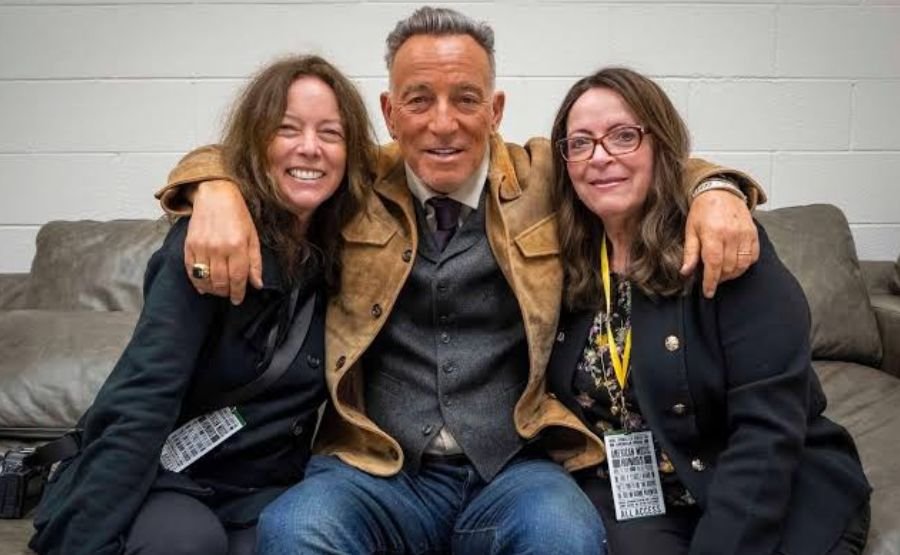
Virginia Springsteen Shave: The Woman Who Became “The River”
Quick Bio
| Detail | Information |
| Full Name | Virginia “Ginny” Springsteen Shave |
| Born | Circa early 1951, Freehold, New Jersey, USA |
| Nationality | American |
| Known For | Being the inspiration for Bruce Springsteen’s landmark 1980 song “The River”; sister of rock legend Bruce Springsteen |
| Parents | Adele Ann Zerilli Springsteen is the mother; Douglas Frederick Springsteen is the father. |
| Siblings | Bruce Springsteen (brother, b. September 23, 1949); Pamela Springsteen (sister, b. February 1963) |
| Husband | Michael “Mickey” Shave (married in youth after unplanned pregnancy) |
| Current Residence | New Jersey |
| Named After | Her paternal aunt Virginia Springsteen, who died tragically at age five in 1927 when struck by a reversing truck |
| Estimated Net Worth | Approximately $500,000 (unverified; no independent sourcing) |
Why Her Story Matters
You’ve probably heard “The River” hundreds of times without knowing it was a true story. That wrenching portrait of a young couple whose early pregnancy closes the door on their dreams before those dreams even had a chance to form — that wasn’t a fictional sketch. It was, according to Peter Ames Carlin’s authoritative 2012 biography of Bruce Springsteen, a word-for-word account of the life his older sister Virginia lived.
She didn’t ask to be anyone’s anthem. She didn’t walk into a recording studio or sit for interviews. She went to high school in Freehold, New Jersey, got pregnant at seventeen, married her boyfriend, and built a life in the same working-class orbit she’d always known. And then her younger brother put all of it onto a record that sold millions of copies and made critics weep.
Virginia Springsteen Shave is not famous. That’s the whole point. She is the kind of person that Bruce Springsteen has always written about: someone living an ordinary, difficult, real American life while the music industry and the culture around it churn out celebrity. The fact that one of rock music’s greatest songs came directly from her experience is worth understanding — not because it changes who she is, but because it changes how we hear the song.
See also “john abraham hewson: The Economist Who Almost Changed Australia“
Freehold, New Jersey: The World She Was Born Into
Freehold Borough sits in Monmouth County in central New Jersey, about an hour south of New York City and a world away from it in almost every other sense. In the 1940s and 1950s it was a working-class town with a mix of manufacturing, light industry, and the kind of densely woven neighborhood life that existed before suburban sprawl pulled communities apart. It was the kind of place where everyone knew your family, where men worked with their hands, and where the gap between a decent life and a hard one could close very quickly depending on luck and timing.
Virginia’s father, Douglas Springsteen, was a man who worked a series of blue-collar jobs throughout his life — bus driver, prison guard, factory worker — and who carried a brooding, interior quality that his son Bruce would spend decades processing in song. Her mother, Adele Ann Zerilli Springsteen, was the vivid counterweight to Douglas’s silence: warm, emotionally expressive, the domestic sun around which the family orbited. They were a Catholic household, working class in the specific Freehold way that meant stability was something you kept by not expecting too much.
Virginia was their second child, born in early 1951 — roughly a year and a half after Bruce. She came into a household that was already taking its shape: the quiet father, the warm mother, the small house on a Freehold street where the walls were thin and the expectations were practical.
Her name carried a weight from the beginning that most children don’t carry. Her aunt — her father’s sister, the original Virginia Springsteen — had died in 1927 at the age of five, struck by a reversing truck from a gas station while she played on the street with her tricycle. It was the kind of family tragedy that doesn’t fully heal across generations. Douglas Springsteen carried it. When his daughter arrived, they named her for the child who had been lost. That naming was an act of remembrance as much as anything else.
Growing Up as Bruce’s Big Sister
The Springsteen household in the 1950s and early 1960s was not a household cushioned by comfort. Douglas’s moods filled the rooms. Adele kept things running. Bruce and Virginia were close in age, navigating the same domestic environment — the same father whose silences could last for days, the same mother who kept the warmth alive in spite of everything.
Virginia was the older sister, which meant she occupied a specific role in a household where older children often serve as buffers and benchmarks for the ones who come after. Bruce would later describe his childhood in terms that made clear the emotional landscape was complicated — his relationship with his father especially, the specific pressure of a home where something unspoken always seemed to be gathering in the corners.
Their younger sister Pamela arrived in February 1963, when Virginia was twelve and Bruce was thirteen — a gap that meant Pamela grew up in a somewhat different family configuration, with two older siblings who had already absorbed a decade of that house’s particular weather.
Virginia’s childhood and early adolescence in Freehold are not documented in public detail — she has never given the kind of extensive public interviews that would supply that portrait. What is known is that she attended local schools, lived in the texture of the same working-class neighborhood that Bruce would describe so specifically and so lovingly across five decades of songs, and came of age in the specific Freehold way: practically, without illusions about what was available to her and what wasn’t.
The Pregnancy, the Marriage, and the Life That Followed
When Virginia was seventeen — still in high school, still inside the life her parents had built — she became pregnant.
In Freehold in the late 1960s, an unplanned teenage pregnancy had a fairly predictable resolution among Catholic working-class families: you got married. Quickly, quietly, without much ceremony or celebration. Virginia and her high school boyfriend, Michael “Mickey” Shave, married in a small ceremony. The fanfare was minimal. The implications were enormous.
That single event — the pregnancy, the marriage, the door that closed on whatever Virginia might have imagined doing with her life — is the subject of “The River.” The song’s narrator describes getting a girl pregnant at seventeen, the hurried marriage at the county courthouse, the construction job that follows, and then the long slow graying of everything that was supposed to be a beginning. The swimming hole where they used to go. The emptiness that settles in. The river that keeps running while the dream dries up.
Peter Ames Carlin’s biography Bruce, published in 2012, describes “The River” as a word-for-word account of Virginia’s life after that pregnancy. That is an extraordinary thing to say about any song, and Carlin says it plainly. This was not a composite portrait. This was not a fictionalized version of something real. This was Virginia’s specific life, rendered in direct terms.
Bruce has spoken publicly about his sister’s situation as a formative experience — something that moved and disturbed him, that he watched from close proximity and couldn’t fully process until he had the language for it. He was her younger brother, watching his sister’s options narrow in real time. What he felt watching that happen eventually became one of the most emotionally devastating songs in the rock canon.
Virginia reportedly felt “exposed” when she first heard “The River.” That word — exposed — says everything about the experience of having your private life translated into public art without having asked for it. The song was a gift of a kind, perhaps. It was also a revelation that the world didn’t need her consent to hear.
A Life Kept Deliberately Private
After her marriage to Mickey Shave, Virginia built a life in New Jersey. The couple had three children. She stayed within the orbit of the community she had grown up in — the same geographic world that Bruce was simultaneously escaping and elegizing through his music.
She has not sought publicity. She does not appear to have an active social media presence. She has not written a memoir or capitalized on her connection to one of the most famous musicians in American history. She lives, as far as public information suggests, in the same state where she was born, in a life defined by family rather than by fame.
That consistency is worth noting. Virginia Springsteen Shave has had decades to do something with her proximity to her brother’s celebrity, and she has consistently chosen not to. That is a genuine choice, not a default. It takes a particular kind of self-knowledge — or a particular kind of privacy instinct — to remain genuinely private when everyone around you is asking questions.
Her brother has brought her into public view occasionally. He has spoken about her in interviews. He has referenced her life in ways that make clear the affection and the guilt are tangled together — the guilt of the artist who transmutes someone else’s pain into something that benefits primarily himself. Bruce Springsteen has articulated this complexity more than once over the years, and his articulations of it have only deepened the sense that “The River” is a song about responsibility as much as it is about loss.

The Song, the Legacy, and What It Means
October 1980 saw the release of “The River” on the same-titled double album. The record was Bruce Springsteen’s fifth studio album and his commercial breakthrough in terms of scale — it debuted at number one on the Billboard 200, making it his first chart-topping album in the United States. The title track became one of the most covered and discussed songs in his catalogue.
It has been analyzed as a critique of the American dream, as a portrait of working-class desperation, as a meditation on the gap between hope and reality. All of those readings are valid. But underneath all of them is the fact that it is a true story. Virginia Springsteen Shave’s true story. The girl from Freehold who got pregnant at seventeen and married Mickey Shave is the specific person the song is about.
That specificity doesn’t reduce the song’s power. If anything it increases it. The reason “The River” feels so particular — so different from the generalized nostalgia of a lesser song — is that it was written with the precision of someone who was actually there, watching it happen to someone he loved.
Bruce brought Virginia onstage during his 2016 The River tour — an extraordinary moment that acknowledged publicly, without requiring her to say a word, that the song’s story was her story and that she had lived beyond it.
The Woman Behind the Name
It is worth pausing on the aunt whose name Virginia carries. The original Virginia Springsteen — her father’s sister, killed at five years old in 1927 — died before Virginia’s father was old enough to process the loss in any adult way. That grief lived in the family for decades. It lived in Douglas Springsteen’s silences. It was transferred, in the form of a name, to his daughter.
There is something poignant about that chain of naming. The original Virginia died on a street corner in a moment of random terrible accident. The Virginia who was named for her grew up in a household shaped by her grandfather’s loss, married young because circumstance required it, and then had her own life story transformed into art by her younger brother. Neither Virginia asked for the weight she carried. Both of them carried it anyway.
Hardships and the Quiet Accumulation of Ordinary Life
The hardship at the center of Virginia Springsteen Shave’s story is not dramatic in the way that makes for exciting biography. It is the quiet, grinding hardship of foreclosed possibility — of a life that gets shaped by necessity before you are old enough to know what you wanted.
A teenage pregnancy in a Catholic working-class family in Freehold, New Jersey in the late 1960s was not a catastrophe. Plenty of people built good, full lives from exactly that starting point. But it was a narrowing. It was the closing of options before the inventory was complete. That’s what Bruce heard in Virginia’s situation. That’s what he put in the song.
What came after — the marriage to Mickey, the children, the decades in New Jersey — is not documented in a way that would support a detailed narrative. What appears consistent, across every credible mention of her, is that Virginia Springsteen Shave built a stable family life and kept it private. That is not nothing. For someone who had the narrative of her young adulthood broadcast to the world without her permission, stability and privacy are forms of reclamation.
Money and the Honest Financial Picture
Virginia Springsteen Shave’s personal finances are not documented in any public filing or verified estimate. The figure of $500,000 that appears on a small number of sites is unverified and appears to have no sourcing. She has no documented independent career in business or entertainment. Her husband Mickey Shave’s professional background is not publicly documented.
What is certain is that she is not wealthy in the way her brother is — Bruce Springsteen’s net worth is estimated at approximately $1 billion, making him one of the wealthiest musicians in the world. Virginia lives an ordinary private life in New Jersey, which does not suggest the kind of wealth that tends to generate documentation.
What She’s Doing Now
As of 2026, Virginia Springsteen Shave is in her mid-seventies, living in New Jersey. She has three children and, presumably, grandchildren by now. She continues to maintain the private life she has chosen consistently across decades. She does not appear to have an active public platform of any kind.
Her brother’s most recent major undertaking — the film adaptation of his memoir Deliver Me from Nowhere, which focuses on the making of Nebraska — has renewed interest in the Springsteen family story. Virginia’s role as the inspiration for “The River” continues to be referenced in coverage of Bruce’s work. She continues, as far as the public record suggests, to decline to participate in that conversation directly.
See also “john abraham hewson: The Economist Who Almost Changed Australia“
Final Words
Virginia Springsteen Shave’s story resists the shape of a traditional biography because she has never tried to have a public story. She is the subject of one of the greatest rock songs ever written, and she has spent forty-five years declining to comment on it at length.
That is, in its own way, a form of dignity. The world decided that her young adulthood was public property when Bruce put it on a record. She decided it wasn’t, and she kept deciding that, year after year. The result is that the song is more famous than the person it’s about — which is a strange inversion that has probably suited her just fine.
What makes her distinctive isn’t what happened to her at seventeen, though that is what everyone focuses on. It is the consistency of her character afterward. The choice to build quietly, to stay put, to remain herself rather than to become a footnote in someone else’s mythology. Bruce Springsteen has spent his career arguing that ordinary working-class lives deserve the full dignity of serious attention. His own sister has spent her life demonstrating exactly that — by simply living it, without commentary, without performance, without the need for anyone else’s validation.
The river keeps moving. Virginia Springsteen Shave has been moving with it, quietly, all along.
FAQs
1. Who is Virginia Springsteen Shave?
She is Bruce Springsteen’s older sister, born in early 1951 in Freehold, New Jersey. She is known primarily as the real-life inspiration for Bruce’s 1980 song “The River,” which is based directly on her experience of an unplanned teenage pregnancy and marriage. She lives a private life in New Jersey and has largely stayed out of the public eye throughout her adult life.
2. What is her connection to the song “The River”?
Peter Ames Carlin’s 2012 biography Bruce describes “The River” as a word-for-word description of the life Virginia led after becoming pregnant at seventeen and marrying her high school boyfriend Mickey Shave. Bruce has spoken publicly about being moved by his sister’s situation and about the specific experience of watching her options narrow at a young age. The song translates those observations into one of the most emotionally devastating tracks in his catalogue.
3. When and where was she born?
She was born in early 1951 in Freehold, New Jersey. Various sources give slightly different dates within 1950 or 1951, but early 1951 is the most consistently cited approximate.
4. Why is she named Virginia?
She was named after her father’s sister — another Virginia Springsteen — who died at the age of five in 1927 after being struck by a reversing truck near a gas station while she played on the street. The naming was an act of family remembrance. The story of the aunt’s death has been documented in coverage of the Springsteen family.
5. Who are her parents?
Her father was Douglas Frederick Springsteen, who worked a series of blue-collar jobs including bus driver and factory worker. Her mother was Adele Ann Zerilli Springsteen, an Italian-American woman known for warmth and emotional expressiveness. Both parents are now deceased.
6. Who are her siblings?
Her brother is Bruce Springsteen, born September 23, 1949, the eldest of the three Springsteen children. Her sister is Pamela Springsteen, born in February 1963, who became a professional photographer and briefly worked as an actress in the 1980s. Virginia is the middle child between Bruce and Pamela.
7. Who did Virginia marry?
She married Michael “Mickey” Shave, her high school boyfriend, in a small ceremony after discovering she was pregnant at seventeen. The marriage was quiet and practical rather than celebratory — the standard response in a Catholic working-class family in Freehold in the late 1960s when an unplanned pregnancy occurred.
8. How did Virginia react to “The River”?
According to sources drawing on the Carlin biography, Virginia felt “exposed” when she heard the song. That reaction captures the particular discomfort of having your private life rendered as public art without having chosen that exposure. The song was not presented to her in advance for approval before its release.
9. Did Bruce bring Virginia onstage?
Yes. During his 2016 tour in support of the reissued The River album, Bruce brought Virginia onstage — a public acknowledgment, without requiring her to speak, of the song’s direct connection to her life and her role in his work.
10. Does Virginia Springsteen Shave have children?
Yes. She and Mickey Shave have three children together. Their identities are not in the public record, consistent with Virginia’s overall approach to privacy.
11. What is her estimated net worth?
Various unverified sources estimate approximately $500,000, but no public filing, verified source, or documented income stream supports any specific figure. She has no documented independent professional career in the public record. Any net worth figure should be treated as speculative.
12. Where does Virginia Springsteen Shave live now?
She continues to live in New Jersey, the state where she was born and has spent her entire life. She maintains a private lifestyle with no documented public platform, social media presence, or involvement in the entertainment industry.
Explore stories that inspire curiosity with The Imperial Magazine.


One Comment