
Nadine Barnett: The Educator Who Spent Twenty Years Learning What She Came Back to Teach
Quick Bio
| Detail | Information |
| Full Name | Nadine Barnett Cosby |
| Nationality | American |
| Occupation | Dean, School of Communications, Quinnipiac University; professor; filmmaker; scholar |
| Known For | First Black dean in Quinnipiac University’s 95-year history; Fulbright Scholar; 20+ year media industry career |
| Education | B.A. in Mass Communications, CUNY Lehman College; M.A. in Media Studies, The New School for Public Engagement; M.A. in Public Relations/Organizational Communication, Iona University; Ph.D. in Communication, Regent University; Certificate, Harvard Graduate School of Education |
| Industry Career | MSG, Fox 5, Albany Broadcasting, Lifetime Television, Disney/ABC |
| Academic Home | Iona University (2012–2024); Quinnipiac University (2024–present) |
| Filmmaking | Writer, director, producer: Her Essence (2011), Rapture (2013), For Brothers (in production) |
| Awards | Africa Regional Research Program, 2020 Fulbright Scholar; Hugh J. McCabe Memorial Award for Social Justice (Iona, 2018) |
| Historic Appointment | Became Quinnipiac’s first-ever Black dean in June 2024 |
| Research Focus | Racial, cultural, and gender representation in media; U.S. academic exchange programs in Africa |
Sometimes taking the long route is the best option.
There are two kinds of people who end up teaching media. The first kind goes more or less straight from their undergraduate degree into a graduate program and then into a classroom. They are knowledgeable, well-prepared, and occasionally limited by the gap between what they’ve read and what they’ve actually lived.
The second kind takes a twenty-year detour through the industry first. They work the overnight shifts and the weekend assignments. They develop real instincts in real newsrooms. They figure out, from the inside, what actually happens between an idea and a finished broadcast — what gets compromised, what gets championed, and what the camera angle decision at 6 p.m. actually says about whose story the station thinks matters.
Nadine Barnett Cosby is the second kind. By the time she walked into a college classroom, she had already worked in radio, television, and film production across some of the most recognizable media organizations in the country. She had spent two decades learning what she came back to teach. And when she eventually shifted into the academic world, she brought with her something that no amount of graduate seminars can fully replicate: twenty years of understanding how the media machine actually runs, who it serves, and whose voices it systematically leaves out.
That trajectory — industry to academy, practice to theory, doing to teaching — is at the heart of everything Nadine Barnett Cosby has built. And in 2024, it culminated in something historic: she became the first Black dean in Quinnipiac University’s ninety-five-year history.
See also “Fawaz Sheikh: The Engineer Who Leads with Heart“
Bronx Beginnings: The City University and a Foundation in Communication
Nadine Barnett Cosby began her academic journey at Lehman College, part of the City University of New York — a public institution in the Bronx that has educated generations of New York City’s working and middle class, many of them first-generation college students navigating higher education without the safety nets that more privileged institutions provide. It is not a school that makes things easy. It is a school that makes things possible for people who are serious about taking advantage of the opportunity.
She earned a Bachelor of Arts in Mass Communications — a degree that, in the early 1990s, was still working out its own identity as a field. The media landscape was shifting: cable was exploding, the twenty-four-hour news cycle was becoming real, and the relationship between traditional broadcasting and newer media forms was beginning the long disruption that would reshape everything. Choosing mass communications at that moment was both a practical and prescient decision. The field was going somewhere. She was going somewhere.
What Lehman gave her was a foundation. What she did next was go get the experience to understand what that foundation was actually for.
Her first graduate degree came from Iona University’s communications program, where she earned a master’s degree in what the institution then called mass communication — later renamed media and strategic communication as the field evolved. She graduated in 1996. And then, rather than continuing directly into doctoral studies or a faculty position, she turned toward the industry.
It was the right call.
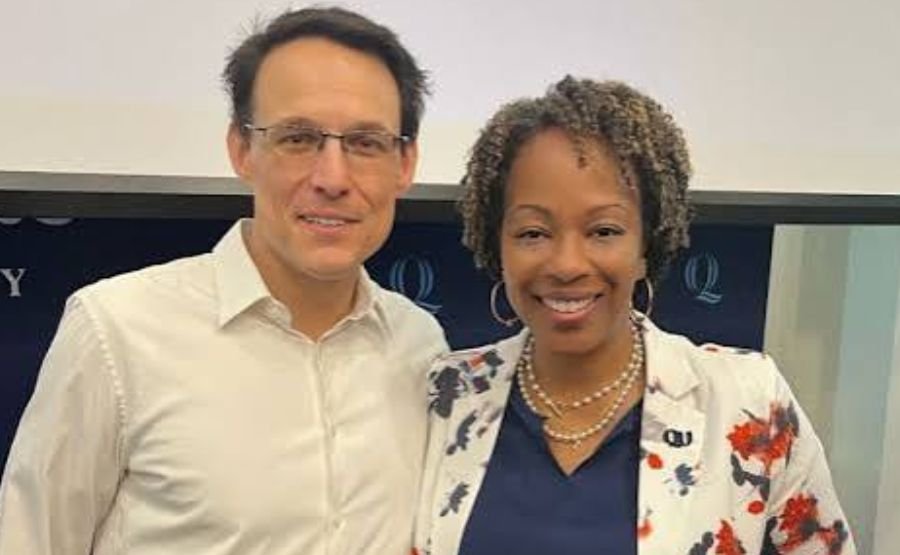
Twenty Years in the Machine: MSG, Fox 5, Lifetime, and Disney/ABC
The media career that followed stretched across two decades and covered an impressive range of contexts. She worked at Madison Square Garden — the iconic New York sports and entertainment complex whose media operations serve as one of the most demanding live broadcasting environments in the country. She worked at Fox 5, the New York City local affiliate where the pressure of daily news production in the nation’s largest market is unlike anything a smaller market can prepare you for. She worked at Albany Broadcasting Company, gaining regional news experience that offered a different and equally important perspective on how local media serves its communities. She worked at Lifetime Television Networks, one of cable’s most significant channels with a specific and long-debated focus on programming for women. She worked at Disney/ABC, inside the apparatus of one of American entertainment’s largest corporate structures.
Each of these environments taught something specific. MSG taught the particular adrenaline and precision of live sports broadcasting. Fox 5 taught the rhythms of breaking news in a competitive urban market. Lifetime taught the specific politics of programming that explicitly targets women — and the constant tension between serving that audience genuinely and exploiting it commercially. Disney/ABC taught what it means to operate inside a corporate media structure where brand identity and programming decisions intersect in ways that smaller organizations never experience.
Across all of these environments, Nadine was developing something that would become the organizing principle of her scholarly and creative work: an understanding of who gets represented in media, how those representations are constructed, and what the consequences are for the communities whose images appear — or don’t appear — on screen.
Race, gender, and culture were not abstract theoretical categories to her. They were the concrete editorial decisions she witnessed and participated in, day after day, across twenty years of professional practice. She saw who got assigned to cover what stories. She could tell whose features were behind the camera and whose were in front of it. She saw the gap between the diversity that media organizations claimed and the actual decision-making that shaped their output.
When she eventually brought those observations into a classroom, they arrived with the credibility of someone who had been in the room where the decisions were made.
The Return to Academia: Iona and a New Identity
In 2012, Nadine Barnett Cosby joined Iona University’s faculty — the same institution where she had earned her first master’s degree years earlier. The symmetry is characteristic. She had gone into the industry, learned what the industry actually was, and came back to teach it at the place that had first helped her understand it theoretically.
What she built at Iona across the next twelve years was substantial and multidimensional. She taught courses that covered the breadth of her professional experience: broadcasting and production, writing for television, TV aesthetics and criticism, race and gender in the media, digital activism, converged technology for public relations, and applied communications research. The range reflects someone who understood media not as a single discipline but as an interconnected set of practices that all touch questions of representation, power, and public communication.
She also built institutional structures. She co-founded Iona’s minor in Black Studies — a program that didn’t exist before she arrived and that created a formal academic space for students to engage with the Black life in America: its history, culture, and current circumstances. She co-chaired the university’s diversity committee. She rose from assistant professor to associate professor, and eventually to a dual administrative role: Associate Vice Provost for Academic Affairs and Associate Vice President for Faculty Development. Then to Associate Vice Provost — one of the institution’s senior administrative positions.
In 2018, Iona recognized her work with the Hugh J. McCabe Memorial Award for Social Justice — the university’s acknowledgment that her commitment to equity and representation extended beyond her classroom into the full fabric of her institutional engagement. She said it was the high point of her teaching career, which reveals something about her values: community appreciation rather than professional credentials.
She also traveled. As part of her faith community’s service work, she moderated Mission and Ministry trips to Zambia and New Orleans — connecting her to the international African context that would later shape her scholarly research. And in 2020, she was awarded a Fulbright Scholar grant under the Africa Regional Research Program, for a multi-year research project in Zambia examining the efficacy of American academic missions and exchange initiatives from the viewpoint of the host communities. Not from the perspective of the Americans doing the exchanging, but from the perspective of the Zambians receiving them. That methodological choice — centering the experience of host communities rather than visiting institutions — is itself a statement about her scholarly orientation.
The Creative Work: Filmmaker With a Point of View
Running alongside the academic career is a body of creative work that makes the same arguments through a different medium. As a writer, director, and producer, Nadine Barnett Cosby has made films that do in practice what her scholarship does in theory: explore how race, gender, and culture are represented and misrepresented in the stories American media chooses to tell.
Her Essence, a short film released in 2011, earned a 7.3 rating on IMDb — respectable recognition for an independent short in a crowded field. She wrote, directed, and produced it. Rapture followed in 2013, again with her in the triple role of writer, director, and producer. For Brothers, a television movie, was in production as of the most recent public record, with Barnett Cosby serving as writer and co-executive producer.
These aren’t commercial films chasing mainstream audiences. They’re work with a deliberate perspective — films that take seriously the question of whose stories get told and how those stories shape understanding. The projects reflect someone who has spent her career watching the gap between the media’s representation of marginalized communities and those communities’ actual experience, and who uses her own filmmaking as one avenue for closing that gap.

Quinnipiac and History: The First Black Dean
In February 2024, Quinnipiac University’s Provost Debra Liebowitz announced that Nadine Barnett Cosby would become Dean of the School of Communications — and that her appointment would make her the first Black dean in the university’s ninety-five-year history.
The significance of that milestone requires a moment of honest consideration. Quinnipiac was founded in 1929. For ninety-five years, the university had never nominated a Black individual to a deanship in one of the most racially and culturally diverse areas of the United States. Mr. Barnett Cosby’s appointment didn’t simply fill a vacancy. It broke a pattern that had persisted across nearly a century.
She assumed the role on June 15, 2024, as Dean of the School of Communications and professor in the Department of Film, Television and Media Arts. The School encompasses undergraduate and graduate programs in film, television and media arts, journalism, public relations, advertising and integrated communications, graphic and interactive design, and communications and media studies — a breadth of academic territory that maps almost exactly onto the professional career she spent twenty years building before returning to academia.
Her statement on assuming the role captured the dual emphasis that has defined her career: “I am honored to lead a community of dynamic minds, where I aim to inspire innovation, amplify voices, and shape the future of communication education with passion and purpose.” Inspiring innovation and amplifying voices are not contradictory goals — they are, in her framing, the same goal.
The Personal Thread: Service, Faith, and Community
The civic and service dimensions of Nadine Barnett Cosby’s career don’t sit separately from her professional work — they run through it. Her volunteer service included six years on the board of the College Careers Fund of Westchester, an organization focused on educational opportunity. She served for three years on the graphic board of The Picture House Regional Film Center, connecting her filmmaking perspective to community arts access. She led mission trips to Zambia and New Orleans. She co-founded a Black Studies program.
These aren’t resume line items. They’re the practical expression of a consistent value: that education and media have responsibilities to the communities they claim to serve, and that those responsibilities require showing up in specific, concrete ways rather than simply asserting commitment in mission statements.
Her personal life — spouse, family arrangements, children — is not part of the public record. She has not discussed it in professional contexts, and that privacy deserves respect.
Money: An Honest Look
Nadine Barnett Cosby’s financial situation is not publicly disclosed in any verified source. What can be reasonably inferred: a doctoral-level academic at the dean level of a private university in the northeastern United States earns a salary that, combined with her filmmaking and consulting work, places her solidly in professional comfort. Deanships at institutions like Quinnipiac typically carry six-figure salaries, and her previous senior administrative role at Iona would have reflected similar compensation.
She is not wealthy in a celebrity sense. She is professionally compensated at a level appropriate to her experience, credentials, and institutional responsibility. Her life’s financial indicators — an academic career, community service board memberships, international research travel on Fulbright funding — suggest someone who has prioritized meaningful work over wealth accumulation.
What She’s Doing Now
In 2026, Nadine Barnett Cosby is approximately two years into her deanship at Quinnipiac, leading a school of communications that spans journalism, film, public relations, advertising, and design. She is teaching, administering, and continuing the research agenda that the Fulbright scholarship supported. She is also, presumably, still working on For Brothers, the television project listed as in production.
She is shaping how hundreds of students understand the relationship between communication, power, and public life — and doing it with the credibility of someone who spent twenty years inside the industry before picking up the classroom key.
Final Words
There’s a particular kind of authority that only comes from having done the thing you’re now teaching. Nadine Barnett Cosby didn’t study media representation from the outside and develop theories about it. She worked inside media organizations for twenty years, watched how representation decisions actually get made, and then built an academic career — and a body of films — organized around the gap between what those organizations claim and what they deliver.
Her appointment as Quinnipiac’s first Black dean in ninety-five years is historically significant and personally meaningful. But it’s also, in a sense, the natural destination of a trajectory that was always moving toward institutional leadership in service of expanding access and amplifying underrepresented voices.
She is a filmmaker who became a professor. A practitioner who became a scholar. A New York media professional who went to Zambia to listen. And now a dean who carries all of those identities simultaneously into one of the most important roles in a university’s life: shaping the next generation of communicators.
That is a genuinely remarkable thing.
See also “Fawaz Sheikh: The Engineer Who Leads with Heart“
FAQs
1. Who is Nadine Barnett Cosby?
Dr. Nadine Barnett Cosby is an American media scholar, filmmaker, and academic administrator currently serving as Dean of the School of Communications at Quinnipiac University in Connecticut — a position she assumed in June 2024, making her the first Black dean in the university’s ninety-five-year history. She spent over twenty years working in the media industry before transitioning to higher education, and has built a career focused on racial, cultural, and gender representation in media.
2. Why is Nadine Barnett Cosby historically significant?
Her appointment at Quinnipiac University in 2024 made her the first Black person ever appointed as a dean in the institution’s history — which spans ninety-five years. The appointment was widely noted in higher education media as a significant milestone for both the university and for representation in academic leadership.
3. Where did Nadine Barnett Cosby go to school?
She earned her Bachelor of Arts in Mass Communications from CUNY Lehman College in the Bronx, New York. She holds two master’s degrees — one in media studies from The New School for Public Engagement in New York, and one in public relations and organizational communication from Iona University. She earned her Ph.D. in communication from Regent University in Virginia. She also holds a certificate in executive leadership from the Harvard Graduate School of Education’s Higher Education Management Development Program.
4. What did Nadine Barnett Cosby do before becoming an academic?
She spent over twenty years working in the media industry across radio, television, and film production. Her employers included Madison Square Garden, Fox 5 in New York City, the Albany Broadcasting Company, Lifetime Television Networks, and Disney/ABC. Across these positions she worked in multiple capacities as a writer, producer, and director.
5. What is the nature of her Fulbright scholarship?
In 2020, she was awarded a Fulbright Scholar grant under the Africa Regional Research Program, for a multi-year research project in Zambia. Her research examined the effectiveness of American academic missions and international exchange programs from the perspective of the Zambian host communities — centering the experience of recipients rather than the American institutions conducting the programs.
6. What films has Nadine Barnett Cosby made?
She has written, directed, and produced two completed short films: Her Essence (2011), which earned a 7.3 rating on IMDb, and Rapture (2013). She is also credited as writer and co-executive producer on For Brothers, a television movie that was listed as in production as of the most recent public records. Her work consistently explores racial, cultural, and gender representation in media.
7. What did she build at Iona University?
She began working at Iona in 2012 and left a lasting institutional imprint over her twelve years there. She co-founded the Black Studies minor — a program that didn’t exist before her arrival. She co-chaired the diversity committee. As she advanced through the academic levels, she was appointed Associate Vise Provost for Academic Affairs. She won the Hugh J. McCabe Memorial Award for Social Justice in 2018. She also returned to Iona as an alumna, having earned her first master’s degree there.
8. What courses did she teach at Iona?
Her teaching portfolio included broadcasting and production, writing for television, TV aesthetics and criticism, race and gender in the media, digital activism, converged technology for public relations, and applied communications research — a range that reflects both her industry background and her scholarly interests.
9. What does the Quinnipiac School of Communications include?
As dean, Nadine Barnett Cosby leads a school that spans undergraduate and graduate programs in film, television and media arts, journalism, public relations, advertising and integrated communications, graphic and interactive design, and communication and media studies. She also holds a faculty appointment as professor in the Department of Film, Television and Media Arts.
10. Has she done any community or volunteer work?
Yes, significantly. For six years, she was a board member of the College Careers Fund of Westchester, which prioritized educational opportunities. For three years, she was a member of the graphic board at The Picture House Regional Film Center. She moderated Mission and Ministry trips to Zambia and New Orleans through her faith community. These activities reflect her consistent commitment to education access and community service beyond institutional settings.
11. What is the Hugh J. McCabe Memorial Award she received?
It is Iona University’s award recognizing extraordinary commitment to social justice, given to faculty who have demonstrated exceptional dedication to equity and service beyond the classroom. She received it in 2018 and described it as a highlight of her teaching career.
12. What is Nadine Barnett Cosby doing in 2026?
She is serving as Dean of the School of Communications at Quinnipiac University, leading faculty and students across journalism, film, public relations, advertising, and design programs. She continues her teaching role in the Department of Film, Television and Media Arts, and is continuing the international research work supported by her Fulbright scholarship. Her television project For Brothers remains in development. She is approximately two years into what appears to be a sustained and consequential chapter of her academic leadership career.
Explore stories that inspire curiosity with The Imperial Magazine.



One Comment