Amy Grant Family: The Story Behind Her Marriage, Children, and Personal Life
Quick Bio
| Detail | Information |
| Full Name | Amy Lee Grant |
| Born | November 25, 1960 — Augusta, Georgia, USA |
| Nationality | American |
| Occupation | Singer-songwriter, musician, author |
| Known For | Pioneering Christian pop crossover; “Baby Baby”; six Grammy Awards |
| Parents | Dr. Burton Paine Grant (1931–2018) and Gloria Dean Napier Grant (1931–2011) |
| Siblings | Three older sisters: Carol, Mimi, Kathy, and Jan |
| First Marriage | Gary Chapman (1982–1999); three children together |
| Current Spouse | Vince Gill (married March 10, 2000) |
| Children | Matthew Garrison Chapman (b. 1987), Gloria “Millie” Mills Chapman (b. 1989), Sarah Cannon Chapman (b. 1992), Corrina Grant Gill (b. 2001) |
| Net Worth | Approx. $30 million (combined with Vince Gill) |
| Major Honors | 6 Grammys, 22+ Dove Awards, Gospel Music Hall of Fame (2003), Hollywood Walk of Fame, Kennedy Center Honors (2022) |
Why Amy Grant’s Story Still Matters
Somewhere between gospel hymns and mainstream pop radio, a young woman from Nashville figured out that faith and chart success didn’t have to live in separate rooms. That was a genuinely radical idea in 1977, and the person who proved it possible was Amy Grant — a teenager with a homemade demo tape, a big voice, and absolutely no sense of the industry she was about to reshape.
Decades later, she’s still here. She’s survived a marriage, a divorce, a remarriage that scandalized a large portion of her fanbase, open-heart surgery, a traumatic brain injury, and a long stretch of near-silence. And in 2025, she released her first album of entirely new material in thirteen years. That’s not the arc of someone who got lucky once. That’s someone built to last.
To understand Amy Grant properly, though, you have to start before the fame. You have to start with the family she came from.
The Grant Household: Faith, Medicine, and Music at the Dinner Table
Amy was born on November 25, 1960, in Augusta, Georgia — but she didn’t stay long. Her father, Dr. Burton Paine Grant, had been completing a medical residency at Augusta’s military hospital, and when Amy was just six months old, the family packed up and relocated to Nashville, Tennessee. That’s the city that would come to define her entire life.
Burton Grant was a physician by profession and a man of deep, quiet faith by nature. He made a good living and provided a stable home for his wife Gloria and their four daughters — Carol, Mimi, Kathy, Jan, and the youngest, Amy. The family wasn’t flashy or extravagant, but they were close-knit and genuinely warm. The Grants were churchgoers, and church wasn’t just a Sunday obligation. It was woven into the texture of daily life — the stories, the songs, the moral framework through which everything else was understood.
Music happened naturally in that house. Family gatherings came with singing. Sunday services came with hymns. Amy absorbed it all without anyone making a deliberate effort to teach her. It wasn’t training — it was atmosphere.
She attended Harpeth Hall, a private girls’ school in Nashville, where she was a reasonably normal teenager who happened to feel most alive when she was making up songs. She wrote her first original composition at fifteen, a piece called “Mountain Top,” in 1976. Nobody told her to write it. She simply did.

A Tape, a Record Deal, and a Life Changed Forever
The story of how Amy Grant became Amy Grant is almost charmingly accidental. She recorded a rough demo tape at her church, working with a youth group leader named Brown Bannister who happened to have connections in the music world. The tape made its way — through entirely ordinary channels — to Word Records, one of the country’s leading Christian music labels.
Word signed her. She was fifteen years old.
Her debut album, simply titled Amy Grant, came out in 1977, when she was sixteen. It sold a quarter million copies almost immediately, and eventually crossed the million mark — extraordinary numbers for any genre, let alone the comparatively niche world of contemporary Christian music. Bannister produced the record, and he would go on to produce the next eleven albums as well. That’s a creative partnership that lasted for years and helped shape one of the most distinctive voices in American music.
She enrolled at Furman University and later transferred to Vanderbilt University in Nashville, but by the time college came around, her career was already making demands on her schedule that a traditional academic path couldn’t easily accommodate. She eventually left college to focus on music full-time — a decision that, in retrospect, most people would call correct.
Her second album, My Father’s Eyes (1979), extended her momentum. Then came Never Alone (1980), followed by Age to Age in 1982, which became a watershed moment. That record earned her a Grammy for Best Gospel Performance and made her the first contemporary Christian artist ever to have an album certified platinum. She was twenty-one years old. The Christian music world had never seen anything quite like her.
Rising Through the Ranks: From Church Pews to Pop Radio
Through the early 1980s, Amy Grant was the undisputed star of Christian music — touring constantly, releasing records that outsold virtually everything else in the genre, winning Dove Awards and Grammys with regularity. She also performed barefoot on stage, a quirky trademark that fans adored and that said something about her easy, unguarded stage presence. She wasn’t performing at her audience. She was performing with them.
But somewhere in the mid-1980s, something shifted. Amy began to hear a broader musical calling. The 1985 album Unguarded started nudging her sound toward mainstream pop. Straight Ahead followed, earning her a Grammy nomination that brought her to a national awards stage for the first time. She was warming up for something bigger.
That something arrived in 1991 with Heart in Motion, a pop album so polished and so immediate that it couldn’t be kept inside any genre boundary. The lead single, “Baby Baby” — written for her newborn son — shot to number one on the Billboard pop chart. “Every Heartbeat” climbed the charts after it. The album sold millions and turned Amy Grant into a household name far beyond the Christian music community she’d built her career in.
She had become a crossover artist. Not by accident — by design, and with clear intention.
Awards, Achievements, and a Legacy Built Album by Album
The numbers behind Amy Grant’s career are striking in their own right: six Grammy Awards, more than twenty Dove Awards from the Gospel Music Association, over thirty million albums sold worldwide, more than two billion global streams. She was the first Christian music artist ever to earn a platinum album. She was the first to hit number one on the mainstream pop charts. She has a star on the Walk of Fame in Hollywood. In 2022, she received the Kennedy Center Honors alongside legends including George Clooney, Gladys Knight, and U2.
However, the actual accomplishment is more difficult to measure. She made it genuinely acceptable — commercially viable and artistically coherent — to be both a woman of explicit Christian faith and a mainstream pop star. That combination was considered impossible before her. After her, it became a template.
Key landmarks along the way include Age to Age (1982), which broke the platinum ceiling for Christian music; Unguarded (1985), which began her mainstream pivot; Heart in Motion (1991), her commercial peak; House of Love (1994), which featured a duet with country star Vince Gill that would prove personally significant; and Rock of Ages… Hymns and Faith (2005), which won another Grammy and returned her firmly to her devotional roots.
Her 2025 album The Me That Remains — her first batch of original songs in thirteen years — arrived as a deeply personal statement of survival, faith, and renewal. It was produced by Mac McAnally and reflected everything she’d been through since her last original release.

Marriage, Family, and the Life She Actually Lived
In 1979, during the release party for her second album, Amy met a young gospel singer-songwriter named Gary Chapman. They dated through her rising years and married on June 19, 1982. It seemed a natural match: two Christian musicians, both serious about their faith, building careers in the same world.
Together they had three children. 1987 saw the birth of Matthew Garrison Chapman. Gloria Mills Chapman — known to everyone as Millie — arrived in 1989. Sarah Cannon Chapman, named after Minnie Pearl’s real name (a warm nod to country music heritage), came along in 1992. The family looked, from the outside, like everything Christian America celebrated.
But marriages are more complicated than they look from the outside. After nearly seventeen years together, Amy and Gary divorced in 1999. The breakup was traumatic and well reported. The Christian music community — which had embraced Amy as one of its own for two decades — reacted with a mixture of sadness, confusion, and in some quarters, genuine anger.
Part of the reason for the intensity of the reaction was what came next. Amy had collaborated with country singer Vince Gill on her 1994 album, recording a duet called “House of Love.” Their creative friendship deepened over the following years. Gill had his own marriage to navigate — he and his first wife, singer Janis Oliver, divorced in 1998. Then, in March 2000, Amy and Vince married in Tennessee.
The backlash from a portion of her Christian fanbase was real and stung. Radio stations in some markets stopped playing her music. Certain Christian bookstores pulled her albums. Some people who had admired her for twenty years felt genuinely betrayed.
Amy didn’t hide from any of it. She addressed it, absorbed it, and kept going.
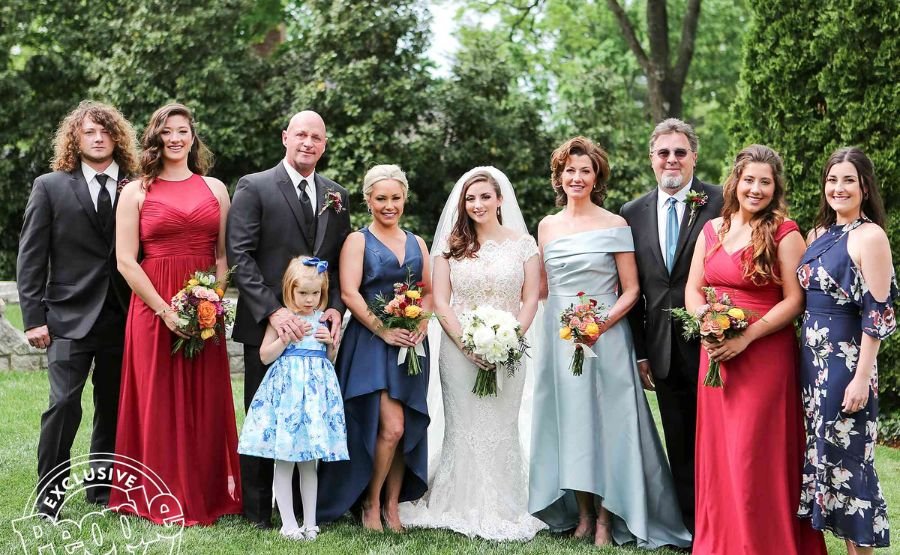
When Vince brought his teenage daughter Jenny from his previous marriage, and Amy brought her three children, they became a blended family of five. Then in March 2001, Corrina Grant Gill was born — the couple’s first and only child together, completing the picture.
Hard Times: Controversy, Health Crises, and Coming Through
The public controversy around her divorce and remarriage was the first major storm Amy weathered as a public figure. She got through it, in part because her music remained genuinely good and her sincerity never wavered. Fans who had left eventually drifted back. The narrative around her became one of grace under fire rather than hypocrisy.
But the health challenges of her sixties were something else entirely.
In 2020, Amy went along with Vince to a routine cardiologist appointment. While there, doctors happened to scan her heart and discovered something that had been hidden her entire life: a rare congenital defect called partial anomalous pulmonary venous return, or PAPVR. The condition caused her blood to circulate incorrectly between heart chambers. A doctor later told her, bluntly, that if the defect hadn’t been found when it was, she would not have survived to reach sixty-two.
She had open-heart surgery in June 2020. Recovery was significant but ultimately successful. She felt, by her own account, more energetic afterward than she had in years — like a machine suddenly running on all its cylinders for the first time.
Then, in July 2022, while riding her bike through Nashville with a friend, she hit a pothole. She was wearing a helmet. The accident still knocked her unconscious for ten minutes and left her with a traumatic brain injury that affected her memory, her balance, her stamina, and her ability to recall song lyrics. She also required shoulder surgery two months after the accident.
The brain injury recovery was, by her own description, harder than the heart surgery. She kept a spiral notebook during those months, writing constantly just to anchor her memory to the present day. Depression set in during the long recovery. The words that used to come naturally had to be coaxed back, slowly, painstakingly.
But they came back. And the album she eventually made from that experience — The Me That Remains — arrived in 2025 as proof of it.
Money and Net Worth: The Honest Picture
Amy Grant’s personal net worth is most commonly cited at around $30 million, and that figure typically reflects combined assets with Vince Gill rather than her earnings alone. Some estimates place her individual wealth higher, in the 35–45 million range, based on five decades of album sales, touring income, songwriting royalties, and related commercial activity.
Her biggest financial years coincided with the mainstream pop surge of the early 1990s. “Baby Baby” alone was a global phenomenon. But the long tail of her Christian music catalog — recordings that have never gone out of print and continue generating streaming revenue — forms a durable financial foundation that few musicians in any genre can claim.
She and Vince live in Nashville, where their combined real estate holdings have been estimated at several million dollars. Both have remained active philanthropically, supporting organizations including Compassion International, the American Heart Association (particularly after her own surgery), and various local Nashville causes.
What She’s Doing Now
In 2025, Amy Grant is sixty-five years old, fully recovered from the bike accident and heart surgery, and creatively active in a way she hadn’t been in over a decade. The Me That Remains, released in May 2025, marks her return to original songwriting after the long health-driven hiatus, and it has been received warmly by fans and critics alike.
She continues to perform live, often sharing stages with Vince Gill. Her blended family is fully grown: Matthew, Millie, Sarah, and Corrina are all adults pursuing their own paths. Millie made headlines in early 2017 when she donated a kidney to her lifelong best friend — a remarkable act that her family supported and celebrated publicly. Corrina, the youngest, began performing music in 2021, occasionally joining her parents on stage, continuing what has become a thoroughly musical family tradition.
Her connection to Nashville, to her faith, and to the people she loves has never wavered — through divorce, illness, public criticism, and physical trauma. That consistency is arguably her most defining characteristic.
Final Words
What makes Amy Grant’s story genuinely worth telling — beyond the platinum records and the Grammy shelf and the Kennedy Center stage — is the texture of how she’s handled everything that didn’t go according to plan.
She grew up in a warm, rooted family that gave her values without giving her ego. She built a career on musical honesty rather than industry calculation. When she chose to expand her artistic reach, she did it at real cost and on her own terms. When her marriage ended, she faced the judgment of people who had loved her work for two decades and she didn’t pretend the criticism wasn’t fair — she just kept being herself.
And when her body started sending serious warnings in her sixties, she listened, healed, and then sat down and wrote new songs about it.
There’s a kind of family legacy running through all of this — not just the family she was born into, or the family she raised, but the broader community of people who have followed her music for nearly fifty years and who have watched her grow up, stumble, recover, and keep singing. That’s a rarer thing than six Grammys. And Amy Grant seems to know it.
FAQs
1. Where was Amy Grant born and where did she grow up?
Amy Grant was born in Augusta, Georgia, on November 25, 1960. Her family moved to Nashville, Tennessee, when she was just six months old, and she spent her entire childhood there. Nashville has remained her home throughout her adult life as well.
2. Who are Amy Grant’s parents?
Her father was Dr. Burton Paine Grant, a physician who served in the military before settling his family in Nashville. At the age of 86, he passed away in 2018. Her mother was Gloria Dean Napier Grant, who passed away in 2011. Both were people of strong Christian faith, which shaped the household Amy grew up in.
3. How many siblings does Amy Grant have?
Amy is the youngest of four daughters. Her three older sisters are Carol, Mimi, Kathy, and Jan Grant. The family was close-knit, and music was a natural part of their shared household life.
4. How did Amy Grant get her first record deal?
At fifteen, she made a basic demo recording at her church with a youth leader named Brown Bannister. That tape found its way to Word Records, a leading Christian music label, which signed her. She released her debut album, Amy Grant, in 1977 at age sixteen.
5. What is Amy Grant’s most successful album?
Heart in Motion (1991) is considered her commercial peak. It reached number one on the mainstream Billboard pop chart, produced the hit single “Baby Baby,” and introduced her to a global audience far beyond the Christian music world. It remains her best-selling album.
6. Who was Amy Grant’s first husband?
She married gospel singer-songwriter Gary Chapman on June 19, 1982. They had three children together — Matthew, Millie, and Sarah — and divorced in 1999 after approximately seventeen years of marriage.
7. Who is Amy Grant married to now?
Since March 10, 2000, Amy has been married to country singer-songwriter Vince Gill. The two first worked together professionally in 1993 and became close during the period leading up to both of their divorces from previous spouses. They have one daughter together, Corrina Grant Gill, born in 2001.
8. How many children does Amy Grant have?
She has four children in total. With Gary Chapman: Matthew Garrison (born 1987), Gloria “Millie” Mills (born 1989), and Sarah Cannon (born 1992). With Vince Gill: Corrina Grant Gill (born March 2001). Vince also has a daughter, Jenny, from his previous marriage.
9. What health issues has Amy Grant faced?
In June 2020, she underwent open-heart surgery to repair a rare congenital heart defect called PAPVR (partial anomalous pulmonary venous return) — a condition she hadn’t known about her entire life. Then in July 2022, she suffered a traumatic brain injury after a bicycle accident in Nashville. Recovery from the brain injury was lengthy and involved memory problems, depression, and difficulty recalling lyrics. She has since recovered and returned to performing and recording.
10. What awards has Amy Grant won?
She has received six Grammy Awards, more than twenty-two Dove Awards from the Gospel Music Association, and an induction into the Gospel Music Hall of Fame in 2003. She has a star on the Hollywood Walk of Fame and was honored at the Kennedy Center in Washington D.C. in 2022.
11. What is Amy Grant’s net worth?
Her net worth is most commonly estimated at approximately $30 million, though some sources place her individual figure higher. The number reflects decades of album sales, touring revenue, songwriting royalties, and collaborative projects. It is often cited as a combined figure with husband Vince Gill.
12. What is Amy Grant doing now?
In 2025, Amy released The Me That Remains, her first album of original songs in thirteen years. Produced by Nashville Songwriters Hall of Famer Mac McAnally, the record reflects her experiences with illness, recovery, family, and faith. She continues to perform live, frequently alongside Vince Gill, and remains connected to various charitable causes including the American Heart Association.
Explore stories that inspire curiosity with The Imperial Magazine.