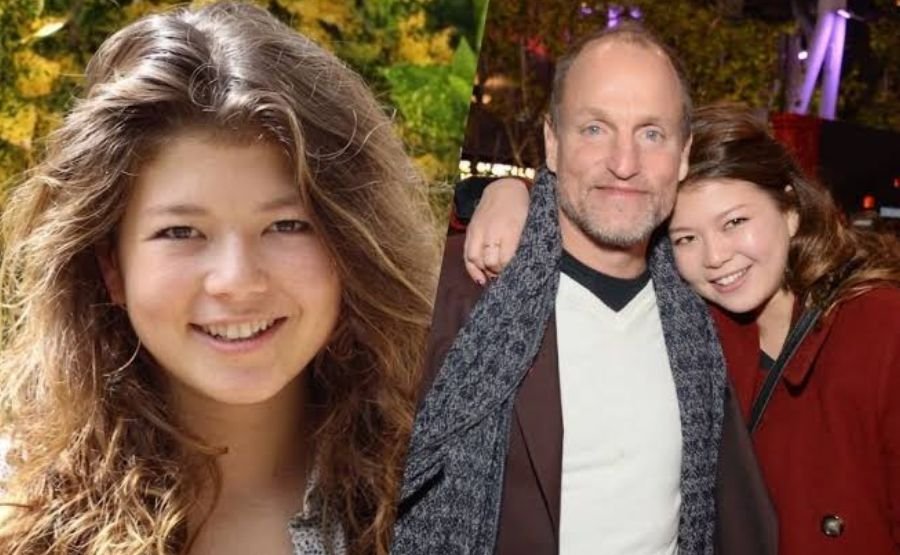
Zoe Giordano Harrelson: Growing Up Off the Grid in Hollywood’s Shadow
Quick Bio
| Full Name | Zoe Giordano Harrelson |
| Born | September 22, 1996, Los Angeles, California, USA |
| Nationality | American |
| Occupation | Private individual; brief acting appearance |
| Known For | Daughter of actor Woody Harrelson; TEDxYouth speaker (2015); U2 “Song for Someone” music video |
| Father | Woody Harrelson — Academy Award-nominated actor, activist, vegan advocate |
| Mother | Laura Louie — co-founder of Yoganics organic food delivery; Woody’s wife since 2008 |
| Siblings | Deni Montana Harrelson (older sister, born 1993); Makani Ravello Harrelson (younger sister, born 2006) |
| Education | Homeschooled (early years); Seabury Hall preparatory school, Makawao, Maui |
| Raised In | Maui, Hawaii (sustainable eco-village, Kipahulu area) |
| Uncle | Brett Harrelson (actor) |
| Current Status | Entirely private; no confirmed social media or public career |
The Middle Daughter Who Made Her Own Statement
Here’s the thing about growing up as Woody Harrelson‘s kid: practically every inherited advantage comes wrapped in an equal and opposite expectation. Your father is one of the most recognizable faces on the planet. Your family lives in a commune. You don’t have a smartphone because your parents think technology is ruining childhood. And then, at seventeen, you stand in front of a room full of people and tell them exactly why they should put their phones down too.
That’s Zoe Giordano Harrelson in a nutshell. The middle daughter of one of Hollywood’s most unconventional actors, raised in the green hills of Maui rather than the smoggy sprawl of Los Angeles, homeschooled for years, and then dropped into a preparatory school where she promptly gave a TED Talk and acted in a U2 music video — all in the same year.
She hasn’t done much in public since. And honestly, given everything that shapes her story, that makes complete sense.
See also “Rodney Keith Jones: The Brother Behind the Laughter“
Born in LA, Raised by Maui
Zoe arrived on September 22, 1996 — a Virgo, appropriately enough for someone who has been quietly methodical about keeping her life out of the tabloids. Her birthplace was Los Angeles, California, where Woody was still very much in the thick of a film career that had launched from Cheers and had by then expanded into Natural Born Killers, The People vs. Larry Flynt, and a string of other demanding roles.
But Los Angeles wasn’t where Zoe actually grew up. By the time she was forming real memories, her family had shifted their center of gravity to the Hawaiian island of Maui — and not to the upscale resort side of Maui that most visitors see. Woody and Laura Louie settled in Kipahulu, in a small intentional community of roughly two hundred residents on the island’s rugged eastern end. It was deliberately off-grid. Solar powered. Surrounded by organic gardens and rainforest. The kind of place where the nearest significant town is a long drive away and the ocean is both your backyard and your reality check.
Zoe grew up in that environment alongside her older sister Deni, who was three years ahead of her, and eventually alongside younger sister Makani, who arrived a full decade after Deni in 2006. The age gap between oldest and youngest means these three experienced the same childhood in genuinely different ways, but the common thread was always Maui — the land, the water, the community, the deliberate choice their parents had made to build a life at a certain remove from Hollywood’s gravitational pull.
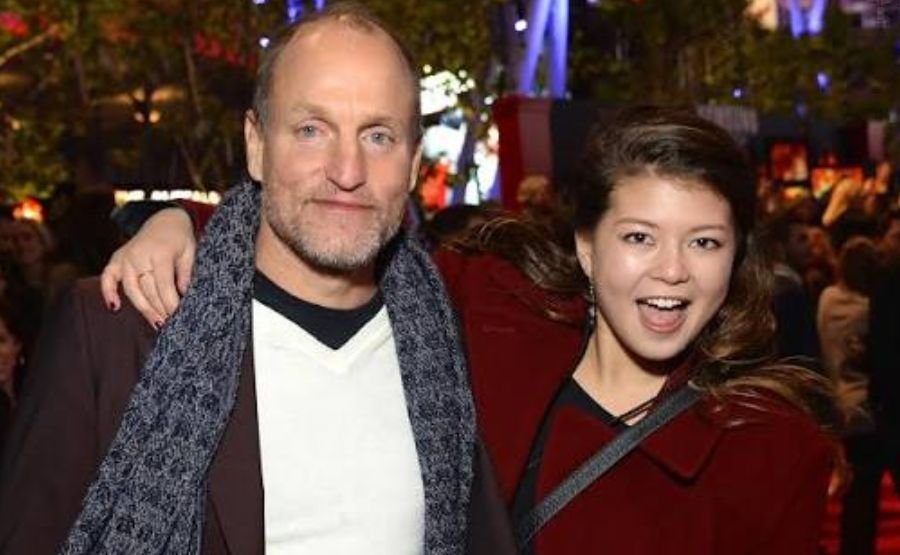
The Parents Who Built the World She Grew Up In
You can’t understand Zoe without understanding who her parents are, because the household she grew up in wasn’t typical by any standard, Hollywood or otherwise.
Woody Harrelson is complicated in the most interesting ways. He was raised partly in Midland, Texas, and partly in Ohio after the incarceration of his father — Charles Harrelson, a contract killer convicted of murdering a federal judge and who would die behind bars in 2007 at a maximum-security prison in Colorado. That history has never been absent from Woody’s public consciousness, even if he’s addressed it obliquely rather than constantly. It informs his approach to criminal justice, to systemic inequality, and to the specific tenderness he brings to roles about fathers and children navigating broken relationships.
Woody met Laura Louie in 1987 when she was working as his personal assistant on the Cheers set. He’s said in interviews that she fundamentally changed how he thought about commitment — that he wasn’t capable of sustained relationships before her, and that she rewired something fundamental. They spent two decades together and had all three daughters before finally getting legally married in a small private ceremony on Maui in December 2008.
Laura is not a background character in this story. She co-founded Yoganics, an organic food delivery service on Maui, and later developed a yoga and healthy food business with Woody. The family’s vegan lifestyle — Woody is a committed raw vegan — wasn’t a celebrity dietary trend for them. It was structural. The eco-village, the organic businesses, the choice of Maui over Malibu — all of it flows from a consistent set of values that Laura and Woody built together and that shaped every aspect of their daughters’ childhoods.
Zoe grew up eating organically grown food before “organic” became a marketing category. She grew up in a sustainable community before sustainability was a corporate buzzword. And she grew up largely without the constant screen time that defines most childhoods in her generation — a choice that would later become the subject of her first real public statement.
Homeschooling and a Different Kind of Curriculum
For the early portion of her education, Zoe and her older sister Deni were homeschooled. This was a deliberate parental choice that fit naturally with the broader philosophy of their upbringing — a conviction that education happens in life, in nature, in conversation and engagement with the real world, not exclusively within institutional structures.
Homeschooling on Maui, in a community of two hundred people with organic gardens and an ocean on the doorstep, is a different animal from homeschooling in a suburban house. The curriculum of that environment included the kind of practical, embodied knowledge that conventional schooling rarely touches: understanding ecosystems, food production, community interdependence, the rhythms of the natural world. It also included the curriculum that comes from having an actor and activist for a father who travels constantly for work, brings the conversations of his films home, and treats the dinner table as a seminar in whatever he’s currently thinking about.
Zoe eventually transitioned to Seabury Hall, a private college preparatory school in Makawao — a small upcountry Maui town known for its cool climate and its equestrian culture. Seabury Hall is a genuinely rigorous academic institution by any standard, the kind of school that produces students who can function at a university level by the time they graduate. The transition from homeschooling to Seabury Hall would have required real academic adjustment, but it also gave Zoe something new: a structured public platform, and an audience.
The TED Talk That Said Everything
In 2015, as a senior at Seabury Hall, Zoe Giordano Harrelson delivered a TEDxYouth talk that became, briefly, one of those moments that circulates on the internet with genuine resonance.
Her subject: smartphones. Specifically, the case for putting them away.
She talked about what she’d observed in her own peer group — the constant pull of screens, the anxiety of connection and disconnection, the way digital noise was eroding something quieter and more important. She made the argument for deliberate, chosen silence. For the value of boredom. For the kind of thinking that only happens when your hands aren’t occupied with a device.
The talk wasn’t naive digital panic. It was the considered observation of someone who had grown up without that particular noise dominating her childhood, who had watched it arrive among her peers and seen what it did to attention, to conversation, to solitude. She knew what she was talking about not because she’d read studies but because she’d lived the contrast.
This was a seventeen-year-old making a case for something that most adults were still nervously tiptoeing around in 2015. And she made it calmly, clearly, without the kind of self-consciousness you’d expect from a teenager addressing a room.
The talk circulated. It got attention. And then Zoe went back to being exactly who she had always been.
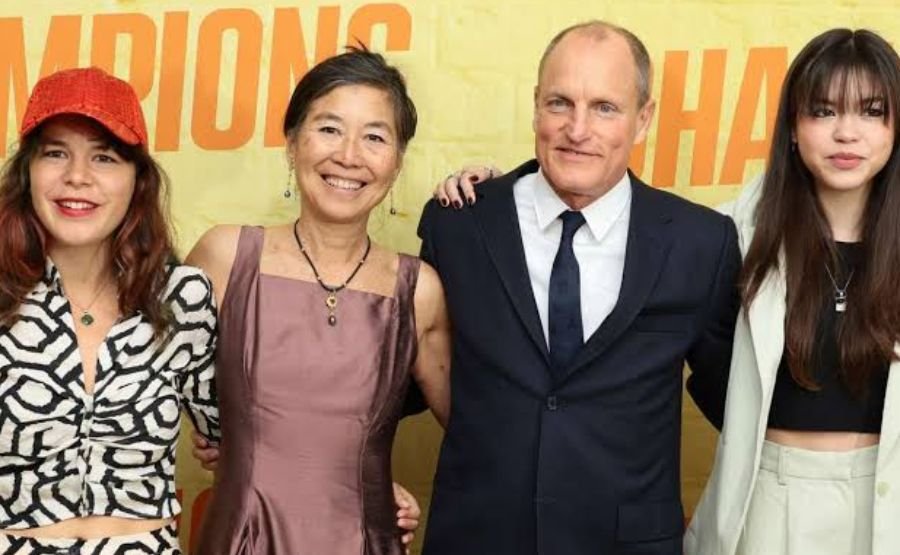
Song for Someone: A Father, a Daughter, and U2
A few months after the TED Talk, Zoe’s first on-screen credit arrived — and it couldn’t have been more fitting.
U2 was releasing their Songs of Innocence album and needed a music video for “Song for Someone” — an emotionally direct track about connection and estrangement. Director Vincent Haycock had a concept: a father being released from prison, picked up by his daughter, the two of them navigating the charged silence of a relationship fractured by years apart. He wanted Woody Harrelson in the father role.
Woody said yes. And he brought Zoe.
The nine-minute short film that resulted is genuinely affecting. Woody’s character walks out of a correctional facility and into the car of a daughter — Zoe’s character — whose feelings about his return are written on her face without being stated in dialogue. The estrangement is palpable. So is the love underneath it. It’s a film about all the things people mean when they can’t say what they mean.
The fact that it was an actual father and daughter playing this particular relationship added something the camera caught and held. U2 and Bono publicly praised both performers. The band said that Haycock’s direction and the Harrelson performances didn’t merely complement the song — they completed it.
The choice of this story, given the actual family history on Woody’s side — the father who went to prison, who died there, whom Woody lost to incarceration — was not accidental. Zoe understood what she was participating in when she agreed to it. The film debuted on SundanceTV in July 2015 to real critical warmth.
Her IMDb page has one credit. She’s listed as “Aaron Brown’s daughter.” She has never added another.
The Watergate Moment and What It Revealed
In 2010, an incident at the Watergate Hotel in Washington, DC, generated some press coverage that said more about Woody than about Zoe, but it belongs in her story because she was at the center of it.
An intoxicated man photographed Woody and Zoe on the hotel rooftop. Woody told him to erase the pictures. The man — according to accounts — became aggressive rather than compliant. Woody struck him.
The subsequent lawsuit against Woody was eventually dismissed. But the incident revealed something about how seriously he takes his children’s privacy and safety — not as a PR matter but as a visceral, immediate priority. When his daughter’s boundaries were being violated by someone who thought the famous father was a sufficient reason to photograph them without consent, Woody’s response was physical and instinctive.
The lesson for the press, apparently, was noted.
Personal Life: Deliberate Invisibility
Zoe Giordano Harrelson has no public social media accounts. She has not spoken to a reporter. She has not appeared at a premiere, a party, or an award ceremony in any capacity that generated photographs or coverage since 2015. She has not indicated any interest in acting, in activism, in any public career whatsoever.
This is not an accident. It is not shyness. It is a considered, sustained choice made by someone who had a front-row seat to what public life actually costs and who appears to have concluded, quite early, that the price is not worth the product.
Her parents modelled that choice in their own way — Woody is famous but Maui is deliberately not-Hollywood, Laura has stayed out of the spotlight almost entirely despite decades married to one of its most recognizable occupants, and the family’s eco-village existence was always oriented toward depth rather than display.
Zoe absorbed that orientation completely. Where she lives now, what she does, whether she is in a relationship, whether she has pursued higher education beyond Seabury Hall — none of it is on public record.
Net Worth and the Honest Financial Picture
Zoe Giordano Harrelson has no documented personal income or independent wealth. Her one acting credit was an appearance in a music video alongside her father — almost certainly not a commercial arrangement in the conventional sense.
Her father Woody Harrelson’s net worth is estimated at approximately sixty-five million dollars, accumulated across nearly four decades of film and television work, theater, and various business interests including the world’s first certified organic vegan beer garden. That wealth provides the family a financial cushion that is substantial by any measure.
Whether Zoe has access to, or interest in, any portion of that is entirely private. What can be said is that she grew up in a household where material wealth was subordinated to environmental values and personal integrity, which tends to shape a particular relationship with money — one less oriented toward accumulation than toward sufficiency.
Where She Is Now
As of 2026, Zoe Giordano Harrelson is twenty-nine years old, and virtually nothing is publicly known about how she is spending those years. Her family’s connection to Maui remains strong — the island has been the family’s home base for more than two decades, though Woody has also reportedly spent time in Austin, Texas in recent years.
Her older sister Deni has maintained a similarly low profile. Her younger sister Makani, still a teenager, has begun to appear occasionally in family photographs. The Harrelson family’s approach to public life has been consistent across all three daughters: present in the world, absent from its appetite for celebrity.
Zoe’s TED Talk remains viewable. The U2 music video remains on YouTube and IMDb. And then, as far as the public record is concerned, the story pauses.
She’s out there somewhere, living a life that apparently needs no audience. That’s the whole point.
See also “Rodney Keith Jones: The Brother Behind the Laughter“
Final Words
What makes Zoe Giordano Harrelson’s story genuinely compelling has nothing to do with the access she chose not to take.
She arrived in the world with every lever available. Famous father. Wealthy household. Industry connections that could have fast-tracked an acting career before she was out of high school. And the two moments she chose to step into public view — the TED Talk and the U2 video — both said something specific and meaningful about who she actually is.
She is someone who thinks carefully about attention — what it costs, what it’s for, and when it serves something real. The TED Talk was an argument for less of it. The music video was a collaboration built around emotional truth rather than celebrity exposure. Both were undertaken seriously and then set aside.
The pattern is consistent. Zoe Giordano Harrelson grew up in a community that valued depth over display, raised by parents who chose Maui over Malibu and principles over profile. She internalized all of it. And in a world that constantly insists on being watched, she has simply declined.
That’s a harder thing to do than it looks, especially when you’re twenty-nine and your father is Woody Harrelson.
FAQs
1. Who is Zoe Giordano Harrelson?
She is the second of three daughters born to actor Woody Harrelson and his wife Laura Louie. Born September 22, 1996, in Los Angeles, she was raised primarily in Maui, Hawaii, in a sustainable eco-community. She is best known for appearing in U2’s “Song for Someone” music video in 2015 and for giving a TEDxYouth talk at her high school that same year.
2. When was Zoe Giordano Harrelson born?
She was born on September 22, 1996. Her birthplace was Los Angeles, California, though her family relocated to Maui, Hawaii while she was young, and that is where she spent the majority of her childhood and adolescence.
3. Who are Zoe’s parents?
Her father is Woodrow Tracy Harrelson — the Academy Award-nominated actor known for Cheers, Natural Born Killers, The People vs. Larry Flynt, No Country for Old Men, True Detective, and The Hunger Games franchise, among many others. Her mother is Laura Louie, who worked as Woody’s personal assistant before they became a couple in the late 1980s. Laura co-founded Yoganics, an organic food delivery service on Maui, and is a committed vegan and environmental advocate. Woody and Laura married in December 2008 in a small ceremony on Maui.
4. Does Zoe have siblings?
Yes. Her older sister is Deni Montana Harrelson, born in 1993. Makani Ravello Harrelson, who was born on June 3, 2006, is her younger sister. All three daughters were raised on Maui and have all maintained notably private lives.
5. Where did Zoe go to school?
She and her older sister Deni were homeschooled during part of their early education. Zoe later attended Seabury Hall, a private college preparatory school in Makawao, Maui, where she delivered her TEDxYouth talk in 2015 during her senior year.
6. What was Zoe’s TED Talk about?
In 2015, as a high school senior at Seabury Hall, Zoe gave a TEDxYouth talk on the negative effects of smartphone overuse and the importance of voluntarily disconnecting from digital devices. The talk drew on her own experience of having grown up in a household and community where screens were deliberately minimized, and made a case for reclaiming the quiet and mental space that constant connectivity erodes.
7. What is the U2 music video she appeared in?
In July 2015, U2 released a short film for “Song for Someone,” a track from their Songs of Innocence album. Directed by Vincent Haycock, the nine-minute film starred Woody Harrelson as a man walking out of prison after a long sentence and reuniting with his estranged daughter, played by Zoe. The band publicly praised both Harrelsons’ performances, saying they completed rather than merely complemented the song.
8. What other acting has Zoe done?
Her IMDb profile lists one credit: the role of Aaron Brown’s daughter in the U2 “Song for Someone” short film. She also made a brief appearance on Entertainment Tonight in 2015. She has not taken on any other on-screen work before or since.
9. What happened at the Watergate Hotel incident involving Zoe?
In 2010, while Woody and Zoe were at the rooftop of the Watergate Hotel in Washington, DC, an intoxicated man photographed them without consent. When Woody asked the man to delete the images, the man became aggressive. Woody struck him. The man subsequently filed a lawsuit against Woody, which was eventually dismissed by the courts.
10. What lifestyle did Zoe grow up with?
She grew up in a small intentional eco-community of about two hundred residents in the Kipahulu area of Maui, where the family lived off-grid with solar power. Both parents are committed vegans — Woody practices raw veganism — and the family ran an organic food delivery business on the island. Zoe was raised without significant screen time and in close contact with nature, food production, and sustainable community living.
11. Is Zoe Giordano Harrelson active on social media?
No. She has no verified public social media presence on any platform. This appears to be a deliberate and sustained personal choice consistent with her upbringing and her public statements about the value of digital disconnection.
12. What is Zoe’s net worth and what is she doing now?
She has no documented personal wealth or independent career. Her father Woody Harrelson’s net worth is estimated at approximately sixty-five million dollars. As of 2026, Zoe’s current location, occupation, and personal circumstances are entirely unknown to the public. She has maintained complete privacy since her two brief public appearances in 2015.
One Comment