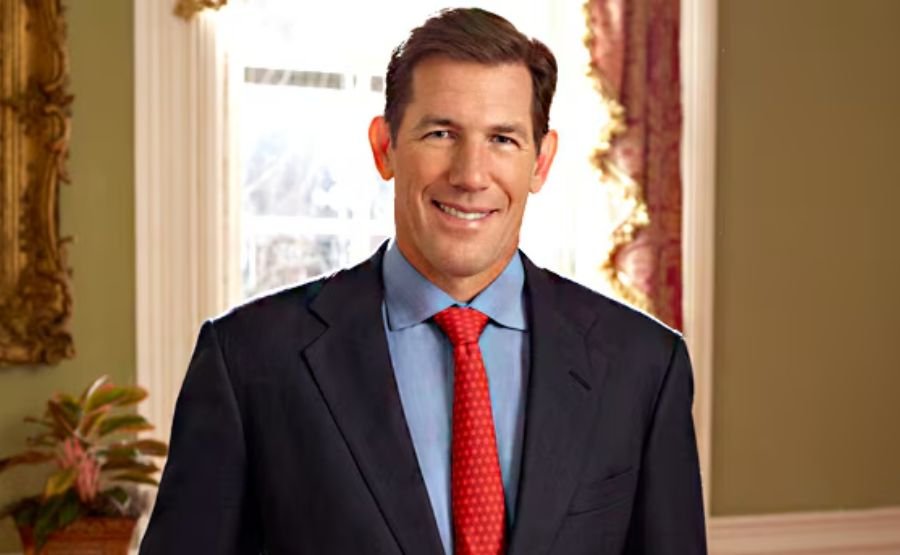
Thomas Ravenel: Charleston Aristocracy, Political Wreckage, and a Second Act Nobody Quite Predicted
Quick Bio
| Detail | Information |
| Full Name | Thomas Jonathan Jackson Ravenel |
| Born | August 11, 1962 — Charleston, South Carolina, USA |
| Nationality | American |
| Occupation | Real estate developer, former politician, former reality television personality |
| Known For | South Carolina State Treasurer (2007); cast member of Bravo’s Southern Charm (2014–2018) |
| Father | Arthur Ravenel Jr. — former U.S. Congressman; namesake of the Arthur Ravenel Jr. Bridge in Charleston |
| Education | B.S. in Business Administration, The Citadel (1985); M.B.A., University of South Carolina (1991) |
| First Marriage | Mary Ryan Ravenel (1995–1998) |
| Children | Kensington “Kensie” Calhoun Ravenel (b. 2014, with Kathryn Dennis); St. Julien Rembert Ravenel (b. 2015, with Kathryn Dennis); one child with Heather Mascoe |
| Criminal Record | 2007 federal cocaine distribution guilty plea; 2019 third-degree assault and battery guilty plea |
| Estimated Net Worth | Approx. $2 million (significantly diminished from earlier estimates of $10+ million) |
A Name That Carries Weight in South Carolina
There’s a bridge in Charleston, South Carolina. It stretches across the Cooper River in a long, graceful cable-stayed arch, and it bears the name of Arthur Ravenel Jr. — a longtime congressman, a figure of the old Southern establishment, a man who left the kind of footprint on his state that very few people ever manage.
Thomas Ravenel is that man’s son. And in some ways, everything that’s happened to Thomas — the remarkable rise, the spectacular collapse, the grinding legal years, and the strange persistent ambition — can’t be fully understood without that fact sitting at the center of it.
He grew up carrying one of the most storied surnames in Charleston, a city that takes its surnames very seriously indeed. He moved through prep schools and military colleges and graduate programs and boardrooms and eventually a statewide elected office, all of it at least partly in the shadow of a father whose legacy was already written on a bridge. And then he threw much of it away. Repeatedly. In public. With cameras rolling.
This is the story of Thomas Ravenel. Most people don’t realize how fascinating it is.
See also “Jesse Jackson: The Voice That Would Not Be Silenced“
Born into the Charleston Establishment
Charleston in 1962 was still a city deeply conscious of its own history — not the plantation mythology exactly, but the particular social architecture of a place that had been the wealthiest city in colonial America and never quite forgot it. Old families, old houses, old churches, old manners. The kind of city where lineage still moved doors that money alone couldn’t open.
Thomas was born the youngest of six children in that world. His father Arthur was a towering figure in South Carolina Republican politics — a state legislator turned congressman, a man who commanded rooms and shaped policy and whose connection to the conservative establishment of the Palmetto State was deep and durable. Growing up as the youngest child of someone like that gives you a peculiar kind of formation. You are simultaneously privileged and overlooked, surrounded by expectation but also somewhat free from the crushing pressure that the eldest often feels.
The Ravenel children grew up comfortable. That is just the truth; it is not a critique. Charleston’s old money families maintained a style of life defined by large houses, church attendance, social connection, and a shared understanding that certain things were done in certain ways. The French Huguenot Church of Charleston, one of the oldest Protestant congregations in America, was part of the Ravenel family’s spiritual and social landscape. The military tradition ran through the family’s identity too, pointing Thomas eventually toward The Citadel.

The Citadel, the MBA, and the Making of a Developer
The Citadel, South Carolina’s public military college in Charleston, is not an easy place to spend four years. It demands physical discipline, institutional conformity, and the kind of subordination of self to structure that either shapes young people into something formidable or breaks them. Thomas earned his Bachelor of Science in Business Administration there, graduating in 1985.
After The Citadel, he spent four years selling real estate — learning the business from the ground level before deciding that a graduate degree might help him think bigger. He enrolled at the University of South Carolina’s Moore School of Business in Columbia, concentrating on finance and real estate, and earned his MBA in 1991.
Then, in 1992, he founded Ravenel Development Corporation. He was thirty years old. He set up his operation initially in Atlanta rather than Charleston, which was a deliberate choice — Atlanta in the early 1990s was booming, a Sun Belt city expanding outward in every direction, and retail development was particularly hot. He focused on freestanding single-tenant stores and strip-mall projects, the kind of unglamorous but lucrative commercial real estate that feeds off suburban sprawl.
He did well. The company grew. He accumulated the kind of net worth — estimates reached into the range of ten to fifteen million dollars at his peak — that made him a substantial player in South Carolina’s business and social world. Not a billionaire, not a national figure, but significant in the context of a mid-sized Southern state where old money and new money still moved in recognizable circles.
The Political Rise: Toppling a Nine-Term Institution
By the mid-2000s, Thomas Ravenel was restless. Business was fine. But he came from a political family, and politics pulled at him in the way it tends to pull at the children of people who’ve been good at it.
In 2006, he ran for South Carolina State Treasurer as a Republican. His opponent was Grady Patterson, a Democrat who had held the office for an almost unbelievable nine consecutive terms — thirty-six years as the state’s top financial officer. Patterson was a fixture, a piece of furniture almost, and the conventional wisdom said he was unbeatable.
Thomas beat him. Decisively. He ran on a platform emphasizing fiscal conservatism, limited government, and free-market principles — the standard Republican playbook in South Carolina, but delivered with the credibility of someone who had actually run a business and understood financial markets. The Ravenel name didn’t hurt either.
His election was a genuine political event. He became chairman of the State Board of Financial Institutions and a member of the Budget and Control Board, overseeing portions of approximately thirty billion dollars in state retirement funds. He threw himself into the Rudy Giuliani presidential campaign, serving as Giuliani’s South Carolina state chairman during the 2008 primary cycle.
It lasted approximately five months.
The Crash: Federal Indictment and Prison
In June 2007, a federal grand jury indicted Thomas Ravenel on charges of cocaine distribution. The allegations described him purchasing cocaine for personal use and for the use of others at social gatherings — not a street-level trafficking operation, but a wealthy man’s recreational drug use that crossed the federal threshold when it involved distribution to other people.
Governor Mark Sanford suspended him from his duties the moment the indictment became public. Thomas resigned as Treasurer on July 24, 2007 — less than seven months into the job he had campaigned for and won. He entered a rehabilitation facility.
On March 14, 2008, he appeared in federal court and was sentenced to ten months in federal prison. He served the sentence, was released, and faced the question that everyone faces after a public fall of that magnitude: what happens next?
The answer, in Thomas’s case, was: he tried again. He returned to his real estate ventures. He kept his social connections in Charleston. He gradually reentered public life with the particular resilience — some would call it audacity — of someone who genuinely believes his story isn’t over.
In 2012, he ran for the U.S. Senate seat being vacated by Jim DeMint, entering the Republican primary. He didn’t win, but he ran. Then in 2014, he ran again for that same Senate seat, this time as an independent, while simultaneously agreeing to appear on a new Bravo reality series that would follow the social lives of Charleston’s upper crust. That show was Southern Charm, and it changed the trajectory of Thomas Ravenel’s story in ways neither he nor the producers probably fully anticipated.

Reality Television and the Life That Cameras Found
In March 2014, Southern Charm made its Bravo debut. The premise was exactly what the network’s marketing suggested: a look inside the social world of Charleston, South Carolina, where money, tradition, eccentricity, and the legacies of the old South collided in ways that produced excellent television and uncomfortable conversations.
Thomas was the show’s anchor in the early seasons — the most famous cast member, the one with the real political history and the real criminal record and the real Charleston pedigree. He was also the oldest, the wealthiest, and in many ways the most complex figure on the screen.
His relationship with Kathryn Calhoun Dennis — a twenty-one-year-old descended from her own distinguished South Carolina lineage when they met — became the defining storyline of the show’s first several seasons. She was young, volatile, beautiful, and politically connected in her own right. He was fifty-two, carrying the weight of a felony conviction and a ruined political career, and trying to rebuild something with a new audience watching.
They had two children together: Kensington Calhoun Ravenel, known as Kensie, born in 2014, and St. Julien Rembert Ravenel, known as Saint, born in 2015. Their relationship was stormy in real time and on camera, and their eventual breakup set off a custody battle that would drag through the courts for years and generate more headlines than anything else in either of their lives.
Thomas appeared on Southern Charm through its first five seasons, reportedly earning approximately twenty-five thousand dollars per episode — across roughly sixty-seven episodes, that represents a meaningful income stream on top of his real estate work. He became one of Bravo’s recognizable faces, a figure that viewers either loved or loved to despise.
The Second Fall: Assault Allegations and the End of Bravo
In the spring of 2018, allegations of sexual assault began to surface against Thomas Ravenel. The first came from a Florida real estate agent whose mother claimed Ravenel had assaulted her after meeting on a dating application. Then came a second, more damaging accusation: Dawn Ledwell, the former nanny of Thomas and Kathryn’s two children, alleged that in January 2015, Ravenel had assaulted her at his Charleston home after returning from a night out with friends.
Ravenel initially denied the allegations. In September 2018, Charleston police arrested him on a charge of second-degree assault and battery. Bravo severed ties with him immediately. His five-season run on Southern Charm was over.
The legal process moved forward. In September 2019, Thomas Ravenel pleaded guilty to third-degree assault and battery — a reduced charge from the original. His sentence: thirty days in jail, immediately suspended in exchange for a five-hundred-dollar fine. He also agreed, as part of a separate civil settlement with Ledwell, to pay one hundred and twenty-five thousand dollars, with proceeds directed to People Against Rape, a Charleston nonprofit serving sexual assault survivors. He issued a public apology as part of the settlement agreement.
The financial penalty and the public admission marked a low point that even his 2007 federal conviction hadn’t quite reached — not because the legal consequences were more severe, but because the nature of the offense was different, and because it played out against the backdrop of a national reckoning with sexual misconduct that made the context impossible to separate from the specific facts.
The Custody Battle and Its Outcome
While the assault case wound its way through the courts, so did a parallel battle that Thomas describes as his most important fight: custody of his children with Kathryn Dennis.
The chronology was genuinely complicated. Kathryn lost primary custody in 2016 after testing positive for marijuana, cocaine, and opiates during a drug test ordered by the family court. Thomas was charged with assault in 2018, and Kathryn then filed to regain primary custody. They reached a joint custody agreement in 2019. Then, in 2021, Thomas filed an emergency motion citing what his legal team described as dangerous circumstances during Kathryn’s custody time. The Charleston County Family Court ultimately awarded Thomas permanent sole custody, with Kathryn receiving a supervised visitation schedule.
Thomas has spoken publicly about winning that custody case as one of the most meaningful outcomes of his adult life. Whatever one makes of the full complexity of the situation — and it is genuinely complex, involving two imperfect people, family court proceedings, and children caught between them — the court’s determination reflects a sustained legal process rather than a casual outcome.
He also has a third child, born to former girlfriend Heather Mascoe, whose relationship with Thomas produced a son and whose presence in his life represents yet another strand of a very tangled personal biography.
Money: What Remains After the Legal Fees
At his peak, Thomas Ravenel’s net worth was estimated in various sources at between ten and fifteen million dollars — built from the Ravenel Development Corporation and the commercial real estate portfolio he’d assembled across South Carolina and elsewhere over two decades of work.
That number has shrunk considerably. Legal fees from a federal criminal case, a prolonged custody battle fought in family court, civil settlements, and the general drag of years of contested litigation have collectively taken a significant toll. Current estimates place his net worth at approximately two million dollars, though the precise figure is impossible to verify without financial disclosures he hasn’t made publicly.
His real estate business continues to operate, which provides ongoing income. The Southern Charm salary ended with his departure from the show. His political career has not generated income in any documented way. He is, by the standards of Charleston’s upper class, still comfortable — but the fortress of wealth he once occupied has been substantially reduced.
What He’s Doing Now
In February 2025, Thomas Ravenel announced on social media that he was running for Governor of South Carolina, posting a combative declaration that he had a message capable of transforming not just his state but the country. He identified as a Libertarian for the purposes of the announcement.
Immediately after the announcement, there was discussion over whether someone with his criminal history could run for office. Under South Carolina’s constitution, a person convicted of a felony becomes eligible to seek office again once fifteen years have passed from the completion of their sentence. Thomas completed his federal prison sentence in 2009, which means the fifteen-year window closed in 2024 — leaving him technically eligible.
Whether his gubernatorial campaign gains real traction remains to be seen. His previous attempts at higher office — the 2012 Republican Senate primary, the 2014 independent Senate run — demonstrated that he can generate attention and funding but has struggled to convert those into electoral success. A 2025 governor’s race would be his most ambitious attempt yet.
He continues to raise Kensie and Saint in Charleston, where he has maintained his primary residence throughout everything that’s happened. He is active on social media, characteristically unfiltered, and still deeply embedded in the city that gave him everything he has and watched him squander a significant portion of it.
Final Words
Thomas Ravenel is, depending on your vantage point, a cautionary tale, a survivor, an unreformed character, or some genuinely complicated combination of all three.
His life contains undeniable achievements alongside undeniable wreckage. He built a real business. He won a significant political office against long odds. He raised two children in difficult circumstances and fought tenaciously through the courts to provide them stability. These are real things.
But he also pleaded guilty to federal cocaine distribution and spent ten months in prison. He pleaded guilty to sexual assault against an employee in his home. He lost a marriage, burned through a fortune, and spent years in legal battles that consumed enormous energy and resources.
What makes his story interesting — rather than simply sad — is the persistence. Not a virtuous persistence, necessarily, but a real one. He keeps coming back. He announces runs for governor while most people in his position would have quietly retired. He remains in the city that knows his full history and continues trying to shape that city’s narrative about him.
Charleston is a place that has always had a complicated relationship with its own history — which perhaps explains why it keeps producing people like Thomas Ravenel. People who carry the weight of a storied name and can’t quite decide whether that name is something to honor or something to escape.
FAQs
1. Who is Thomas Ravenel?
Thomas Jonathan Jackson Ravenel is an American real estate developer, former politician, and former reality television personality from Charleston, South Carolina. He served briefly as South Carolina State Treasurer in 2007 before resigning after a federal cocaine indictment, and later became widely known as a cast member on Bravo’s Southern Charm from 2014 to 2018.
2. Who was Thomas Ravenel’s father?
His father was Arthur Ravenel Jr., a former South Carolina state legislator and U.S. Congressman who represented the Charleston area. Arthur Ravenel Jr. was a significant figure in South Carolina Republican politics, and the Arthur Ravenel Jr. Bridge spanning the Cooper River in Charleston was named in his honor.
3. Where did Thomas Ravenel go to school?
After graduating from The Citadel, South Carolina’s military institution in Charleston, with a Bachelor of Science in Business Administration, he went on to receive an MBA with a focus on finance and real estate from the University of South Carolina’s Moore School of Business in Columbia.
4. What is Ravenel Development Corporation?
It is a commercial real estate development company that Thomas founded in 1992, initially based in Atlanta and later operating in South Carolina. The company focused on retail development including freestanding single-tenant stores and strip-mall projects. It provided the financial foundation for his personal wealth and professional identity before he entered politics.
5. How did Thomas Ravenel become South Carolina State Treasurer?
He ran as a Republican in the 2006 general election and defeated nine-term Democratic incumbent Grady Patterson. His campaign emphasized fiscal conservatism and free-market principles, and his business background lent credibility to arguments about financial management.
6. Why did Thomas Ravenel resign as State Treasurer?
In June 2007, a federal grand jury indicted him on charges of cocaine distribution, alleging he had purchased cocaine for himself and for use at social gatherings. Governor Mark Sanford suspended him from duty immediately upon learning of the charges. Thomas resigned on July 24, 2007, entered a rehabilitation facility, and in March 2008 was sentenced to ten months in federal prison after pleading guilty.
7. What is Southern Charm and what was Ravenel’s role in it?
Southern Charm is a Bravo reality television series that premiered in 2014 and follows the social lives of Charleston, South Carolina’s affluent social set. Thomas was an original cast member and one of the show’s central figures through its first five seasons, appearing in approximately sixty-seven episodes. He reportedly earned around twenty-five thousand dollars per episode. His relationship with co-star Kathryn Calhoun Dennis and subsequent custody battle over their two children formed a major storyline.
8. What happened with the sexual assault allegations against Thomas Ravenel?
In 2018, two women made sexual assault allegations against him. The more legally significant involved Dawn Ledwell, the former nanny of his children with Kathryn Dennis, who alleged he assaulted her at his home in January 2015. He was arrested in September 2018. In September 2019, he pleaded guilty to third-degree assault and battery, received a thirty-day jail sentence that was suspended in exchange for a five-hundred-dollar fine, and settled a related civil lawsuit for one hundred and twenty-five thousand dollars directed to a local sexual assault nonprofit. Bravo removed him from Southern Charm following his arrest.
9. Who is Kathryn Dennis and what is her relationship to Thomas Ravenel?
Kathryn Calhoun Dennis is a South Carolina native and Southern Charm cast member who met Thomas through the show during its first season filming in 2013. They were in a relationship from approximately 2013 to 2016 and have two children together: daughter Kensington (“Kensie”) and son St. Julien (“Saint”). Their relationship and subsequent custody battle became one of the show’s defining storylines and generated years of legal proceedings.
10. Who has custody of Thomas Ravenel’s children?
Thomas holds permanent sole custody of his two children with Kathryn Dennis, Kensie and Saint, as awarded by the Charleston County Family Court. Kathryn was given a supervised visitation schedule. The custody outcome followed years of contested proceedings during which both parties faced significant personal challenges, including Kathryn’s documented substance use issues and Thomas’s criminal charges.
11. What is Thomas Ravenel’s net worth?
Estimates place his current net worth at approximately two million dollars — a significant reduction from earlier estimates of ten to fifteen million dollars. The decline reflects years of legal fees, civil settlements, and the general cost of sustained litigation across multiple cases. His real estate business continues to operate and provides ongoing income.
12. What is Thomas Ravenel doing in 2025 and 2026?
In February 2025, he announced a run for Governor of South Carolina, identifying himself as a Libertarian and posting a combative social media statement. Under South Carolina’s constitution, he became eligible to seek elected office again after fifteen years from completing his federal prison sentence, a threshold he passed in 2024. He continues to reside in Charleston, raise his children, and operate his real estate business. He remains active on social media and consistently generates attention whenever he steps back toward the public sphere.
Explore stories that inspire curiosity with The Imperial Magazine.



2 Comments