
Alexey Pajitnov Net Worth: The Man Behind the World’s Most Addictive Game
Quick Bio
| Detail | Information |
| Full Name | Alexey Leonidovich Pajitnov |
| Born | April 16, 1955, Moscow, Russian SFSR, Soviet Union |
| Nationality | Russian-American |
| Occupation | Computer engineer, video game designer |
| Known For | Creating Tetris (1984) |
| Education | Moscow Aviation Institute (Applied Mathematics) |
| Key Employer(s) | Dorodnitsyn Computing Centre; Microsoft; The Tetris Company |
| Co-founder | The Tetris Company (with Henk Rogers, 1996) |
| Awards | Game Developers Choice First Penguin Award (2006); LARA German Games Award (2009) |
| Estimated Net Worth | ~$20 million (as of 2026) |
| Spouse | Nina Pajitnov |
| Children | Two sons |
The Man Who Gave the World a Game It Can’t Quit
There’s a reasonable case to be made that Alexey Pajitnov is responsible for more lost hours of human productivity than almost any person in history. And he accomplished it completely by chance.
In the summer of 1984, sitting at a government computer terminal in a Moscow research institute, a quietly brilliant mathematician thought it might be fun to build a puzzle game. He wasn’t trying to get rich. He wasn’t trying to become famous. He was just entertaining himself between research tasks.
What came out of that session on an Electronika 60 computer was Tetris — arguably the most recognizable video game ever made. Played on over 50 platforms, sold in hundreds of millions of copies, bundled with the original Game Boy that introduced gaming to a generation, and the subject of a 2023 film starring Taron Egerton. That little puzzle born in a Soviet lab went on to become a global cultural artifact.
And for the first decade of its existence, the man who created it saw not one ruble in royalties.
Pajitnov’s story is as much about the peculiarities of Soviet intellectual property law as it is about game design. It’s about a genuinely gifted, curious person whose creation was essentially confiscated by the state he worked for — and who then, eventually, found a way to get it back. It’s a story of late justice, international friendship, Cold War bureaucracy, and one of the most elegant game mechanics ever invented.
See also “Diane Plese: The Optometrist Who Helped Build an Empire and What Came After“
Growing Up in Moscow: Words and Numbers
Alexey Pajitnov was born on April 16, 1955, in Moscow, into an unusually literary household. His father was an art critic. His mother was a journalist — she wrote for newspapers and also for a film magazine. The arts were part of the furniture of his childhood.
His mother took him to film screenings regularly, including events at the prestigious Moscow Film Festival, and that exposure to cinema gave him a genuine love of narrative and visual craft. It was an unusual sensibility for someone who would go on to work in computing — but it probably contributed to his instinct for elegant, clean design that would later make Tetris so visually satisfying.
When Pajitnov was about eleven years old, his parents divorced. It was 1967, and the family arrangement shifted — he and his mother eventually moved into a private apartment. It was a time of personal transition.
What remained constant was his love of mathematics and puzzles. He was drawn to the problem-solving end of thinking. Not just doing sums for their own sake, but the feeling you get when a complicated thing suddenly resolves into something simple and clear. That feeling — the pleasure of order emerging from chaos — would sit at the very heart of Tetris.
He also loved pentominoes. These are geometric puzzles made of five-square shapes that fit together in different configurations. You’d put them together, then try to get them all back in the box. That part — the cramming shapes into a space before it fills up — planted a seed in his imagination that wouldn’t bloom for another fifteen years.
Education: Applied Mathematics and the Computing World
Pajitnov studied applied mathematics at the Moscow Aviation Institute — a rigorous program that pushed him deep into abstract thinking, algorithms, and problem solving. By the time he graduated in 1979, he had developed a sharp computational mind paired with that rare creative streak.
In 1977, before finishing his degree, he worked as a summer intern at the Soviet Academy of Sciences — essentially getting a preview of where he’d end up working. When he graduated, the Academy offered him a full position at their Dorodnitsyn Computing Centre, and he took it.
His role there was focused on speech recognition research — an early attempt to get computers to understand human language. It was demanding, technically sophisticated work that most of his colleagues regarded as not particularly glamorous. But it put Pajitnov in a room full of serious minds and cutting-edge hardware for the Soviet Union, which was the computing lab for the Academy of Sciences.
The Day Tetris Was Born
Here’s how it actually happened, stripped of the mythology.
When the Computing Centre received new equipment, researchers were expected to write a small test program to evaluate its capabilities. It was a standard, slightly boring procedural task. But Pajitnov, already a puzzle enthusiast, decided to make his test program into something he actually wanted to play.
He started thinking about those childhood pentomino puzzles. The challenge of fitting geometric pieces into a confined space. The satisfaction when a row completed cleanly. The anxiety of pieces piling up faster than you could manage them.
Using an Electronika 60 terminal — a machine with text-only display, no graphics to speak of — he built a first version. Because the machine couldn’t display actual graphics, pieces appeared as clusters of brackets. But even in that crude form, the game had the thing. The compulsion. Pajitnov himself couldn’t stop playing it.
The date was June 6, 1984.
He quickly recruited two colleagues to help develop it further. Dmitry Pavlovsky was a fellow programmer at the Centre. Vadim Gerasimov was a sixteen-year-old intern who had somehow gotten permission to hang around the lab and happened to be brilliant at programming the IBM-compatible computers the Centre had recently acquired. The three of them worked for about two months, porting the game to the PC, adding color, cleaning up the mechanics.
One thing Pajitnov quietly changed from the pentomino concept: he reduced the pieces from five-square shapes to four-square shapes — tetrominoes — because they were slightly simpler to work with and created a cleaner, faster gameplay loop. The word Tetris itself is a combination of “tetra” (Greek for four) and “tennis,” Pajitnov’s favorite sport.
When the game circulated among colleagues at the Computing Centre, something remarkable happened. People couldn’t stop. Vladimir Pokhilko, a psychologist working nearby who saw the game and took a copy back to his own institute, found the same thing: anyone who touched it became absorbed. Work stopped getting done. Pajitnov had, without fully intending to, discovered something neurologically compelling about the game’s core loop.
The Soviet Machine Takes Over
Here’s where the story gets complicated.
Pajitnov worked for the Soviet Academy of Sciences. That meant anything he created on the job — and arguably, anything created on state computers in state time — belonged to the state. He couldn’t patent the game. He couldn’t sell it. He couldn’t negotiate any kind of deal on his own behalf.
The state organization responsible for importing and exporting Soviet software was ELORG — Elektronorgtechnica. When Tetris began spreading beyond the Soviet Union in 1986 and 1987 (first to Eastern Europe and then, via copies of copies, to Western Europe and North America), it was ELORG that handled licensing. Not Pajitnov.
The game had essentially been taken off his hands the moment it left his desk.
Meanwhile, Western publishers were making real money. Mirrorsoft sold it in Europe. Spectrum HoloByte sold it in America. The Nintendo Game Boy launched with Tetris packed in — a deal that turned a Japanese handheld console into a cultural phenomenon. Estimates of Game Boy units sold with Tetris run into the tens of millions.
Pajitnov had agreed, reportedly, to give the rights to the Computing Centre for ten years. Whether fully voluntary or not, the arrangement meant that until 1995 or 1996, the royalties from one of the world’s most successful games went to the Soviet state, and then to its successor Russian entities. Pajitnov received his regular government salary.
He said later that he was simply grateful people were enjoying his game. That the joy it gave people was enough. But there’s something about that sentence that lands differently when you know the full picture.
Henk Rogers and the Road to America
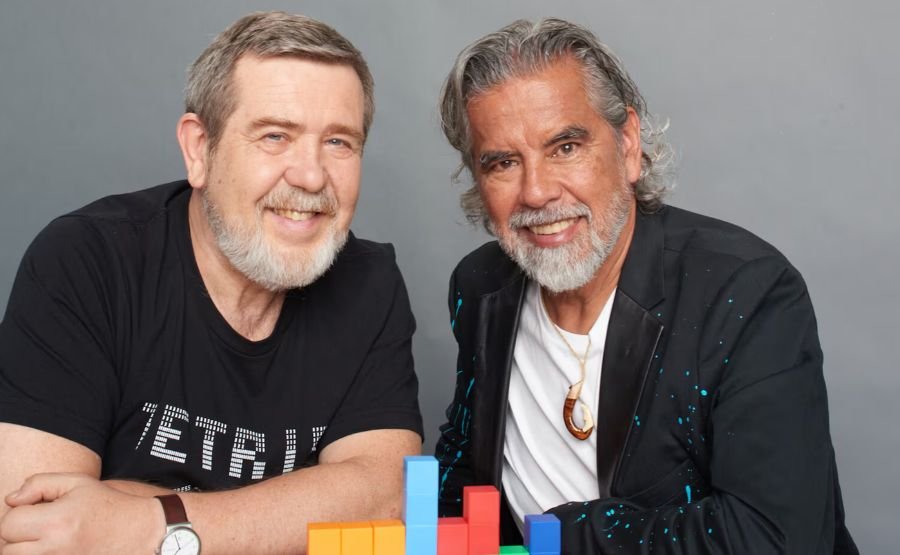
The person who changed everything was a Dutch-American video game entrepreneur named Henk Rogers.
Rogers flew to Moscow in 1989, uninvited, on a tourist visa, with the specific goal of securing the handheld rights to Tetris for Nintendo’s Game Boy. He turned up unannounced at ELORG’s offices and somehow talked his way in. The negotiations that followed were extraordinary — Rogers was technically not allowed to conduct business as a tourist — but he pulled it off. Nintendo got the Game Boy rights. Tetris went global.
In the process, Rogers met Pajitnov. Rogers later described him as the only person in the room who actually knew anything about games. The two became friends, a friendship built on mutual respect between people who both understood what made play valuable.
When the Soviet Union collapsed in 1991, Pajitnov and his longtime collaborator Vladimir Pokhilko moved to the United States. Rogers helped facilitate the move. Pajitnov settled near Seattle.
In 1996 — the year his ten-year agreement with the Soviet Academy finally expired and the rights to Tetris legally reverted to him — Pajitnov and Rogers founded The Tetris Company together. For the first time since 1984, Pajitnov was receiving money from his own creation.
That same year, he joined Microsoft as their first staff game designer, a position he held until 2004 or 2005. At Microsoft he worked on the Entertainment Pack puzzle collection, MSN games projects, and other puzzle titles. His most notable Microsoft-era work was Hexic — an elegant hexagonal puzzle game — whose HD version was bundled with every Xbox 360 Premium console when that system launched in 2005.
AnimaTek, Welltris, and Life Beyond the Headlines
Pajitnov is primarily remembered for Tetris. But he was an active and prolific game designer throughout the 1990s and 2000s.
Shortly after arriving in America, he co-founded AnimaTek with Vladimir Pokhilko. The company developed a game and screensaver called El-Fish — a generative aquarium program where fish were created algorithmically. It was strange and beautiful and not massively commercially successful, but it illustrated Pajitnov’s genuine interest in artificial life and procedural generation.
He also designed Welltris (a 3D Tetris-style game), Hatris (a falling-hat stacking game), Faces (a face-completion puzzle), Wordtris (a word-game variant), and contributed puzzle design to Yoshi’s Cookie on the Super Nintendo. His fingerprints are on dozens of puzzle titles across two decades.
He is also known to do approximately ten Sudoku puzzles per day in his private life. The man simply cannot stop engaging with puzzles.
Personal Life: Family and Privacy
Pajitnov and his wife Nina have been together for many years. In 1984, when Tetris was first taking shape, he was 29, married, and starting a family. Nina was an English teacher — a linguistic skill that served the family well when they eventually emigrated.
The couple has two sons. The family has maintained a relatively private life, not particularly associated with the celebrity or spectacle that might be expected from someone of Pajitnov’s impact on popular culture. He is not a person who courts attention. He prefers puzzles.
The Money Question: Twelve Years With Nothing, Then Finally Something
The net worth question around Pajitnov is both simple and complicated.
He received nothing — zero royalties — for the first eleven or twelve years that Tetris generated money around the world. During that time, Tetris was bundled with the Game Boy, sold for PCs, licensed to arcades, and became a defining cultural touchstone of the late 1980s and early 1990s. All of that money went to the state.
From 1996 onward, as co-owner of The Tetris Company, he began receiving his share of licensing fees. And Tetris has never really stopped making money. It’s available on every major platform. It was adapted into a film in 2023. The brand generates ongoing revenue through new game releases, mobile apps, merchandise, and licensing deals.
Estimates of Pajitnov’s current net worth range from roughly $10 million to $25 million, with many sources converging around $20 million. The wide range reflects the fact that The Tetris Company’s finances are private, and Pajitnov’s exact share of ongoing revenues isn’t publicly disclosed. What is clear is that his later decades were financially comfortable — a sharp contrast to the years when the world was playing his game and he was collecting nothing.
What He’s Doing Now
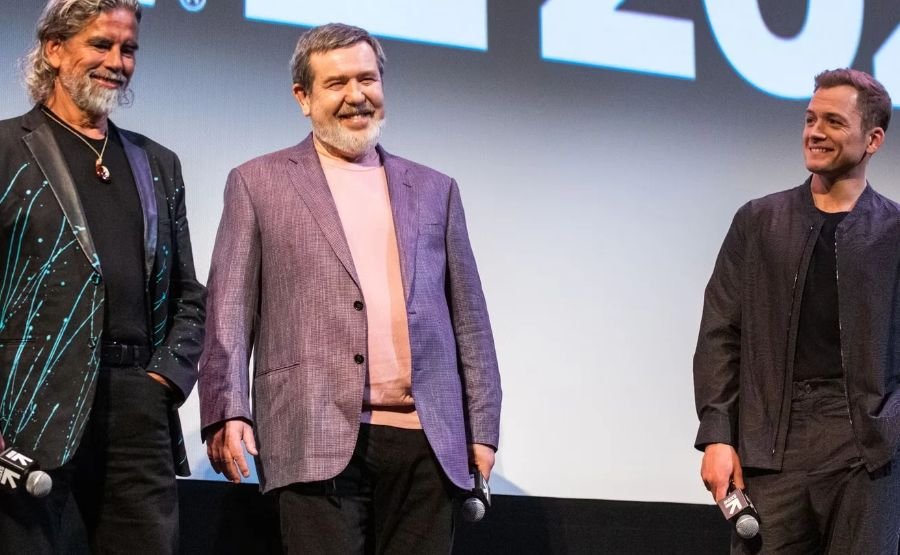
Alexey Pajitnov is in his early seventies as of 2026, and he remains engaged with The Tetris Company and the broader puzzle-game world. He attended the Tetris world premiere at SXSW in March 2023, where the Apple TV+ film dramatizing his and Rogers’s story debuted. He’s been photographed at industry events, clearly enjoying the recognition that arrives now much more easily than it did in 1984.
He has described his life in the United States as genuinely happy. He appreciates the freedom. He continues working on puzzle concepts. He does his daily Sudoku. He remains a person of genuine intellectual curiosity who seems, by all accounts, to have no particular bitterness about the decade-plus of royalties he missed — or if he does, he keeps it to himself with characteristic dignity.
Final Words
Alexey Pajitnov’s story has an unusual shape. It’s not the straightforward tech-founder narrative where the creator gets rich and famous and builds an empire. It’s more human and stranger than that.
He created something genuinely profound — a game whose mechanics seem to tap into something deep in how the brain processes order and satisfaction — and then watched it become enormous while he received nothing. His reward was the pleasure of knowing people loved it. That’s a remarkable thing to hold onto, and a testament to either extraordinary equanimity or a genuine philosophical detachment from material reward.
When he finally did get his share, it wasn’t through legal battles or dramatic confrontation. It was through friendship — the specific friendship with Henk Rogers that began in a Moscow meeting room in 1989 and ended up reshaping both men’s lives.
Pajitnov is a puzzle person. He thinks in patterns, in shapes, in the pleasure of things fitting cleanly together. Tetris was not a product. It was an expression of who he is. And it turned out that who he is resonates with virtually everyone on earth who has ever played a game.
That is a genuinely rare thing.
FAQs
1. Who is Alexey Pajitnov?
He is a Russian-American computer engineer and game designer, best known as the creator of Tetris. He built the first version of the game in June 1984 while working at the Dorodnitsyn Computing Centre in Moscow.
2. When and where was Alexey Pajitnov born?
He was born on April 16, 1955, in Moscow, in the Russian SFSR of the Soviet Union. He later emigrated to the United States in 1991 and became an American citizen.
3. How did Pajitnov get the idea for Tetris?
He was partly inspired by childhood memories of playing pentominoes — geometric puzzles where you fit shapes into a box. He simplified the five-square shapes to four-square pieces (tetrominoes) and built a falling-block game around the idea of filling rows before the board filled up.
4. Why didn’t Pajitnov get royalties from Tetris initially?
Because he was a government employee working on state computers, the Soviet system treated his creation as state property. ELORG, a Soviet agency, managed all international licensing. Pajitnov signed an agreement giving rights to the Computing Centre for ten years. He earned his standard salary but no royalties.
5. When did Pajitnov finally start earning money from Tetris?
In 1996, when his ten-year agreement with the Soviet Academy expired and rights reverted to him. That same year, he and Henk Rogers co-founded The Tetris Company, which has managed global Tetris licensing ever since.
6. What is Alexey Pajitnov’s estimated net worth?
Estimates converge around $20 million as of 2026, though some sources vary between $10 million and $25 million. His wealth comes primarily from his stake in The Tetris Company and decades of licensing income since 1996.
7. Who helped Pajitnov get his rights back and move to America?
Henk Rogers, a Dutch-American game entrepreneur who went to Moscow in 1989 to secure Game Boy rights for Nintendo. Rogers befriended Pajitnov, later helped him emigrate to the Seattle area, and partnered with him to form The Tetris Company.
8. What other games did Pajitnov create?
He designed Welltris, Hatris, Wordtris, Faces, El-Fish (through AnimaTek), and contributed puzzle design to Yoshi’s Cookie. At Microsoft he created Hexic and Hexic HD, the latter bundled with the Xbox 360. He also worked on the Microsoft Entertainment Pack puzzle collection.
9. What did Pajitnov do at Microsoft?
He joined Microsoft in 1996 as their first staff game designer and worked there until 2004–2005. His projects included puzzle titles for MSN, the Entertainment Pack, and his most visible Microsoft work: Hexic HD, which shipped with the Xbox 360 in 2005.
10. What is The Tetris Company?
In order to oversee the international Tetris licenses, Pajitnov and Henk Rogers established this business in 1996. It is the exclusive source of official Tetris licenses across all platforms. In 2005, it also acquired ELORG, the original Soviet licensing body.
11. Is Pajitnov still active in the gaming industry?
Yes. He remains affiliated with The Tetris Company and continues to participate in industry events and discussions. He appeared at the 2023 SXSW premiere of the Tetris film and maintains an active interest in puzzle game design.
12. What awards has Pajitnov received?
He received the Game Developers Choice Awards First Penguin Award in 2006, recognizing his pioneering role in the casual games market. In 2009, he received the LARA German Games Award. He has also been listed among the most influential figures in the history of video games by multiple industry organizations.