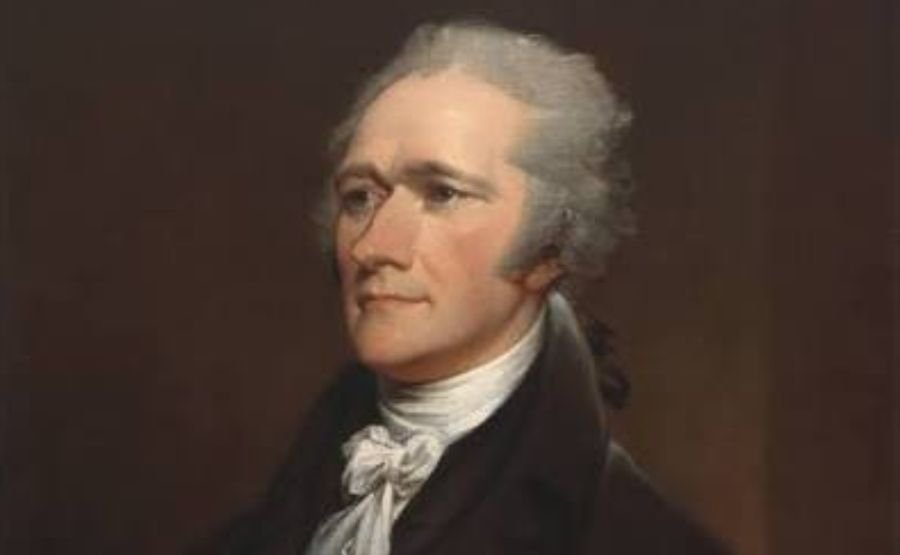
Alexander Hamilton: The Immigrant Who Built a Nation’s Economy
Quick Bio
| Detail | Info |
| Full Name | Alexander Hamilton |
| Born | January 11, 1755 or 1757 — Charlestown, Nevis, British West Indies |
| Died | July 12, 1804 — New York City, USA (age 47 or 49) |
| Nationality | American (British colonial origin) |
| Occupation | Statesman, Lawyer, Military Officer, Political Philosopher, Economist |
| Known For | First U.S. Secretary of the Treasury; co-author of The Federalist Papers; founder of the U.S. financial system; founder of the Bank of the United States; founder of the New York Post |
| Military Service | Continental Army; Washington’s aide-de-camp (1777–1781); commanded charge at Yorktown (1781) |
| Political Party | Federalist |
| Spouse | Elizabeth Schuyler Hamilton (married December 14, 1780) |
| Children | Eight, including Philip Hamilton (killed in duel, 1801) |
| Death | Mortally wounded in duel with Aaron Burr, July 11, 1804 |
The Man Who Invented America’s Money
If you had to pick one person who shaped the United States less through battle and more through sheer force of argument, ambition, and intellectual output, Alexander Hamilton would be near the top of the list.
Here is the remarkable thing about him. He arrived in America as a penniless, illegitimate teenager from a Caribbean island most people today can’t find on a map. He had no family connections to colonial aristocracy, no inherited wealth, no powerful uncle to smooth his way. What he had was a mind that processed information faster than nearly anyone around him, an almost pathological need to prove himself, and a capacity for written output that makes most modern writers tired just to contemplate.
By the time he died at forty-seven — or forty-nine, depending on which birth year you believe — he had served as George Washington’s most trusted aide during the Revolutionary War, helped write the most consequential set of political essays in American history, created the blueprint for the U.S. financial system, founded the nation’s first central bank, and established institutions and precedents that the country still runs on today.
He also died in a duel. Which is perhaps the most Alexander Hamilton way to exit a story.
The Caribbean Beginning: An Unlikely Origin
Alexander Hamilton was born on the small island of Nevis in the British West Indies, probably on January 11, 1755, though the year remains genuinely disputed — he himself sometimes claimed 1757, which may have been a deliberate adjustment of his age. Either way, his beginnings were precarious from the start.
His mother, Rachel Faucette, was a woman of partly French Huguenot descent who had made several unconventional choices for her era, including leaving a first marriage and living with James Hamilton, Alexander’s father, without formal marriage. James Hamilton was the fourth son of a Scottish nobleman — enough aristocratic connection to have a title in the family tree but, crucially, not enough money or stability to amount to much in practice.
The family relocated to the island of St. John from Nevis. Croix when Alexander was young. Then, in the way that fragile households in the eighteenth century tended to collapse, things fell apart. James Hamilton abandoned the family. Rachel died of fever in 1768, when Alexander was around thirteen. James Jr., Hamilton’s elder brother. were left effectively alone, taken in by a cousin who promptly died as well.
What saved Alexander was a combination of a brilliant early letter that came to the attention of local merchants — a vivid, extraordinarily mature piece of writing about a hurricane that struck St. Croix in 1772 — and the generosity of community members who recognized in him something worth funding. To pay for his schooling in North America, a fund was raised.
He was seventeen or so, alone, and crossing an ocean to a continent he had never seen. He never went back.

Education: Absorbing Everything as Fast as Possible
Hamilton arrived in New York and enrolled at Elizabethtown Academy in New Jersey in 1773, before moving on to King’s College in New York City, which would eventually become Columbia University. He was, by multiple contemporary accounts, a force of nature academically — reading everything, writing constantly, completing what might have taken other students several years in a dramatically compressed period.
His education was interrupted, as was everyone’s, by the growing Revolutionary crisis. Hamilton had already been writing politically charged pamphlets, and when war with Britain effectively began in 1775, he joined a New York militia artillery company. He drilled his soldiers with such precision and demonstrated such competence under fire that he attracted attention from generals who needed capable officers.
The education he received — from Elizabethtown, from King’s College, from the vast amount of independent reading he did across law, history, economics, political philosophy, and military science — gave him the toolkit he would use for the rest of his life. He was particularly drawn to the works of writers who had thought carefully about how governments worked, how money functioned, and what made societies stable or unstable. These were not casual intellectual interests. They were the raw materials of what he would build.
Washington’s Right Hand: The War Years
One of the best personnel choices of the Revolutionary War was made by George Washington in early 1777 when he invited Alexander Hamilton to become a senior aide-de-camp with the rank of lieutenant colonel.
Hamilton was twenty-one or twenty-two years old. He would spend the next four years essentially running Washington’s correspondence, managing communications with Congress and foreign allies, drafting Washington’s most important letters, and translating the general’s strategic intentions into clear, persuasive prose. This was not a glorified secretarial role. Washington was managing a revolutionary government, a continental army, and a diplomatic relationship with France all at once. Hamilton was the person who made the words happen.
The arrangement worked brilliantly and eventually fractured. Hamilton wanted combat command, not administrative work, and after years of absorbing Washington’s trust while chafing at the limitations of the role, he engineered a separation from the staff in 1781 on the pretext of a minor quarrel. Washington, who understood exactly what was happening and why, eventually gave Hamilton what he wanted: command of a battalion at the Siege of Yorktown. Hamilton led the assault on Redoubt Number 10 with characteristic intensity — the last major land engagement of the Revolutionary War.
He had proved himself on both the intellectual and physical battlefield. Now came the real work.
Building a Country’s Financial Architecture
After the war, Hamilton studied law — with the focused, accelerated self-teaching that characterized everything he did — passed the New York bar, and began building a successful legal practice. He also married Elizabeth Schuyler, the daughter of General Philip Schuyler, one of the most prominent families in New York State. The marriage, in December 1780, was both a genuine love match and a social connection that gave the orphaned Caribbean immigrant access to the inner circles of American colonial society.
His political career accelerated rapidly. He served in the Continental Congress, helped organize the Constitutional Convention in 1787, and then produced the literary achievement for which his reputation in political philosophy most rests: the Federalist Papers.
Working with James Madison and John Jay, Hamilton wrote fifty-one of the eighty-five essays that made up the Federalist Papers — a set of arguments for the ratification of the new Constitution published under the shared pseudonym Publius. The pace at which he produced them is staggering: at times writing multiple essays per week, covering everything from the structure of executive power to the theory of judicial review to the necessity of a unified national government. Even now, reading these works is crucial for understanding American constitutional law.
When Washington became the first President and needed a Treasury Secretary, Hamilton was the obvious choice. Appointed in 1789, he immediately set to work on the problem that most threatened to unravel the young nation: its finances were a disaster.
His solution was comprehensive, controversial, and brilliant in its systemic thinking. He proposed that the federal government assume all state debts from the Revolutionary War — a move that tied the financial fate of the states to the federal government and created a unified national credit. He argued for the establishment of a national bank, which he pushed through Congress over fierce opposition from Thomas Jefferson and James Madison. He created a system of tariffs and excise taxes to generate federal revenue. He established the structural foundations for what would become the United States Mint.
The political fight over these proposals was brutal. Jefferson in particular viewed Hamilton’s vision of an active federal government managing a sophisticated financial system as a betrayal of republican principles and a step toward monarchy. Hamilton saw Jefferson’s preference for a purely agrarian, decentralized nation as impractical idealism that would leave America permanently weak and perpetually dependent. They were both partly right, which is why the argument has never entirely gone away.
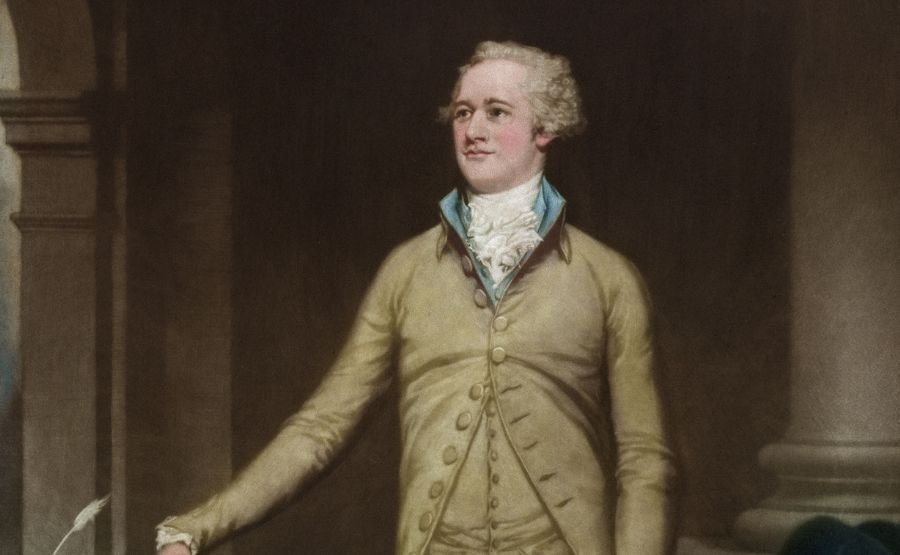
Personal Life: Elizabeth, the Affairs, and the Children
Elizabeth Schuyler — known throughout her life as Eliza — was one of the more remarkable figures in early American history, though she spent most of it in Hamilton’s enormous shadow. She bore him eight children, managed the household through his obsessive work schedule, and outlived him by fifty years, spending much of her long widowhood preserving his letters and papers and co-founding the first private orphanage in New York City.
Hamilton was a devoted father and, by the standards of his era, a reasonably attentive husband. He was also a man who had affairs. The most consequential was his relationship with Maria Reynolds, a married woman who became entangled with Hamilton in 1791 and whose husband subsequently attempted to blackmail him. The political aftermath, when the affair became public in 1797 through the efforts of journalist James Callender, was the scandal of the age. Hamilton’s response — publishing a lengthy pamphlet acknowledging the affair in explicit detail in order to prove he had not committed financial corruption — was characteristically Hamilton: politically self-destructive but personally honest.
His oldest son Philip was killed in a duel in 1801 at the age of nineteen. The death devastated Hamilton and Eliza both, and their daughter Angelica, who had been close to Philip, suffered a mental breakdown from which she never fully recovered. The tragedy cast a shadow over Hamilton’s final years.
The Federalists and Anti-Federalists: The Conflict between Jefferson and Hamilton
The rivalry between Alexander Hamilton and Thomas Jefferson is one of American history’s most consequential political conflicts, and it was genuinely personal as well as ideological.
Jefferson believed that the federal government Hamilton was building would corrupt the republican values of the Revolution. He saw banks as instruments of financial manipulation, cities as incubators of vice, and a strong executive as a path toward tyranny. Hamilton thought Jefferson’s agrarian utopia was a fantasy that ignored economic reality and left the United States permanently vulnerable to European powers who would never take seriously a weak confederation of yeoman farmers.
Hamilton eventually aligned with the view that Aaron Burr — the ambitious New York politician who had come within a hair of the presidency in 1800 — was genuinely dangerous to the republic. When Burr ran for Governor of New York in 1804, Hamilton worked against him. Burr blamed Hamilton after losing the election. The exchange of letters that followed, with each man interpreting honor according to his own code, led inevitably to a duel.
The Duel: July 11, 1804
The duel between Aaron Burr and Alexander Hamilton took place at dawn on July 11, 1804, at Weehawken, New Jersey — the same location where Hamilton’s son Philip had been killed three years earlier.
What Hamilton intended to do with his shot is something historians have debated ever since. He had written, in letters composed before the duel, that he intended to throw away his fire — to discharge his pistol without aiming at Burr, effectively accepting whatever Burr chose to do while refusing to be the cause of another man’s death. Whether he followed through on this is not certain. What is certain is that Burr’s shot struck Hamilton in the lower abdomen, severing his spine, and that Hamilton died the following afternoon surrounded by his family.
He was carried across the river to New York, where he died on July 12, 1804. He was attended by his wife, his children, and various friends. He received last rites, though he had not been a practicing church member for much of his adult life.
Hardships That Shaped Everything
Hamilton’s hardships began at birth and never fully let go.
The illegitimacy of his birth was a source of genuine stigma in the eighteenth century. The abandonment by his father, the death of his mother, the poverty of his Caribbean years — these were not background details. They were the engine of his ambition, the source of the driven, sometimes frantic energy that produced so much but also generated so many enemies.
His financial hardships were real throughout his career. He made money through law and government but spent it generously, and the family was not wealthy in the way that Jefferson (with his vast plantation and enslaved labor force) or Madison could be. Eliza was left in genuine financial difficulty after his death, supported primarily by her father’s family and the generosity of friends.
The psychological burden of being an outsider in a world of American aristocrats — of always needing to prove a legitimacy that others inherited at birth — runs through everything he wrote and everything he did.
Net Worth and Financial Reality
Hamilton was, for most of his adult life, a man whose income came from professional work rather than inherited wealth or land. His legal practice was genuinely successful and generated real income. His government salary as Treasury Secretary, by contrast, was modest — he famously left the position in 1795 partly because he could not afford to stay on government pay with a growing family.
He never owned significant amounts of land or property in the way that the Virginia planters who were his primary political opponents did. He built no plantation. He engaged in no major speculative ventures. He died leaving Eliza in a financial situation that required assistance from friends and family.
The irony is enormous: the man who built America’s financial system, who created the architecture that would make the country fabulously wealthy, died with relatively modest personal means.
Legacy: What He Left Behind
Alexander Hamilton died at forty-seven (or forty-nine) and never held elected office above a state level. By conventional political biography standards, that is a limited résumé.
And yet the world he shaped is still the world we inhabit. The central bank he created and fought for became the template for the Federal Reserve. The financial instruments and national credit system he designed underpinned American economic expansion for the next two centuries. The constitutional arguments he made in the Federalist Papers are cited in Supreme Court decisions today. The New York Post, which he founded in 1801, is still publishing. The United States Coast Guard, which he organized as the Revenue Cutter Service in 1790, still exists.
He was not a man who accumulated fame easily in his lifetime. He was too combative, too willing to make enemies, too committed to saying what he thought even when silence would have served him better. But the things he built outlasted the enemies he made.
Final Words
What makes Alexander Hamilton genuinely extraordinary — not just historically significant but humanly interesting — is the combination of where he started and what he built.
He arrived in America with nothing except a letter of recommendation and the kind of raw intellectual talent that announces itself immediately to anyone paying attention. He built his career through pure output — through writing more, reading more, arguing more effectively, working harder and longer than the people around him. He made himself indispensable to Washington through sheer competence. He shaped the Constitution’s ratification through essays that are still studied in law schools. He built a financial system from scratch that held together a nation that might otherwise have dissolved within a generation.
He was also vain, combative, occasionally reckless, capable of extraordinary personal cruelty in political combat, and ultimately killed by an argument that a calmer man would have found a way around. His flaws and his greatness were products of the same engine: an orphan’s desperate need to matter, combined with a mind that could genuinely deliver on that ambition.
The ten dollar bill, the Lin-Manuel Miranda musical, the endless academic debates about his legacy — all of it reflects the same truth. He was not the most beloved of the Founders while he lived. He has become one of the most fascinating of them since.
FAQs
1. When and where was Alexander Hamilton born?
Hamilton was born on January 11, on the island of Nevis in the British West Indies. The year is disputed — contemporary records and his own statements suggest either 1755 or 1757. Most historians now lean toward 1755, though Hamilton himself sometimes gave 1757, possibly to appear younger.
2. Why was Hamilton’s birth considered illegitimate?
Hamilton’s parents, Rachel Faucette and James Hamilton, were never formally married. Rachel had been previously married to another man and never fully completed a divorce before taking up with James Hamilton. Under the laws and social customs of the eighteenth century, this made Alexander legally and socially illegitimate — a stigma that followed him and that he was acutely aware of throughout his life.
3. How did Hamilton get to America?
After the death of his mother in 1768 and the abandonment of the family by his father, Hamilton was working as a clerk for a trading company in St. Croix. He wrote a remarkably vivid essay about a hurricane in 1772 that impressed local community members enough that they organized a collection to fund his education in North America. He sailed to the American colonies in 1773.
4. What were the Federalist Papers?
The Federalist Papers were a series of 85 essays published in New York newspapers in 1787 and 1788, arguing for ratification of the new United States Constitution. Hamilton wrote 51 of the essays, with the remaining 34 divided between James Madison and John Jay. Written under the collective pseudonym Publius, they remain the most important extended commentary on the Constitution’s meaning and intent, and are regularly cited in Supreme Court decisions.
5. What did Hamilton actually do as Treasury Secretary?
Appointed as the first Secretary of the Treasury in 1789, Hamilton transformed the United States’ disastrous post-Revolutionary finances. He proposed federal assumption of state war debts, creating a unified national credit. The United States’ First Bank was founded by him. He created a system of tariffs and excise taxes. He designed the architecture of the national currency system. He wrote comprehensive reports on public credit, manufacturing, and banking that established the theoretical foundations for American economic policy for generations.
6. What was the Reynolds affair?
In 1791, while serving as Treasury Secretary, Hamilton began an affair with Maria Reynolds, a married woman. Her husband James Reynolds subsequently blackmailed Hamilton, demanding money to stay quiet. When political enemies later accused Hamilton of financial corruption involving Reynolds, Hamilton made the extraordinary decision to publish a detailed pamphlet acknowledging the affair in full in order to prove there had been no financial wrongdoing. The political damage to his reputation was enormous.
7. Who killed Alexander Hamilton?
Hamilton was fatally shot by Aaron Burr — then the sitting Vice President of the United States — in a duel at Weehawken, New Jersey, on July 11, 1804. Hamilton was struck in the abdomen and died the following afternoon, July 12, 1804. Burr was subsequently charged with murder in both New York and New Jersey, though he was never tried. He completed his term as Vice President and died in 1836.
8. Why did Hamilton and Burr duel?
The immediate cause was a letter that had been published in a newspaper in which Hamilton was quoted making critical remarks about Burr’s character during the 1804 New York gubernatorial election. Burr had already lost the 1800 presidential election partly due to Hamilton’s opposition, and he demanded satisfaction for the accumulated insults. Hamilton’s refusal to provide a blanket apology and Burr’s insistence on one made the duel effectively inevitable under the honor codes of the era.
9. Was Hamilton planning to shoot Burr?
Hamilton wrote, in letters composed before the duel, that he planned to throw away his fire — to deliberately miss Burr or discharge his pistol harmlessly — and accept whatever Burr chose to do without seeking to kill him. Whether he did this in the actual duel is unknown. His pistol discharged, but historians disagree about whether this was intentional, reflexive, or the result of being shot first. Burr’s shot, by contrast, was aimed accurately and fatally.
10. How many children did Hamilton have?
Hamilton and Elizabeth Schuyler had eight children together: Philip (1782–1801, killed in a duel), Angelica (1784–1857), Alexander Jr. (1786–1875), James Alexander (1788–1878), John Church (1792–1882), William Stephen (1797–1850), Eliza (1799–1859), and Philip (second child named Philip, 1802–1884, born after the first Philip’s death).
11. What institutions did Hamilton create that still exist?
Hamilton founded the New York Post in 1801, making it one of the longest continuously published newspapers in the United States. He organized the Revenue Marine (now the United States Coast Guard) in 1790. The First Bank of the United States, which he created, was the template for the Second Bank of the United States and eventually the modern Federal Reserve system. The U.S. Mint was established during his tenure as Treasury Secretary.
12. Why has Hamilton’s reputation grown so dramatically in recent years?
Several factors converged: Ron Chernow’s comprehensive 2004 biography reintroduced Hamilton to a broad audience as a complex, fully human figure rather than a dry historical name. Lin-Manuel Miranda read Chernow’s biography and created the Broadway musical Hamilton (2015), which made Hamilton’s story accessible to an entirely new generation through hip-hop and contemporary musical theater. The musical’s extraordinary cultural reach — Pulitzer Prize, multiple Tony Awards, global touring production, Disney+ streaming — brought tens of millions of new readers to Hamilton’s actual history.
Explore stories that inspire curiosity with The Imperial Magazine.





One Comment