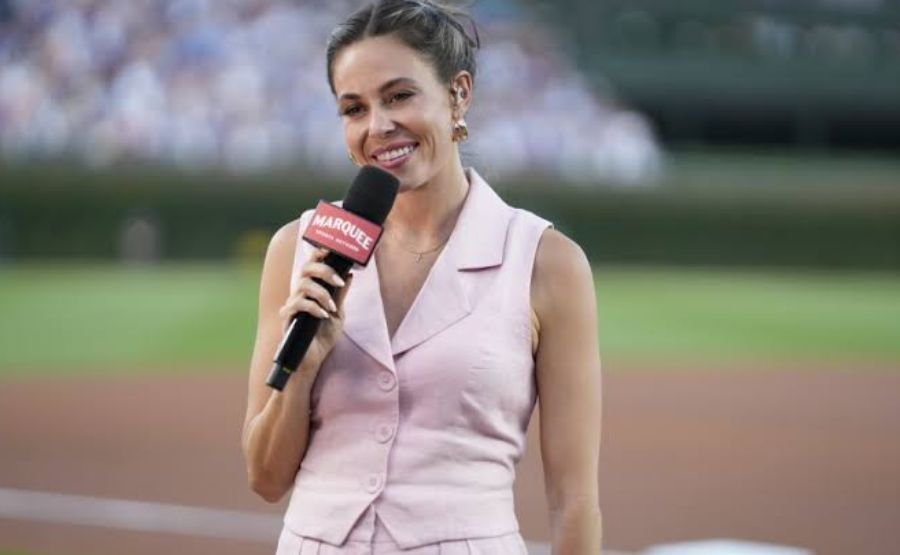
Taylor McGregor: Growing Up in the Press Box and Finding Her Own Field
Quick Bio
| Detail | Information |
| Full Name | Taylor McGregor |
| Born | Circa 1992–1993 — Colorado, USA (exact date not publicly confirmed) |
| Nationality | American |
| Occupation | Sports broadcaster, sideline reporter, television host |
| Known For | ESPN college football & UFL sideline reporter; Chicago Cubs lead reporter, Marquee Sports Network |
| Education | Golden Senior High School, Colorado; University of Arkansas (B.A. Broadcast Journalism, 2015) |
| Father | Keli Scott McGregor — NFL tight end, Colorado Rockies president (1963–2010) |
| Mother | Lori McGregor |
| Siblings | Three — Jordan, Landri, and Logan |
| Current Role | Full-time ESPN, as of 2026 |
| Estimated Net Worth | Approximately $2 million |
| Residence | Chicago, Illinois |
A Story That Starts Before She Was Born
Taylor McGregor’s story doesn’t start with her first broadcast. It starts with her father.
Keli Scott McGregor was born in Primghar, Iowa, in 1963 — a small farming town that most people outside Iowa have never heard of. He ended up at Colorado State University as a walk-on, the kind of player who shows up without a scholarship and earns everything through sheer effort. By the time he finished playing he was a two-time All-American tight end, Colorado State’s fifth-leading receiver of all time, and had been drafted by the Denver Broncos in the fourth round of the 1985 NFL Draft. He and Lori Hunt were high school sweethearts. They eventually married, moved around as his career evolved, and built a family in Colorado.
After football, Keli moved into sports administration — coaching at the University of Florida, earning a master’s in sports administration, then landing at the University of Arkansas as an associate athletics director. He joined the Colorado Rockies in late 1993, right as the expansion franchise was getting started. Over the next seventeen years he climbed steadily through the organization, becoming club president in 2001. He became, by all accounts, one of the most respected and beloved figures in Colorado sports. He was also, by his daughter’s telling, a great dad.
Taylor grew up in that world. She grew up watching what integrity and commitment looked like in professional sports. She grew up at Coors Field. She grew up knowing, from a very young age, what she wanted to do — even if she couldn’t fully articulate it yet.
And then, in the spring of her junior year of high school, her father died.
See also “Hassan Campbell: Speaking the Unspeakable From the Bronx to the Internet“
Colorado Roots and a Household Shaped by Sport
Taylor was raised in Colorado alongside her three siblings — Jordan, Landri, and Logan. She attended Golden Senior High School, a public school in the Jefferson County area. She was an athlete in her own right, playing soccer through her high school years. But the sport that mattered most in her household was always baseball.
The Rockies weren’t just her dad’s job. They were part of the family’s identity. Father’s Days were spent at the ballpark. Keli McGregor was a familiar, beloved presence at Coors Field — the kind of executive who knew players by name, who worked out alongside them in the weight room, who understood the game from the inside because he’d competed at elite levels himself. His daughter absorbed all of it.
Taylor has also talked about the way her father’s faith shaped the household. Keli was a committed Christian who lived his values openly. He was known for advocating heart health awareness, for his attention to relationships within the Rockies organization, and for the kind of leadership that was based on genuine care for people rather than authority. Those values came home with him.
When Taylor was a junior at Golden High School — around seventeen years old — her phone rang with news that no teenager should have to receive. Her father had been found unresponsive in a Salt Lake City hotel room on April 20, 2010. He was on a business trip for the Rockies. He was 47 years old. He had been in apparently excellent health. Months of uncertainty followed his death, before the family eventually revealed that a rare virus had attacked the muscle of his heart — a condition called lymphocytic myocarditis. An organism nobody could have predicted had silently disrupted the electrical pathways that kept his heart beating.
Just like that, a man who was larger than life to his daughter was gone.
Arkansas, and the Years That Built a Career
In the fall of 2011, Taylor enrolled at the University of Arkansas in Fayetteville to study broadcast journalism. This wasn’t a random choice. Her father had spent four years as an associate athletics director at Arkansas before moving to the Rockies, and the university carried a piece of his legacy. Going there was, in some ways, going toward him.
She threw herself into the program. She completed internships at the SEC Network, at RazorVision (the university’s student sports media operation), at MLB Network, at FOX Sports Kansas City, at ROOT Sports, and at KNWA-TV in Northwest Arkansas. This is not a typical internship resume. Most broadcast journalism students manage one or two placements. Taylor was stacking experience the way a professional stacks credentials — deliberately, relentlessly, with a very clear idea of where she was heading.
She graduated in 2015 with her bachelor’s degree. She was ready.
Starting at the Bottom and Working Every Room
The first paid job in sports broadcasting is almost never glamorous. Taylor’s was at KCWY News 13 in Wyoming — a small market television station that is exactly the kind of place where young reporters learn how to do the job under conditions where the margin for error is essentially zero and the camera crew is also the producer. It was not glamorous. It was essential.
From Wyoming she moved to THV-11 in Little Rock, Arkansas, working as a sports anchor and reporter for close to three years. Little Rock was a meaningful step up — bigger market, better exposure, a stronger platform to demonstrate what she could do. She was covering college football, Arkansas Razorbacks athletics, and building the kind of consistent, reliable screen presence that local television demands. She was good at it.
Then came the opportunity that pulled her back to Colorado. Taylor began reporting on the Colorado Rockies on television after being recruited by AT&T SportsNet in Denver as a sports anchor and reporter. The same franchise her father had run. The same stadium she had grown up in. She has spoken about what it felt like to walk back into Coors Field in a professional capacity, to start learning what kind of impression he had left behind through the eyes of the people he had worked with. She called it surreal. She also called it home.
In 2018, during her first season covering the Rockies professionally, Taylor was asked if she had ever imagined working there. It has always been the dream, she claimed. She also said she had never genuinely thought she’d get there. There’s something moving about that honesty — the gap between the goal you hold privately and the life that eventually closes the distance.
ESPN, the Cubs, and the Big Leagues
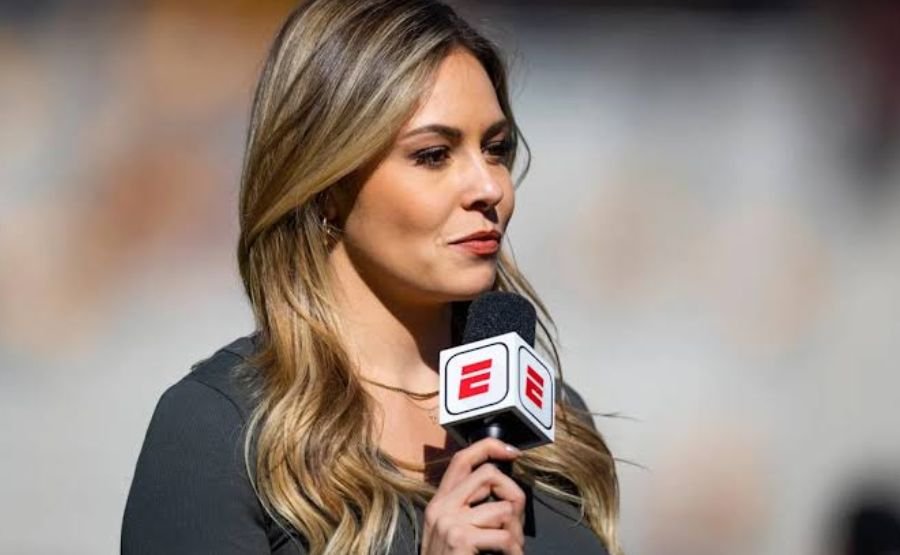
In September 2019, Taylor joined ESPN. The network brought her in as a college football sideline reporter — the kind of role that places you on-camera every Saturday during the fall season, working alongside lead broadcasters and color commentators to deliver from field level what the booth can’t see. She was paired with Dave Pasch and Dusty Dvoracek for a run of games across ESPN and ABC. It’s high-pressure, high-profile, and demands a reporter who can perform under every condition — in noise, in chaos, in rain, in front of national audiences.
She handled it with the composure of someone who had been preparing for it her whole life.
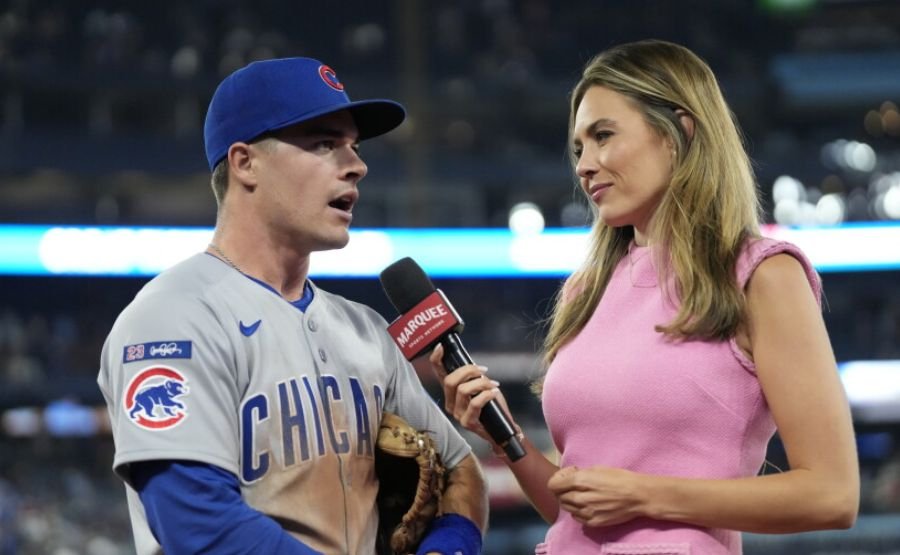
Simultaneously, she took on the lead reporter role for Marquee Sports Network in Chicago — the regional cable channel launched in 2020 as the dedicated broadcast home of the Chicago Cubs. For six years, Taylor was the face of Cubs coverage on Marquee, following the team through a full season every year, conducting postgame interviews, breaking news, and doing the unglamorous daily work that keeps a 162-game baseball season covered. She was also one of the first prominent reporters at a network that was brand new, which meant helping to define the identity of the whole operation rather than inheriting an established template.
She also added the United Football League to her ESPN portfolio when the league launched in 2024, further expanding her coverage into spring professional football. There were few reporters in American sports media covering as many different formats across as many different platforms simultaneously.
In 2026, Taylor made a significant professional decision: she departed Marquee Sports Network after the season and transitioned to ESPN as a full-time employee. It was the natural culmination of the parallel track she had been running for seven years — finally consolidating her presence at the network that had become her primary professional home.
The Legacy She Carries and the One She Is Building
One of the more quietly extraordinary details of Taylor McGregor’s career came in 2018, when a letter arrived that had been addressed to her father years earlier and never delivered. The contents were private, but Taylor spoke about the experience of opening it. It was another thread connecting her back to him, another reminder of the size of the life he had lived in the seventeen years she had with him.
She has spoken frequently about what she hopes to leave at Coors Field and elsewhere — something like what he left. Not just competence. Character. The presence that people sense and recall.
What’s interesting about watching Taylor’s career develop is the way she’s avoided coasting on the association. She could have made Keli McGregor the story at every turn. Instead she’s made herself the story, and when she does mention him — which she does, openly and warmly — it reads as a tribute rather than a crutch.
She is roughly thirty-three years old. She has been working in professional sports media for over a decade. She has covered college football, professional baseball, and professional football at the national level. She has a net worth estimated around $2 million, built through a decade of consistent, dual-network work rather than any single explosive career moment. She lives in Chicago.
Her personal life has been kept genuinely private. She has mentioned in interviews having high standards when it comes to relationships — she described wanting a partner who shared her Christian faith and was comfortable in the sports world she inhabits — but she has not publicly confirmed a marriage or a partner.
Final Words
There’s a version of Taylor McGregor’s story that starts with her father and ends there — the daughter who followed in his footsteps, who came back to Coors Field, who carries his name and his legacy. That version is real and it’s moving.
But it’s incomplete.
The fuller version is of someone who chose a demanding profession, paid her dues in Wyoming and Little Rock and Denver, stacked internship upon internship and market upon market until the opportunity she’d always imagined came within reach — and then grabbed it with both hands. The version that joined ESPN at thirty, covered Cubs games and college football and the UFL simultaneously for six years, and at thirty-three made the decision to go all-in on the biggest platform in American sports broadcasting.
Her father gave her the love of sport and the understanding of what it looks like to do a job with integrity. Taylor McGregor built everything else herself, station by station, city by city, Saturday by Saturday. The two things together — the inheritance and the effort — are what make her career worth following.
She is only just getting started.
See also “Hassan Campbell: Speaking the Unspeakable From the Bronx to the Internet“
FAQs
1. Who is Taylor McGregor?
Taylor McGregor is an American sports broadcaster from Colorado, currently working full-time for ESPN as a college football and UFL sideline reporter. She previously served as the lead reporter for Chicago Cubs coverage on Marquee Sports Network for six years alongside her ESPN duties.
2. Who was her father, Keli McGregor?
Keli Scott McGregor was a two-time All-American tight end at Colorado State University who was drafted by the Denver Broncos in the fourth round of the 1985 NFL Draft. After football, he built a distinguished career in sports administration, eventually becoming president of the Colorado Rockies in 2001. He held that position until his sudden death in April 2010.
3. How did Keli McGregor die?
Keli McGregor was found unresponsive in a Salt Lake City hotel room on April 20, 2010, while on a business trip for the Rockies. He was 47. Months of uncertainty followed before his family announced that he had died of a rare virus called lymphocytic myocarditis, which attacked his heart muscle. He had been in apparently excellent physical health.
4. How old was Taylor when her father died?
She was approximately seventeen years old and a junior at Golden Senior High School in Colorado at the time.
5. Where did Taylor McGregor go to university?
She attended the University of Arkansas in Fayetteville, where she earned a bachelor’s degree in broadcast journalism in 2015. Her father had previously been an associate athletics director at the same university.
6. What was her first professional job?
Her first paid sports broadcasting role was at KCWY News 13 in Wyoming, a small-market television station where she developed foundational reporting skills.
7. How did she get to ESPN?
After building her resume through stations in Wyoming, Arkansas, and Denver — and working as the Rockies’ television reporter at AT&T SportsNet — she joined ESPN in September 2019 as a college football sideline reporter. She covered Cubs games on Marquee Sports Network simultaneously until departing for ESPN full-time in 2026.
8. What is her connection to the Colorado Rockies?
Her father ran the organization as president from 2001 until his death. Taylor herself served as the Rockies’ television reporter at AT&T SportsNet beginning in 2018 — eight years after Keli’s death — bringing the McGregor name back to Coors Field in a new capacity.
9. What sports does she cover?
Primarily college football and the United Football League (UFL) for ESPN, and professional baseball — specifically the Chicago Cubs — through her six years at Marquee Sports Network.
10. Is Taylor McGregor married?
As of the most recent publicly available information, Taylor McGregor has not confirmed a marriage. Her private life has been kept mostly under wraps.
11. What is Taylor McGregor’s estimated net worth?
Approximately $2 million, accumulated across more than a decade of continuous work in sports broadcasting across multiple networks simultaneously.
12. What is she doing now?
As of 2026, Taylor McGregor is a full-time ESPN employee, expanding her broadcasting role with the network after departing Marquee Sports Network following the conclusion of the Cubs’ 2026 season. She continues to work college football sideline reporting and UFL coverage for ESPN and ABC.
Explore stories that inspire curiosity with The Imperial Magazine.

One Comment