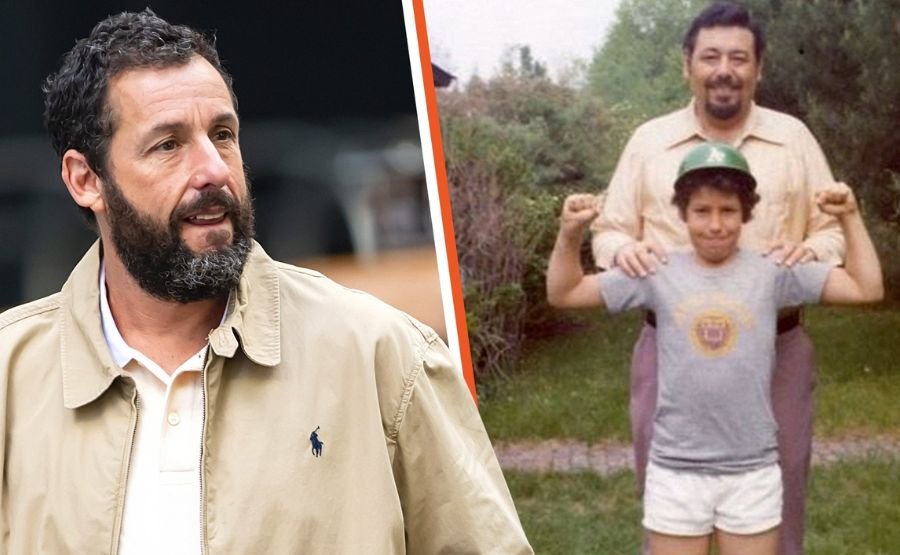
Alan Stanley Adam Sandler: A Closer Look at His Family and Personal Story
Quick Bio
| Detail | Information |
| Full Name | Adam Richard Sandler |
| Born | September 9, 1966, Brooklyn, New York |
| Nationality | American |
| Occupations | Actor, Comedian, Screenwriter, Producer, Musician |
| Known For | Billy Madison, Happy Gilmore, The Wedding Singer, Uncut Gems, SNL |
| Education | NYU Tisch School of the Arts (BFA, 1988) |
| Spouse | Jackie Sandler (née Titone), married June 2003 |
| Children | Sadie Madison Sandler (b. 2006), Sunny Madeline Sandler (b. 2008) |
| Production Company | Happy Madison Productions (founded 1999) |
| Net Worth | Approximately $440–500 million (est. 2025) |
| Major Award | American Humor Mark Twain Prize, Kennedy Center (2023) |
| Hollywood Walk of Fame | Inducted 2011 |
The Guy Who Made Loud Look Like an Art Form
Adam Sandler is one of those rare entertainers who somehow became massive despite — or maybe because of — doing almost everything the industry said you shouldn’t do. He was too silly for critics. Too lowbrow for prestige. Too loyal to his childhood friends to ever chase prestige at the expense of fun.
And yet, here he is in his late fifties, a Golden Globe nominee, a Mark Twain Prize recipient, a Netflix powerhouse worth nearly half a billion dollars, and the kind of star that directors like Noah Baumbach call first when they want genuine emotional depth on screen.
The story of how he got there is surprisingly human. It involves a boy who cracked jokes to survive a new town, a stage debut pushed by an older brother, a firing he turned into a calling card, and a dramatic pivot that left critics scrambling to recalibrate everything they’d written about him.
See also “Laura Deibel: The Quiet Force Behind a Hollywood Name“
Brooklyn Kid, New Hampshire Soul
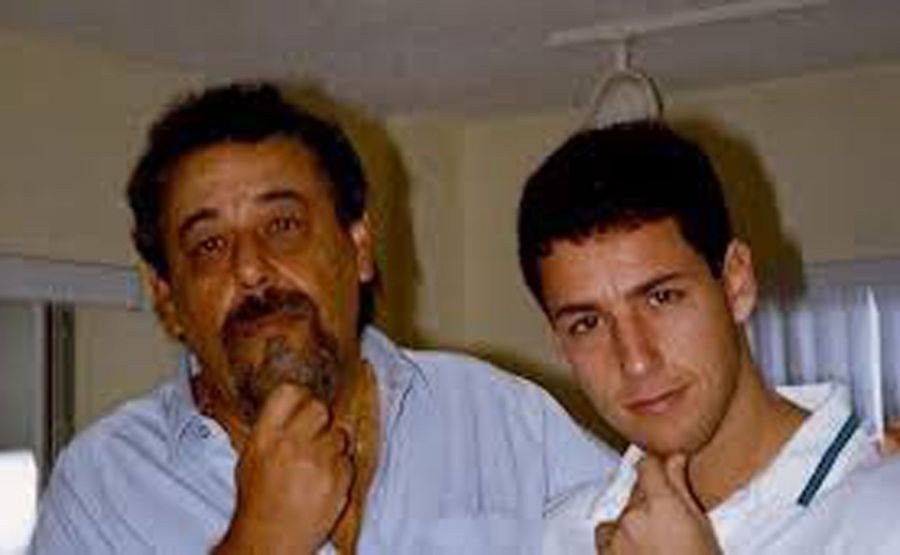
Adam Sandler entered the world on September 9, 1966, in Brooklyn, New York. His parents — Stanley, an electrical engineer, and Judith, a nursery school teacher — raised four children in a tight-knit Jewish household. Adam was the youngest.
When he was roughly six years old, the family packed up and moved to Manchester, New Hampshire. It was a significant shift. Brooklyn’s urban energy gave way to a quieter, smaller-town life, and young Adam had to find his footing in a new place where nobody knew him yet.
He found it through laughter. By middle school, he had established himself as the kid who could make the whole room lose it. It wasn’t calculated — he’s said he’s not entirely sure where it came from — but by the time he hit sixth grade, the instinct to perform and provoke laughter had already taken root.
His family was important to him in a way that would define his adult choices decades later. The Sandlers weren’t wealthy, but they were warm. Adam’s faith, his Jewish identity, and his connection to his siblings would show up again and again — in his humor, in his hiring decisions, and in the way he talked about the people who mattered most.
An Older Brother’s Dare
When Adam Sandler was seventeen, his older brother Scott pushed him toward a Boston comedy club stage. The dare, more or less, was simple: get up there and try it.
He did. And something clicked.
From that first night on, Sandler was hooked. He began performing wherever he could — clubs, colleges, anywhere that would have him. The material was raw, the delivery still forming, but the appetite for the crowd’s reaction was fully there.
After high school at Manchester Central, he enrolled at New York University’s Tisch School of the Arts — one of the most competitive performance programs in the country. It was there that he began developing not just his stagecraft, but the friendships and collaborations that would follow him throughout his career. His writing partner, Tim Herlihy, was his roommate at NYU. The two would go on to co-write more than a dozen films together.
Sandler also trained at the Lee Strasberg Theater and Film Institute, building a formal dramatic foundation that most people wouldn’t know about until decades later, when he started applying it in ways nobody expected.
He earned his Bachelor of Fine Arts in 1988 and stepped into a city that was buzzing with comedy.
The SNL Years: Chaos, Characters, and a Firing That Changed Everything
A turning point arrived when comedian Dennis Miller caught Sandler performing stand-up in Los Angeles and referred him to Lorne Michaels. That connection got him into the SNL writers’ room in 1990. A year later, he became a featured player — part of a cast generation that also included Chris Farley, Chris Rock, and David Spade.
What Sandler brought to Saturday Night Live was something genuinely unlike the show’s usual sensibility. He wrote and performed original songs that became instant audience favorites — “Lunchlady Land,” “The Thanksgiving Song,” and the now-legendary “The Chanukah Song,” which turned a cultural celebration into a comedic institution. He also created a gallery of oddball characters: Opera Man, Canteen Boy, Cajun Man — figures built on sound, rhythm, and a kind of gleeful absurdism that audiences found irresistible.
But he also developed a reputation as one of the rougher edges in the cast. Sketches that were funny in the early 1990s aged poorly. The show’s ratings slid during Season 20, and in 1995, Lorne Michaels made cuts. Sandler and Farley were both let go.
Sandler later made the firing part of his monologue when he returned to host in 2019. He turned the humiliation into comedy. That, in many ways, was always his move.
What appeared to be a setback turned into a springboard. He was already plotting his next chapter before the door closed behind him.
The Comedy Empire Takes Shape
Fresh off SNL, Sandler moved fast. Billy Madison came out in 1995, the same year he was fired. He played a grown man forced to repeat grades one through twelve. Critics savaged it. The public adored it.
It was the first real lesson Sandler received about the disconnect between what reviewers wanted and what audiences actually watched. He later recalled that he genuinely expected warm reviews — and that the harsh reception shook him. But when he looked at ticket sales and heard people quoting lines back at him, he recalibrated his compass.
Happy Gilmore followed in 1996, with Sandler playing a failed hockey player who discovers a freakishly powerful golf swing. It became a cultural staple, the kind of film that gets quoted by people who couldn’t tell you the director’s name. The Waterboy in 1998 broke October box office records at the time. The Wedding Singer, also in 1998, showed a softer side — a romantic comedy set in the 1980s that expanded his audience considerably and proved he could carry a film with genuine warmth rather than just chaos.
Big Daddy in 1999 further cemented his drawing power.
That same year, he made a move that would define the next two decades of his career. He founded Happy Madison Productions — named after two of his biggest films. The company gave him control: over scripts, over casting, over tone, over who got to come along for the ride. He used that power to hire friends and collaborators from his comedy circle, a practice that critics often interpreted as laziness and that fans often interpreted as loyalty. Both readings had some truth to them.
Turning Serious — and Turning Heads
In 2002, something unexpected happened. Director Paul Thomas Anderson — known for dense, layered, demanding cinema — cast Sandler in Punch-Drunk Love. Sandler played Barry Egan, a socially isolated man with explosive simmering anger who falls into an unlikely romance. It was a film that required stillness, vulnerability, and interior complexity.
Sandler delivered all three. Critics who had spent years dismissing him were suddenly watching him very carefully.
The Golden Globe nomination for Best Actor in a Musical or Comedy that followed was a genuine surprise to many. But Sandler moved on from the experiment, returning to familiar comedic territory rather than chasing awards.
Then came the years that tested his reputation more seriously.
The Valley: When Critics Called It Over
The early 2010s were rough. Jack and Jill in 2011 became perhaps the most notorious entry in his filmography. He played both a man and his twin sister. Critics were brutal — it swept the Razzie Awards that year, taking home every single category. It was the first film to accomplish that. The critical consensus was that Sandler had stopped trying.
He hadn’t stopped working. Films kept coming through Happy Madison — quickly made, broadly marketed, and frequently mocked. Some were genuinely funny. Many were not. Audiences still showed up, but the mainstream cultural conversation around his name had shifted from affection to something closer to exasperation.
It was a real career valley, not a manufactured one. The question wasn’t whether Sandler cared about the criticism — he’s acknowledged it stung — but whether he’d do anything different.
The Netflix Bet — and the Biggest Gamble of His Career
In 2014, Sandler looked at the entertainment landscape and made a bet that most of Hollywood thought was strange. He signed a four-film deal with Netflix — then still seen primarily as a DVD-by-mail company that had gotten lucky with streaming — for a reported $250 million.
People laughed. Not in a good way.
Sandler laughed too, eventually — because the deal was prescient. His Netflix films, whatever critics thought of them, were watched by enormous numbers of people. The platform reported hundreds of millions of viewing hours across his catalog. The deal was renewed, then renewed again. The cumulative value of his Netflix relationship across all agreements has been estimated to exceed $500 million.
Then, in 2019, everything shifted again. The Safdie brothers — Josh and Benny — cast him as Howard Ratner, a diamond-district jeweler in New York City who is addicted to gambling and perpetually one bad decision away from catastrophe. Uncut Gems is a film that operates at a near-constant state of controlled panic. Sandler was in almost every scene, shouting, pleading, negotiating, charming, and slowly unraveling.
The performance drew some of the most rapturous praise of any film that year. He received the Best Actor award from the National Board of Review. Critics who had written him off for a decade were now writing apologies — or at least revisions. He won the Independent Spirit Award for Best Actor.
The Academy famously did not nominate him. When asked about it, Sandler told Howard Stern he would respond by making a film “so bad on purpose” to punish them. It was a joke. Mostly.
Family: The Constant in an Unpredictable Life
In 1999, on the set of Big Daddy, Sandler met Jackie Titone — she was playing a waitress in the film. They started dating for the remainder of his life.
They married in June 2003 in Malibu. Their first daughter, Sadie Madison, arrived in May 2006. Sunny Madeline followed in November 2008.
Sandler has spoken about his family in ways that feel unusually sincere, even by Hollywood standards. He has said the secret to his long marriage is simply that he and Jackie genuinely enjoy each other’s company — not a complicated formula, but apparently a working one. In 2023, he marked their twentieth wedding anniversary by sharing a wedding photo and the note: “Your ‘I do’ was the best gift of my life.”
Both daughters have appeared in his films over the years, including a joint starring turn in the 2023 Netflix film You Are So Not Invited to My Bat Mitzvah. The overlap between his professional and personal life is not accidental — he has always made space for his family on set, in casting, in the fabric of what he makes.
Jackie has appeared in numerous Sandler productions across more than two decades. It’s a working partnership as much as a personal one, and it seems to suit both of them fine.
What He’s Worth — and How He Built It
Adam Sandler’s net worth is estimated at approximately $440 to $500 million as of 2025, depending on the source. The number is legitimately enormous, and understanding how it happened requires looking past any one film.
His box office films from the 1990s and early 2000s accumulated over $2 billion in global receipts combined. He was earning upwards of $20 million per film, and on some projects — including Anger Management in 2003 — his backend percentage of gross profits pushed his total payout dramatically higher.
Happy Madison Productions adds another layer. Rather than simply acting for hire, Sandler owns the company that produces much of his output. That means producer fees, ownership of intellectual property, and a financial stake in how well each project performs — all flowing back to him at every stage.
The Netflix relationship completed the picture. That initial $250 million deal, plus subsequent renewals and backend participation, represents one of the most financially successful partnerships in the history of streaming. His films drive hours watched in a way that matters to Netflix’s internal metrics, and the platform has rewarded that loyalty accordingly.
He also tours as a stand-up comedian, with high-profile shows commanding fees in the hundreds of thousands per appearance.
Recognition — Finally, Officially
In 2011, Sandler received a star on the Hollywood Walk of Fame. It was nice. The whole picture was not fully captured.
The more meaningful recognition came in 2023, when he was awarded the Kennedy Center Mark Twain Prize for American Humor — the most prestigious honor in American comedy. The evening, broadcast on Netflix, featured tributes from Steve Buscemi, David Spade, Conan O’Brien, and others. Steve Buscemi told him: “Nobody makes me laugh like you and nobody has taken better care of me in this business than you.” It was that second part — the loyalty, the generosity, the decency — that kept coming up across the night.
Hustle in 2022, a Netflix drama in which Sandler plays a basketball scout who discovers an undiscovered player in Spain, earned him further dramatic recognition and showcased his genuine love of the sport. Basketball is not just a prop for him — it’s a real, daily part of his life.
Where He Stands Now
In 2025, Sandler released two very different films — and somehow both of them worked.
Happy Gilmore 2 arrived on Netflix on July 25, 2025, nearly three decades after the original. It was nostalgia delivered with commercial precision. His daughters Sadie and Sunny appeared in the film. Audiences responded warmly.
Then Jay Kelly, directed by Noah Baumbach, premiered at the Venice Film Festival in August 2025 before streaming on Netflix in December. Sandler played Ron, the devoted manager to a spiraling movie star played by George Clooney. The film is quieter, more interior, more emotionally textured than anything Sandler had made in the broad comedy lane. At Venice, he said being asked to find the scene’s truth rather than its joke felt like “a gift.” He earned a Golden Globe nomination for Best Supporting Actor for his performance.
He is sixty years old, still playing basketball regularly, still making films with his family around him, and still deciding — on his own terms — when to be funny and when to be something more.
Final Words
What makes Adam Sandler genuinely interesting is that he’s never been just one thing, despite what any given era of press coverage suggested.
He was the goofy SNL guy who got fired. He was the guy who made critics groan and audiences roar. He was the guy who surprised everyone with Punch-Drunk Love, then went back to making goofball comedies anyway. He was the guy who signed with Netflix when it looked ridiculous. He was the guy who finally got his dramatic due with Uncut Gems, and then threatened to respond to the Oscar snub with an intentionally terrible film.
There is a coherence underneath all of it, though. He has always prioritized the people around him — his family, his friends, his creative collaborators. He has always operated from a place of instinct rather than calculation. He has always made the thing he wanted to make, for the audience he knew would show up, and let the critics figure out what to do with that.
The Mark Twain Prize crowd at the Kennedy Center understood it. The long-running and genuinely happy marriage understands it. His daughters, who now act alongside him and are building their own careers, understand it.
Adam Sandler made the industry bend to his terms, not the other way around. That’s a rarer achievement than any single award can capture.
FAQs
1. Where was Adam Sandler born and where did he grow up?
He was born on September 9, 1966, in Brooklyn, New York. His family relocated to Manchester, New Hampshire when he was around six years old, and he spent most of his childhood and teenage years there before heading to NYU.
2. What degree does Adam Sandler have, and where did he study?
He earned a Bachelor of Fine Arts from New York University’s prestigious Tisch School of the Arts in 1988. He also trained at the Lee Strasberg Theater and Film Institute, which gave him a formal foundation in dramatic performance.
3. How did Adam Sandler first get into comedy?
His older brother Scott dared him to get on stage at a comedy club in Boston when he was seventeen. He did — and immediately knew this was what he wanted to do. He spent his teens and early twenties performing wherever he could.
4. How did Adam Sandler end up on Saturday Night Live?
Comedian Dennis Miller saw Sandler performing stand-up in Los Angeles and referred him directly to Lorne Michaels. Sandler joined the writing staff in 1990 and became a featured cast member in 1991. He remained until 1995.
5. Why was Adam Sandler fired from SNL?
During Season 20 of Saturday Night Live, ratings dipped significantly and the show went through a major cast overhaul. Sandler and Chris Farley were among those let go. Sandler has since said the firing was a shock at the time, but he channeled it into his film career almost immediately.
6. What are Adam Sandler’s most successful films?
His biggest box office comedies include Billy Madison (1995), Happy Gilmore (1996), The Waterboy (1998), The Wedding Singer (1998), and Big Daddy (1999). His most critically acclaimed performances came in Punch-Drunk Love (2002) and Uncut Gems (2019). His Netflix output, including Murder Mystery and Happy Gilmore 2, has driven enormous streaming numbers.
7. What is Happy Madison Productions?
It’s the film and television production company Sandler founded in 1999. The name blends Happy Gilmore and Billy Madison. The company gives Sandler creative control over his projects and serves as the production hub for most of his Netflix content, significantly boosting his income beyond what he earns as an actor alone.
8. Who is Jackie Sandler, and how did they meet?
Jackie Sandler (née Jacqueline Titone) is an actress and model. She and Adam met on the set of Big Daddy in 1999, where she was playing a waitress. They began dating and married in June 2003 in Malibu. She has appeared in many of his productions over the years.
9. Does Adam Sandler have children?
Yes. He and Jackie have two daughters: Sadie Madison, born in May 2006, and Sunny Madeline, born in November 2008. Both have appeared in their father’s films, and in 2023 they starred alongside him in You Are So Not Invited to My Bat Mitzvah on Netflix. Sunny also appeared in Happy Gilmore 2 in 2025.
10. Why did Uncut Gems matter so much for Sandler’s reputation?
Uncut Gems (2019), directed by the Safdie brothers, showed Sandler in a dramatic role completely unlike anything audiences associated with him. His portrayal of a desperate, fast-talking jeweler in a spiral of gambling debt was widely described as the best performance of his career. He won the National Board of Review’s Best Actor award and the Independent Spirit Award, though the Oscars did not nominate him — a snub that became something of a running cultural conversation.
11. How much is Adam Sandler worth, and how did he build that wealth?
His net worth is estimated at around $440–500 million as of 2025. It was built through decades of box office hits, backend profit participation in his own films, his ownership of Happy Madison Productions, and an enormously lucrative multi-deal relationship with Netflix worth over $250 million in its first iteration, with subsequent renewals adding considerably more. Stand-up touring also contributes meaningfully to his annual income.
12. What has Adam Sandler been doing most recently?
In 2025, he released Happy Gilmore 2 on Netflix, a long-awaited sequel that brought back his iconic golf-playing character. He also starred in Noah Baumbach’s Jay Kelly, a dramatic comedy opposite George Clooney that premiered at the Venice Film Festival, earning Sandler a Golden Globe nomination for Best Supporting Actor. He received the Kennedy Center’s Mark Twain Prize for American Humor in 2023 — the most significant formal recognition of his career. And his daughters are now actively building their own acting careers, partly through Happy Madison’s pipeline.
Explore stories that inspire curiosity with The Imperial Magazine.