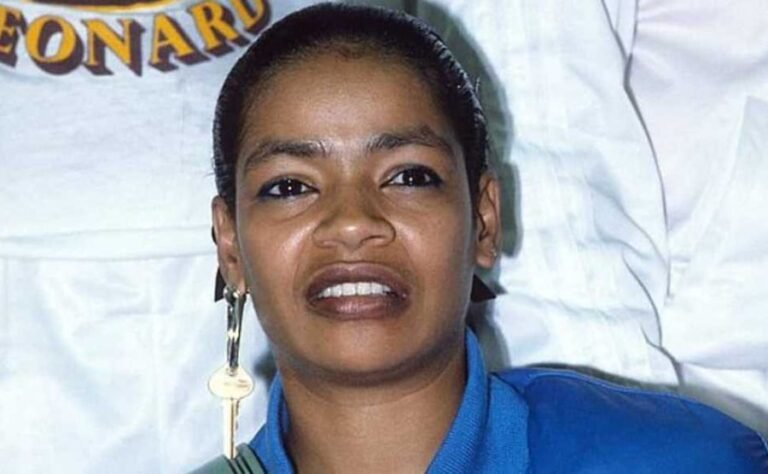
Julianna Farrait: The Puerto Rican Beauty Who Became One of America’s Most Notorious Women
Quick Bio
| Detail | Info |
| Full Name | Julianna Farrait Rodriguez |
| Born | circa 1941, Puerto Rico |
| Nationality | Puerto Rican-American |
| Occupation | Former homemaker; convicted drug trafficker |
| Known For | Wife of Harlem drug kingpin Frank Lucas; convicted drug trafficking (1975 and 2010); inspiration for the character “Eva” in the film American Gangster (2007) |
| Spouse | Frank Lucas (married 1967; died May 30, 2019) |
| Children | Seven (including Francine Lucas-Sinclair, Frank Lucas Jr., Ray Lucas) |
| Estimated Net Worth | ~$1.5 million |
| Film Portrayal | Played by Puerto Rican actress Lymari Nadal in American Gangster (dir. Ridley Scott, 2007) |
A Life Written in Headlines Nobody Expected
Some people enter the public consciousness through talent, ambition, or achievement. Others get there by standing in the wrong place at the wrong time — or by making choices that carve a path nobody could have predicted from the outside.
Julianna Farrait did both.
She came from Puerto Rico with looks that turned heads and a life that, at least on the surface, pointed toward something ordinary. Then she met Frank Lucas on a flight heading north. And from that moment, everything that might have been predictable about her future went out the window.
Her story sits at the center of one of the most extraordinary chapters in American organized crime history. She is the woman behind the fur coat. She is the figure whom Hollywood cast as a glamorous accomplice. She is also a woman who served prison time — not once, but twice — and who watched the man she spent her life with die quietly in New Jersey at the age of 88. She has outlived the empire, the reputation, and, eventually, the man who built it all.
This is her story, told on its own terms.
See also “Marisela Vallejos Félix: The Individual Who Survived Two Losses“
Growing Up in Puerto Rico
Not much has filtered out about Julianna Farrait’s earliest years. She keeps her past locked tight, which tracks with someone who has spent much of her adult life either avoiding scrutiny or enduring it in courtrooms.
What’s known is this: she was born around 1941, somewhere on the island of Puerto Rico. Her family was reportedly comfortable — not wealthy in the way she would later experience wealth, but stable and respectable. She came up in a household where her needs were met and where a girl with her natural confidence and looks had a future that seemed, from the outside at least, straightforward.
By the time she reached high school, Julianna was someone people noticed. She was elected homecoming queen during her school years — a moment of recognition that would later get embellished into something it wasn’t. The 2007 film about her husband’s life would portray her as a former Miss Puerto Rico. That’s Hollywood adding a gloss that reality didn’t actually need. Homecoming queen was real. Miss Puerto Rico was not. She never appeared on any official list for the pageant.
Still, the fact that people felt the need to upgrade her backstory says something. Julianna Farrait was the kind of woman who commanded rooms. The title they invented for her wasn’t far off from the impression she actually made.

The Encounter That Changed Everything
The story of how Julianna met Frank Lucas has been told in a few different versions over the years, depending on who’s doing the telling. What the most reliable accounts agree on is this: it happened in the early 1960s, when Frank was traveling to or from Puerto Rico. She was on a flight. He was on the same flight. Frank Lucas, who by that point had already absorbed the criminal education of legendary Harlem gangster Bumpy Johnson and was starting to build his own operation, apparently didn’t need long to make his intentions known.
Frank later described Julianna in his memoir as someone he had to work to impress. She had simple tastes when he found her, he wrote. She wasn’t particularly interested in flashy displays of wealth. That, of course, would change — partly because of who she married and partly because of the world that marriage pulled her into.
The connection between them was immediate and serious. By 1967, they were married. Julianna became Julie Lucas, and that name would carry a weight she couldn’t have fully anticipated on the day she took it.
Life Inside the Empire
By the late 1960s, Frank Lucas had done something that nobody in Harlem’s drug world had quite managed before. He cut out the Italian mob middlemen who typically controlled heroin distribution and went directly to suppliers in Southeast Asia. The product that came back — which his operation branded as “Blue Magic” — was significantly more potent than what competitors were selling, and priced competitively. The result was an operation that generated, at its peak, staggering sums of money. Frank later claimed his income sometimes hit $1 million a day during the best periods.
And Julianna was right there, living inside all of it.
The family settled in Teaneck, New Jersey — a respectable suburban address that Frank chose deliberately, wanting distance from the streets where his product was sold. The house was well-furnished, the lifestyle was lavish, and Julianna inhabited that world fully. She wore the clothes, wore the jewelry, attended the events. She also, over time, became genuinely enmeshed in the criminal operation rather than simply adjacent to it. She helped manage money. She played a practical role in the logistics of a very illegal business.
But the moment that would define her public image forever happened at a boxing match.
Sometime around 1970-1971, the couple attended a Muhammad Ali bout. Julianna had gifted Frank a full-length chinchilla fur coat — an extraordinary piece that cost in the range of $125,000 — along with a matching hat that added another $40,000 or so to the total. Frank wore it. He wore it proudly, in a room full of people, including people who made it their professional business to track where large amounts of criminal money were going.
The coat became famous for exactly the wrong reasons. Law enforcement didn’t miss it. The image of Frank Lucas wearing that coat would become one of the most recognizable photographs associated with Harlem’s drug era, and it essentially drew a bright line between the Lucas family and the attention they would soon receive.
Julianna, reportedly, had noticed other men in that room wearing expensive fur and decided her husband should look just as powerful. It was an impulse born from loyalty and from a taste for the spectacular that their circumstances made possible. It was also, in retrospect, one of the contributing factors to the heat that eventually brought everything down.
January 28, 1975: The Raid
The DEA and NYPD had been building their case on Frank Lucas for years. On January 28, 1975, they came to the door in Teaneck.
Officers hit the house and found more than $584,000 in cash. Frank was arrested. Julianna was taken in as well. The empire that had seemed impenetrable for years collapsed in a single morning.
Frank was ultimately convicted and sentenced to 70 years in federal prison — a number that sounds almost theatrical. Julianna faced her own charges and ultimately served approximately four and a half to five years. The children — particularly their young daughter Francine, who was about three years old during the raid — were caught in the wreckage. The family’s wealth was seized. The suburban house became a memory.
Then Frank, facing decades behind bars, made a choice that was predictable but still seismic: he cooperated with federal authorities. He named names. He provided information that led to more than a hundred drug-related convictions, including, devastatingly, those of law enforcement officers who had been on his payroll.
That cooperation changed Julianna’s situation significantly. When Frank began naming people in law enforcement, the danger level for his family shot up dramatically. Julianna and daughter Francine were placed in the federal witness protection program — a disorienting and isolated existence that stripped away the last remnants of the life they’d known. Francine would later speak about that period as deeply traumatic, a childhood defined by secrecy and instability.
Frank’s sentence was dramatically reduced. He was eventually released in 1981 — serving far less than the 70 years originally handed down. Julianna, after finishing her own time, had retreated to Puerto Rico with Francine. When Frank was free, the couple reunited on the island and eventually made their way back to New Jersey together, picking up the pieces of something that had been shattered in a very public and very permanent way.

The Film and the Character Who Looked Like Her
In 2007, director Ridley Scott released American Gangster, a crime epic starring Denzel Washington as Frank Lucas and Russell Crowe as the determined prosecutor who brought him down. The film was a major Hollywood production — Academy Award nominations, wide release, the whole thing.
Julianna was rendered on screen as “Eva,” played by Puerto Rican actress Lymari Nadal. The film portrayed Eva as a former Miss Puerto Rico — that fabrication again — and depicted her as a woman who was both devoted to Frank and fully aware of what he was doing. In some ways the portrayal captured the complexity of her real position. In others it smoothed over the harder truths.
Frank was paid as a consultant for the film and was happy enough to talk publicly about his life. Julianna stayed out of it. She gave no interviews to promote the movie, made no appearances tied to its release, and said very little publicly about watching someone else inhabit her life on screen.
What the film did, whatever Julianna thought of it, was bring her story back into the national conversation. A new generation of viewers encountered the Lucas legend. And many of them eventually went looking for the real woman behind the fictional Eva.
The Second Arrest: Puerto Rico, 2010
What happened in May 2010 shocked even people who knew Julianna’s history.
She was approximately 70 years old. Frank was in his late 70s. The drug trade that had consumed the best years of their lives was decades in the past. It seemed — to outside observers, at least — that the story was over. That they had both paid their debts to the justice system and were living out whatever remained of their years in relative quiet.
On May 19, 2010, DEA agents set up a sting operation in the Isla Verde district of Carolina, Puerto Rico. According to federal records, Julianna had been recorded in a conversation on May 11 telling an informant that she had two kilograms of cocaine available and that another associate had additional quantities. When she showed up to complete the sale at a hotel room, DEA agents were there waiting.
She was arrested, escorted out of the building, and photographed being taken to the federal courthouse in San Juan. The images of a 70-year-old woman in DEA custody ran in newspapers and news sites across the country. DEA Special Agent in Charge John Gilbride offered the quote that would be attached to virtually every news story: “Like in the movie, Frank Lucas was known to have made millions peddling heroin throughout New York City.”
Life, Gilbride was essentially saying, had imitated art.
Julianna said almost nothing in court. She asked to speak in Spanish and declined to make any statement beyond that. She was eventually sentenced to five years in federal prison, a term she would serve in her seventies.
Frank was not implicated in the 2010 arrest. He had been out of the drug business for years and, by that point, had become something of a public figure — making appearances, giving interviews, trying to package his past as something worth talking about now that he couldn’t be prosecuted for it.
Children, Fractures, and Francine
The seven children who grew up in and around the Lucas household carried the weight of their family’s story in different ways. The three Julianna bore with Frank — Francine, Frank Jr., and Ray — had the closest exposure to the chaos, and Francine’s path in particular became a matter of public record.
Francine Lucas-Sinclair was three years old during the 1975 raid. She spent a stretch of her childhood in the witness protection program. She later spoke with real candor about the experience of growing up as the daughter of Frank Lucas — about the depression, the instability, the confusion of being yanked between ordinary life and something that was anything but. She eventually became a mortgage broker. She also founded an organization called Yellow Brick Road, specifically aimed at helping children whose parents are incarcerated — working from the inside knowledge of exactly what that experience does to a young person.
Francine’s oldest son went on to become an actor in Hollywood. The family’s story, it turned out, had more than one chapter.
Julianna’s relationship with her children during the years of her own imprisonment and the disruptions of witness protection strained bonds that must have already been complicated. Raising a family inside that world, and then watching it disintegrate, leaves marks that don’t go away easily.
Money: What Remained After the Seizures
At the height of Frank Lucas’s operation, the household income was almost incomprehensible. Frank boasted of having $52 million in offshore bank accounts at one point. The property holdings stretched across multiple cities — New York, New Jersey, Chicago, Miami, Detroit, and Puerto Rico. The cash that agents found in the Teaneck house was more than half a million dollars, and that was what they found. Frank later claimed $11 million had been temporarily stashed in the attic at the time.
All of that evaporated in the wake of the 1975 arrests. Asset seizures, legal costs, and the practical realities of incarceration dismantled the fortune almost completely. What survived was a fraction.
After the 2010 arrest and imprisonment, another round of legal expenses and the financial burdens of a second prison term further eroded whatever remained.
Julianna Farrait’s net worth is estimated today at roughly $1.5 million — a figure that reflects whatever could be salvaged and maintained over the decades since the empire fell. That’s a significant comedown from the world she once occupied, but it’s also a reflection of someone who managed to preserve something through a series of catastrophic events.
Frank died with a net worth estimated by Celebrity Net Worth at around $500,000 — a humbling endpoint for a man who once claimed to have cleared more than a million dollars in a single day.
Frank’s Death and What Came After
Frank Lucas died on May 30, 2019, in Cedar Grove, New Jersey. He was 88 years old. A car accident years earlier had broken his legs and confined him to a wheelchair, and the final chapter of his life was quiet in a way that bore no resemblance to the decades that preceded it.
Julianna was at his side. Photographs from the funeral showed her alongside Frank Lucas Jr. at St. Luke African Methodist Episcopal Church. She had stayed with him — through the first prison sentences, through witness protection, through her own second arrest, through the long strange decades of public fascination and legal scrutiny — and she was still there at the end.
After his death, she receded further from public view. She is reported to still be living, in New Jersey, in a life that has become as private as the earlier years of it were spectacularly exposed.
See also “Marisela Vallejos Félix: The Individual Who Survived Two Losses“
Final Words
Julianna Farrait’s story resists easy summary. She was not simply a bystander to her husband’s crimes — the evidence makes clear that she was an active participant, that she understood what the money came from and made choices accordingly. Her 2010 arrest, when she was 70 years old and long past any reasonable justification of need or circumstance, makes that clear in the starkest possible terms.
But she was also a young woman from Puerto Rico who fell into something much larger than she could have fully understood at the start. She was someone who lost years of her life to prison, who watched her children grow up through a lens of instability and legal chaos, and who somehow stayed attached to the man at the center of it all through nearly six decades of upheaval.
What makes her distinctive, ultimately, is not the glamour — though there was genuine glamour there. It’s the tenacity. The stubbornness to endure, whether you think of that as admirable or troubling. She did not disappear quietly after 1975. She did not reform and give speeches. She lived her life on terms that were entirely her own, consequences included.
Hollywood gave her a cleaner story. A beauty queen, a devoted wife, a woman swept up in something larger than herself. The truth is messier and more human than that. She made choices. She paid for them. And she is, by most recent accounts, still here.
FAQs
1. Who is Julianna Farrait?
Julianna Farrait, also known as Julie Farrait or Julie Lucas, is the widow of Frank Lucas — the Harlem-based heroin kingpin whose operations in the late 1960s and 1970s made him one of the most powerful drug traffickers in American history. She was actively involved in the criminal operation and was convicted of drug-related offenses twice: in connection with the 1975 bust of their New Jersey home, and again in 2010 when she was arrested in Puerto Rico for attempting to sell cocaine to an undercover informant.
2. Where was Julianna Farrait born?
She was born around 1941 in Puerto Rico, likely in or near San Juan, though precise details of her early life are not well documented. She grew up on the island and attended school there before her life took a dramatic turn following her meeting with Frank Lucas.
3. Was Julianna Farrait really Miss Puerto Rico?
No. The 2007 film American Gangster portrayed her character as a former Miss Puerto Rico, but that was a Hollywood embellishment. In reality, Julianna was a homecoming queen during her high school years in Puerto Rico — a meaningful distinction she has never appeared on any official Miss Puerto Rico list.
4. How did Julianna Farrait meet Frank Lucas?
They met when Frank was traveling to or from Puerto Rico, crossing paths on a flight. Frank Lucas, who was already building his criminal network in Harlem, was immediately drawn to her. They married in 1967.
5. What was the famous chinchilla coat incident?
Around 1970-71, Julianna gave Frank a full-length chinchilla fur coat worth approximately $125,000, along with a matching hat costing around $40,000, as a gift. Frank wore the coat to a Muhammad Ali boxing match, drawing immediate attention from law enforcement. The coat became iconic in accounts of the Lucas story, symbolizing both the extraordinary wealth they had accumulated and the recklessness that ultimately contributed to their downfall.
6. How was Julianna Farrait involved in Frank Lucas’s drug empire?
She was more than a passive beneficiary. She helped manage money, participated in the financial logistics of the operation, and was present during major periods of the empire’s activity. She was arrested during the 1975 raid on their Teaneck, New Jersey home and convicted in connection with the criminal enterprise, serving approximately five years.
7. What happened during the 1975 raid?
On January 28, 1975, a joint DEA and NYPD task force raided the Lucas home in Teaneck, New Jersey, seizing more than $584,000 in cash. Frank was arrested and ultimately sentenced to 70 years (later reduced dramatically after he became an informant). Julianna was also charged and served time. When Frank began cooperating with federal authorities, Julianna and their daughter Francine were placed in the witness protection program.
8. Why was Julianna arrested again in 2010?
Decades after the 1975 bust and well into her 70s, Julianna was caught in a DEA sting operation in the Isla Verde area of Carolina, Puerto Rico. She had been recorded telling an informant she had two kilograms of cocaine to sell. When she arrived at a hotel to complete the transaction, federal agents arrested her. She was sentenced to five years in prison — serving that term in her early seventies.
9. How did the film American Gangster portray her?
The 2007 Ridley Scott film, starring Denzel Washington as Frank Lucas, cast Puerto Rican actress Lymari Nadal as Julianna — renamed “Eva” in the film. She was portrayed as a former Miss Puerto Rico who married Frank and stood by him through the rise and fall of his operation. Julianna herself stayed out of the film’s promotional activities and gave no related interviews.
10. How many children did Julianna and Frank have together?
Frank Lucas fathered seven children in total. Of those, three were Julianna’s biological children: daughter Francine Lucas-Sinclair, and sons Frank Lucas Jr. and Ray Lucas. Julianna helped raise the other children as well. Francine, who was only three years old during the 1975 raid, later founded an organization called Yellow Brick Road to support children of incarcerated parents.
11. What is Julianna Farrait’s estimated net worth?
Most estimates put her current net worth at around $1.5 million. Given that the Lucas operation at its peak generated extraordinary income — Frank once claimed to be worth $52 million — the current figure reflects the massive impact of asset seizures, legal costs, and two separate prison sentences. Very little of what was once an enormous fortune survived the legal reckoning of 1975 and its aftermath.
12. Is Julianna Farrait still alive?
As of recent reports through 2025 and 2026, Julianna Farrait is still living. She would be in her mid-eighties. She attended Frank Lucas’s funeral in 2019 and has since maintained an extremely private existence, primarily in New Jersey. She has not made public statements or media appearances in recent years.
Explore stories that inspire curiosity with The Imperial Magazine.