
Mary Kathryn Muenster: The Farm Girl From Nebraska Who Became Illinois’s Most Purposeful First Lady
Quick Bio
| Detail | Info |
| Full Name | Mary Kathryn Muenster (now MK Pritzker) |
| Born | 1967, Nebraska/South Dakota area, USA |
| Nationality | American |
| Occupation | Philanthropist; former foundation director; author; First Lady of Illinois |
| Known For | First Lady of Illinois since January 2019; founder of the Evergreen Invitational equestrian charity; director of the Pritzker Family Foundation for over a decade |
| Parents | Theodore Muenster Jr. (father); Karen Nelsen Muenster (mother) |
| Siblings | Tom Muenster; Ted Muenster |
| Husband | Governor JB Pritzker (married 1993) |
| Children | Teddi Pritzker; Donny Pritzker |
| Book | A House That Made History: The Illinois Governor’s Mansion (Rizzoli, 2023) |
| Key Causes | Women’s healthcare; early childhood education; criminal justice reform; arts; LGBTQ+ advocacy |
| Estimated Net Worth | Enormous — shared wealth with JB Pritzker, one of America’s wealthiest families |
Not the Story You’d Expect
When people hear “First Lady of Illinois” and “Pritzker family,” their minds tend to go somewhere specific. They envision charity galas, manicured country clubs, inherited wealth, and a life that appears effortlessly luxurious from the outside.
Mary Kathryn Muenster is not that story. It’s not the beginning of her story, at least.
She grew up on the land. Her grandmother taught her to sew, to crochet, to bake bread from scratch, to do the books, and to care for farm animals. These weren’t hobbies — they were the skills a woman in the rural Midwest passed down because they were genuinely necessary. The girl who learned all of that in her grandmother’s kitchen eventually became the woman who would walk through the doors of Illinois’s grandest state residence and decide exactly which pieces of Abraham Lincoln’s era belonged back inside it.
Between those two moments lies a story about a woman who never stopped doing the unglamorous work — in Senate offices, in foundation boardrooms, in prison yards in central Illinois — simply because it needed doing.
That’s MK Pritzker. And she’s considerably more interesting than the title suggests.
See also “Kyle Swarber: The Barrel Man Who Refuses to Be Ordinary“
A Nebraska Beginning Built on Family and Farmland
Mary Kathryn Muenster was born in 1967 into a family rooted in the American heartland. Her birth state is listed in some sources as Nebraska and others as South Dakota — in the flat, interlocked geography of the Great Plains, families move across state lines without much fanfare, and the Muenster family appears to have had deep connections to both.
Her father was Theodore Muenster Jr., and her mother Karen Nelsen Muenster — a family of modest Midwestern character who raised their children with the understanding that you show up, you work hard, and you take care of the people around you. Mary Kathryn grew up alongside brothers Tom and Ted, a close-knit household shaped by the rhythms of rural life.
But the person who left perhaps the most lasting impression on her wasn’t a parent — it was her grandmother, Marcelene Muenster. In the family’s telling, Marcelene was the kind of woman who knew how to do everything and taught it all cheerfully. Sewing, crocheting, baking, keeping the farm accounts, tending to livestock — Marcelene passed each of these down to her granddaughter with the quiet confidence of someone who understood that competence is its own kind of power. Mary Kathryn has spoken warmly about those lessons and clearly carries them as foundational to who she became.
There is something in that upbringing — the physical work, the animal care, the domestic precision — that helps explain why she would later become an accomplished equestrian, and why the Governor’s Mansion renovation she oversaw was executed with genuine knowledge rather than delegated entirely to designers. She is, at her core, a woman who learns how things work by doing them herself.
Education and the Road to Washington
The specific details of Mary Kathryn’s undergraduate education are not widely documented in public sources, which is consistent with her general approach to personal privacy. What is documented is what came after it: a move to Washington, DC, where she entered the world of Senate politics as a staff aide.
She worked on the staff of Tom Daschle, who served as U.S. Senate Majority Leader — one of the most demanding and consequential positions in American government. She subsequently worked for Bob Kerrey, the Nebraska senator and former Governor who was himself a figure of considerable political complexity and ambition. These were not decorative positions. Senate aides at that level develop real operational knowledge of how legislation gets made, how coalitions form, and what it takes to move policy through a gridlocked system. Mary Kathryn was absorbing all of that at a period when she was still in her twenties.
She was also educated in historic decorative arts and architecture — a training that would seem like an unusual sidebar until you realize how directly it would inform one of her most significant projects as First Lady twenty-five years later.
It was during her Washington years that she met the person who would redirect the entire trajectory of her life. Not because he overwhelmed her own ambitions, but because he shared them in a way that proved genuinely complementary.
Meeting JB, and Building a Life Committed to Something
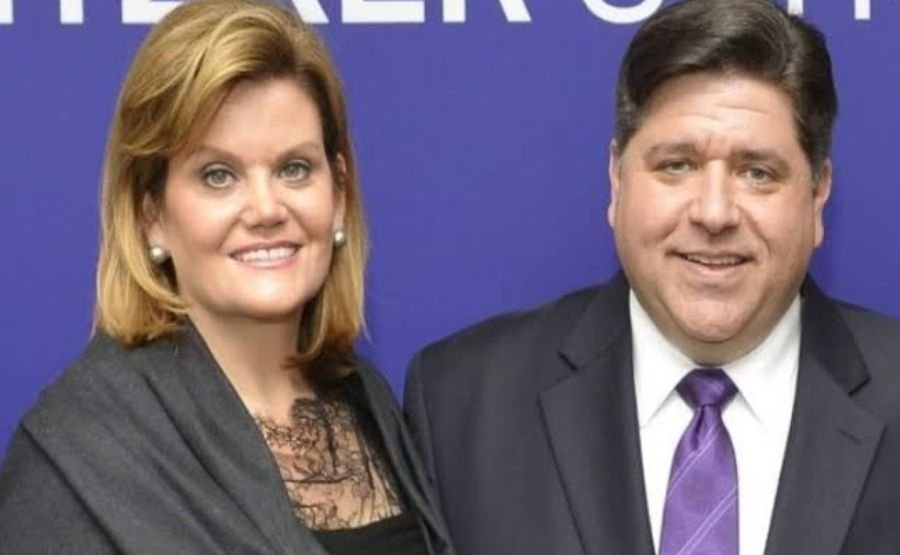
The meeting between Mary Kathryn Muenster and Jay Robert Pritzker happened in Washington, DC — two ambitious young people from very different backgrounds crossing paths in the particular crucible of the Capitol. JB came from one of America’s wealthiest and most prominent families, a Chicago dynasty that had built fortunes in hospitality and business and developed deep roots in philanthropy and Democratic politics. Mary Kathryn came from a Nebraska farm and a Senate staff job.
What they apparently recognised in each other was a shared sense of purpose — a conviction that wealth and position come with genuine obligations, not just opportunities. They married in 1993 and moved to Chicago, where JB was building his career in business and early venture capital, and where Mary Kathryn would find the platform to build something significant of her own.
Their two children, Teddi and Donny, grew up in the Gold Coast neighbourhood of Chicago, inheriting a household that combined the Pritzker family’s philanthropic culture with their mother’s Midwestern work ethic. Both children have followed their parents into equestrian sports, which speaks to the passion their mother brought to that discipline and the family culture she helped create.
A Decade at the Pritzker Family Foundation: Where She Built Her Real Career
For over a decade before her husband ever ran for public office, Mary Kathryn Muenster Pritzker served as a director of the Pritzker Family Foundation — and this is where her independent professional legacy was genuinely built, long before anyone was referring to her as First Lady.
Under her leadership, the foundation directed its resources toward two primary areas: early childhood development and women’s health. These aren’t buzzwords in the Pritzker Foundation context — they translate to real institutional commitments. The foundation supported the Pritzker Consortium on Early Childhood Development, the First Five Years Fund, the Ounce of Prevention Fund, Erie Family Health, and Lawndale Christian Health, among others. These are organisations doing on-the-ground work in communities across Illinois and beyond, and the foundation’s support gave them the kind of sustained backing that allows real programmatic development rather than one-off donations.
MK was also significantly involved in shaping the strategic direction of Northwestern Pritzker School of Law when the family’s landmark $100 million gift to the institution was being planned. The gift was enormous, but its design — with specific emphasis on social justice clinics, entrepreneurship, civil rights scholarships, and human rights initiatives — reflects the values Mary Kathryn had been developing and advocating for across her entire career.
Simultaneously, she was building something that nobody expected a philanthropist to build: a horse show.

The Evergreen Invitational: Turning Equestrian Passion Into Healthcare Funding
Here is the part of the story that genuinely surprises people. Mary Kathryn Muenster is a serious competitive equestrian — not a dilettante who sits elegantly on a horse at charity events, but someone with genuine competitive involvement in show jumping. And rather than keeping that passion and her philanthropic work in separate compartments, she found a way to connect them.
She founded the Evergreen Invitational, a fully sanctioned nonprofit equestrian show jumping competition — the kind of event that serious riders actually enter because the competition is real and the courses are legitimate. And she organised it as a fundraising vehicle for women’s healthcare at Northwestern Memorial Hospital. Over time, the event raised more than six million dollars for those initiatives. Six million dollars, raised through horse shows, directed entirely toward women’s health.
It’s one of the more creative and personal philanthropic constructions you’ll encounter — someone who looked at something she loved, something she had expertise in, and found a way to make it generate lasting benefit for people who had never heard of the Evergreen Invitational and never would. That combination of personal passion and social purpose is genuinely characteristic of the way she operates.
January 2019: The Role That Changed Everything Again
When JB Pritzker won the Illinois governorship and was inaugurated on January 14, 2019, Mary Kathryn Muenster officially became the First Lady of Illinois — a role that carries no formal responsibilities, no salary, and no job description, but which an occupant can shape into almost anything depending on what they bring to it.
What she brought to it was considerable.
She arrived with a decade of foundation leadership behind her, deep expertise in early childhood policy and women’s health advocacy, a background in historic architecture and decorative arts, a network in legal education and social justice organisations, and the particular quiet intensity of someone who has always done more than the situation required.
Her priorities as First Lady were clear and consistent from the start: expanding access to reproductive healthcare, building restorative criminal justice programmes for women behind bars, supporting LGBTQ+ communities, and promoting the arts. These weren’t abstract commitments. She went to the prisons. Without press coverage, without photographers, she visited correctional facilities across Illinois to speak directly with incarcerated women — to listen to their stories, understand the gaps in the system, and bring that knowledge back to the organisations she supported, particularly the Women’s Justice Institute.
During COVID-19, when Illinois’s arts community was facing catastrophic losses, she co-chaired the Arts for Illinois Relief Fund, helping mobilise support for the state’s creative sector at a moment of genuine crisis. She also revived the Illinois Poet Laureate programme, bringing a cultural role back to formal state recognition.
Restoring the Mansion and Writing the Book
One of her most visible and lasting projects as First Lady has been the ongoing curation and restoration of the Illinois Governor’s Mansion in Springfield — a historic Italianate-Greek Revival structure that has housed governors since 1855 and counts Abraham Lincoln among the remarkable figures who walked its rooms.
MK approached the project with the knowledge she had built through her education in historic decorative arts. She sourced Illinois art and historic furniture, worked with designer Michael S. Smith — the same designer who oversaw the Obama White House interiors — and created a residence that functions as a genuine museum of Illinois cultural history as much as a working state home. One hallway features a striking corn-motif wallcovering celebrating the state’s agricultural heritage. She tracked down forty photographs of former Illinois First Ladies from the mansion’s attic and had them reframed and hung properly. She archived recipes from historical first ladies’ cookbooks, including a Mary Todd Lincoln almond cake recipe now served at official dinners.
In 2023, she published the fruit of that work: A House That Made History: The Illinois Governor’s Mansion, Legacy of an Architectural Treasure, released by Rizzoli — one of the world’s most prestigious art and architecture publishers. It is a genuine book by a knowledgeable author, not a vanity project, covering the mansion’s history from its 1855 opening through the contemporary restoration with the depth that only someone who spent years immersed in the project could provide.
She also brought women from the Decatur Correctional Center to help with seasonal decorating at the mansion — a quietly radical act that connected her prison advocacy work to her role as the state’s official hostess in the most literal way possible.
Personal Life and the Partnership at the Centre of It All
Mary Kathryn and JB Pritzker have described themselves as genuine partners in a specific sense — not merely a political couple performing partnership for cameras, but two people who have been working toward aligned goals since before he entered public life.
She has spoken with warmth about their “vastly different backgrounds growing up” — the Midwestern farm kid and the Chicago billionaire dynasty heir — and described their shared conviction that “everybody counts, especially fighting for the voiceless and the powerless” as the connective tissue of their partnership. The marriage of more than thirty years has produced two children and an observable consistency of purpose that cuts through both of their biographies.
She has no active social media presence, which in the current era of obligatory personal branding is itself a statement of values.
Hardships and the Challenges of Philanthropic Leadership at Scale
Mary Kathryn’s career has not been without difficulty, though the challenges she has faced are of a particular kind — the grinding frustrations of trying to move systems that resist movement.
Criminal justice reform for women is not a field that yields quick victories. Illinois’s prison system, like those of most states, was built around assumptions and structures that weren’t designed with women in mind, and reshaping the programme environments, the re-entry support, the healthcare access, and the legal frameworks that govern women’s incarceration takes years of sustained pressure from multiple directions. The Women’s Justice Institute and the other organisations she has supported are doing important work against substantial institutional inertia.
The COVID years brought their own demands — co-chairing a major arts relief fund while serving as First Lady during a public health emergency, without in-person events, with a closed Governor’s Mansion, required a complete rethinking of how to do the job.
And throughout her public role, she has had to navigate the particular dynamic of being a woman with her own substantive identity and history who is nonetheless constantly introduced as someone’s wife, described in relation to someone else’s career. She has handled that with a consistent directness — focusing on the work, articulating her own priorities, maintaining her independence — that speaks to someone who decided long ago not to wait for permission to have an agenda.
Net Worth: The Honest Picture
Mary Kathryn Muenster’s financial circumstances are, to put it plainly, among the most substantial of any First Lady in American history. Her husband JB Pritzker’s net worth has been estimated at around $3.5 billion, making him one of the wealthiest elected officials in the country. The Pritzker family fortune, accumulated across generations through the Hyatt Hotel empire and diverse business investments, places the family in the upper echelon of American wealth.
Mary Kathryn has a career in public service and philanthropy rather than business, hence she does not have a separate, independently acquired fortune in the traditional sense. Her independent contribution is of a different kind: the governance of a major foundation, the strategic direction of significant philanthropic investments, and the creation of charitable vehicles that have generated millions of dollars for causes she has championed.
The Pritzker Family Foundation is a private family foundation whose endowment is not publicly disclosed, but whose grantmaking across early childhood education and women’s health represents tens of millions of dollars of cumulative investment. MK was the director of that foundation for over a decade. That is substantive institutional leadership by any measure.
Where She Is Now
As of 2026, MK Pritzker remains First Lady of Illinois, continuing the advocacy priorities she established at the outset of her husband’s administration and expanded across two terms. She continues to support organisations working on women’s incarceration and re-entry, reproductive healthcare access, arts funding, and early childhood development.
Her 2023 book A House That Made History added “author” to a list of identities that already included philanthropist, equestrian, foundation director, historic preservationist, and First Lady. She continues to work on the Governor’s Mansion’s ongoing curation and maintenance as a living repository of Illinois cultural heritage.
She remains an active equestrian. She lives without social media. She continues to do the unglamorous work — visiting prisons, sitting with policy organisations, reviewing foundation reports — that rarely generates headlines but consistently generates change.
The Nebraskan farm girl who learned how to crochet, maintain the books, and take care of the animals at her grandmother’s knee is still basically doing the same thing: turning up and completing the tasks at hand.
Final Words
What makes Mary Kathryn Muenster genuinely distinctive is not the title or the resources — it’s the consistency. The same qualities visible in the young woman who took a Senate staff job in Washington to actually learn how government works are visible in the First Lady who walked through Illinois prison gates to learn how incarceration actually feels for the women living it.
She has never mistaken access for accomplishment. The Pritzker name and the Governor’s Mansion are platforms, and she has treated them as such — as tools for doing specific, substantive things rather than as ends in themselves. The Evergreen Invitational is a perfect emblem of her approach: take something you genuinely love, build it into something real, make it serve people who need the money it generates.
She grew up learning that useful skills are transferable. Sewing, animal husbandry, bookkeeping — and later, Senate procedure, foundation governance, historic preservation, and criminal justice advocacy. Every skill in the service of whatever the situation actually requires.
That’s the story of Mary Kathryn Muenster. It started on a farm in the Great Plains, and it’s still going strong.
FAQs
1. Who is Mary Kathryn Muenster?
Mary Kathryn Muenster, now known as MK Pritzker, is an American philanthropist, author, foundation director, and the First Lady of Illinois since January 2019. She is the wife of Governor JB Pritzker and was born in 1967 in the Nebraska/South Dakota area to Theodore and Karen Muenster. Before her husband entered politics, she spent over a decade directing the Pritzker Family Foundation and founded the Evergreen Invitational equestrian charity.
2. Where did Mary Kathryn Muenster grow up?
She grew up in the Midwest, with family roots in Nebraska and South Dakota. Her upbringing was shaped significantly by her grandmother Marcelene Muenster, who taught her practical domestic and farm skills — sewing, crocheting, baking, bookkeeping, and animal care — on the family farm.
3. What career did she have before becoming First Lady?
She worked as a staff aide in Washington, DC for U.S. Senate Majority Leader Tom Daschle and for Nebraska Senator and former Governor Bob Kerrey, where she gained hands-on understanding of legislative and governmental operations. She later served for over a decade as a director of the Pritzker Family Foundation, directing philanthropic investments in early childhood development and women’s health.
4. How did she meet JB Pritzker?
They met in Washington, DC while Mary Kathryn was working as a Senate aide. They married in 1993 and settled in Chicago, where they have raised their two children, Teddi and Donny Pritzker, in the Gold Coast neighbourhood.
5. What is the Evergreen Invitational?
The Evergreen Invitational is a nonprofit, sanctioned equestrian show jumping competition that Mary Kathryn founded as both an expression of her passion for equestrianism and a fundraising mechanism for women’s healthcare. Over its history, it has raised more than six million dollars for women’s health initiatives at Northwestern Memorial Hospital in Chicago.
6. What are her main priorities as First Lady of Illinois?
Her priorities have been consistent and specific: expanding access to reproductive healthcare; developing restorative criminal justice programmes for incarcerated women; supporting LGBTQ+ communities and initiatives; promoting the visual and performing arts across Illinois; and continuing early childhood development advocacy.
7. What did she do at the Illinois Governor’s Mansion?
She oversaw a comprehensive curation and restoration of the historic mansion in Springfield — sourcing Illinois art and historic furniture, working with designer Michael S. Smith, recovering and properly displaying photographs of forty former First Ladies found in the attic, and creating themed spaces celebrating Illinois heritage. She also archived historical first ladies’ recipes for official use. The project resulted in her 2023 book published by Rizzoli.
8. Did she visit prisons as First Lady?
Yes. Without much publicity, she traveled to correctional facilities across Illinois to have direct conversations with incarcerated women, learn about their experiences, and contribute to the efforts of organizations she supported, especially the Women’s Justice Institute, which aims to make criminal justice more sensitive to the unique circumstances of women.
9. What book did she write?
In 2023, she published A House That Made History: The Illinois Governor’s Mansion, Legacy of an Architectural Treasure, released by Rizzoli, a prestigious art and architecture publisher. The book covers the mansion’s history from 1855 through the contemporary restoration, drawing on her years of immersion in the project and her background in historic decorative arts and architecture.
10. Is Mary Kathryn Muenster active on social media?
No. She has no active verified social media accounts, a deliberate choice that reflects her general preference for privacy and her focus on substantive work over personal branding.
11. What is her net worth?
She shares in the Pritzker family wealth — her husband JB Pritzker’s net worth is estimated at approximately $3.5 billion. Mary Kathryn herself has no separate independently earned commercial fortune, but she led the Pritzker Family Foundation for over a decade and founded the Evergreen Invitational, which generated over six million dollars for charity. Her personal net worth in isolation is not publicly disclosed.
12. Does she have children?
Yes. She and JB Pritzker have two children: a daughter named Teddi Pritzker and a son named Donny Pritzker. Both have been raised in Chicago and have followed their mother’s interest in equestrian sports.
Explore stories that inspire curiosity with The Imperial Magazine.


One Comment