Peter Fey: Life, Background, Career, and the Story Behind His Name
Quick Bio
| DetailFull Name | InfoPeter Fey |
| Born | 1962 |
| Nationality | American |
| Occupation | Actor, Writer, Television Producer |
| Known For | Repossessed (2010 short), 30 Rock (2006 TV series), Theatre People (2026) |
| Sibling | Tina Fey (younger sister, comedian and actress) |
| Education | Temple University, School of Media and Communication (Class of 1984) |
| Day Career | Writer and Producer, QVC Network, West Chester, Pennsylvania |
| Notable Family | Son of Donald H. Fey (Korean War veteran, Temple University alumnus, writer) and Zenobia “Jeanne” Xenakes Fey (Greek heritage) |
| Brother-in-Law | Jeff Richmond (composer, director, Tina Fey’s husband) |
Who Is Peter Fey, and Why Does His Story Matter?
Most people, when they hear the last name Fey, immediately picture a sharp-tongued comedian with horn-rimmed glasses who reinvented American television satire with 30 Rock and rewrote the rulebook for women in comedy. That woman is Tina Fey, one of the most celebrated comic voices of her generation. But behind every brilliant person is a family, a home, a set of influences — and in Tina’s case, one of those influences was her older brother Peter.
Peter Fey is not a household name. He has never sought celebrity, never chased the spotlight, and by most observable measures has lived a genuinely private, grounded life. But he is an actor who has shown up quietly in some memorable places, a television writer and producer who built a real career in a demanding industry, and a man who, by all accounts, helped shape the comedic instincts of the most famous person in his family tree. His story is about what it looks like to live a creative, purposeful life completely outside of fame’s glare — to contribute meaningfully while letting someone else take the curtain call.
See also “Tristyn Kalama: The Counselor Who Turned Hawaii’s Broken Houses Into Homes“
Childhood in Upper Darby: A Neighborhood Alive with Character
Peter Fey was born in 1962 and grew up in Upper Darby, Pennsylvania, a township sitting just on the western edge of Philadelphia. Upper Darby is the kind of place that leaves its fingerprints on you — a dense, working-class suburban community with a strong sense of local identity, full of families from Greek, Irish, Italian, and Eastern European backgrounds all crammed into twin houses on streets lined with corner stores and Catholic churches.
Peter once described Upper Darby in an essay for the Philadelphia Inquirer as a small city that felt simultaneously safe and slightly dangerous, with a quality of life that drew equally from the gritty industrial character of Philadelphia proper and the quieter rhythms of suburban Pennsylvania. It was, in his telling, a “Greek melting pot” in its earlier years — a detail that maps neatly onto his own family history.
His mother, Zenobia Xenakes — who went by Jeanne — was of Greek heritage, and the family maintained strong cultural ties to that background. His father, Donald H. Fey, was a Korean War veteran, a former Philadelphia firefighter, and a man who eventually worked his way through Temple University on the GI Bill before building a distinguished career as a development writer and university fundraiser. Donald worked at institutions including the University of Pennsylvania and Thomas Jefferson University, and by some estimates raised half a billion dollars for schools, hospitals, and civic organizations through grant proposals and direct mail campaigns over his career. He was also a painter, a linguist who taught himself Italian and enough modern Greek to hold a conversation, and a man described by those who knew him as relentlessly curious about the world.
Peter was the first child. Tina came eight years later, in 1970. That age gap meant Peter had a whole childhood largely to himself before his sister arrived — but it also meant he became, in some ways, her window into an adult cultural world she was too young to access directly.
One of the most charming details about the Fey household involves Saturday Night Live. When the show launched in 1975, Tina was barely five. By the time she was old enough to understand what it was, she was still too young to stay up past 11:30 on a Saturday night. So Peter, who had been watching, would reenact the best sketches for her the following day. He became a one-person rebroadcast system, bringing SNL‘s anarchic energy into their Upper Darby living room on Sunday mornings. If you want a small but meaningful piece of the story of how Tina Fey developed a passion for sketch comedy, that detail sits right at the center of it.
Education and the Temple University Years
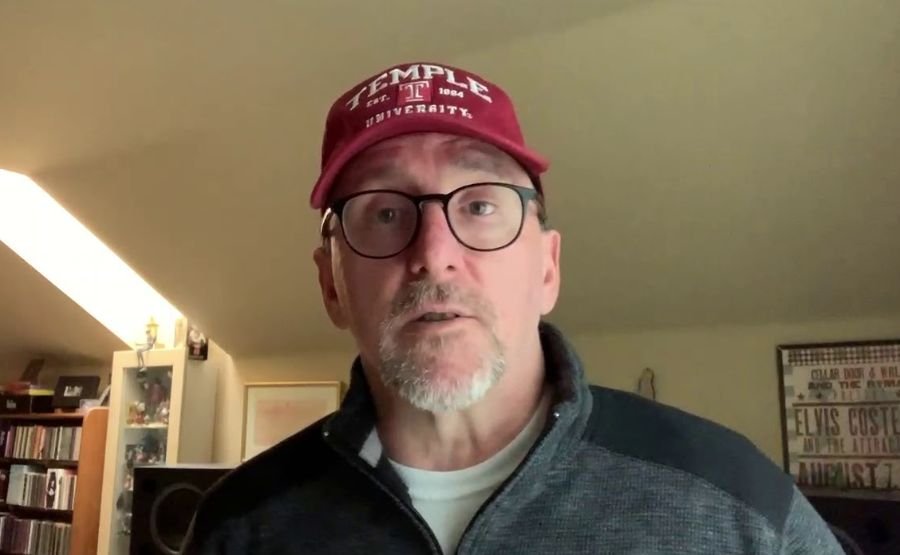
Peter Fey attended Temple University’s School of Media and Communication, graduating in 1984. This is the same school their father Donald had attended in the 1960s after returning from military service in Korea — which gives the connection a kind of full-circle quality that the family clearly found meaningful.
Temple’s media program gave Peter a foundation in writing and production. The school has historically been a training ground for journalists, broadcasters, and media professionals with a focus on the Philadelphia region, and it was there that Peter sharpened the skills he would eventually apply to a long career in television content creation.
It is worth noting that his famous sister actually did not follow him to Temple. Tina attended the University of Virginia, where she studied drama — a different path entirely. But the Fey family’s connection to Temple University ran deep through Peter and their father, and it would become meaningful again decades later under sad circumstances.
First Steps in a Creative Career: From Film Extras to QVC
Peter’s film career began quietly and early. He appeared as an uncredited extra in Brian De Palma’s Blow Out in 1981, while he was still a teenager — a Philadelphia-shot thriller that made excellent use of the city’s landmarks and streets. Two years later, he showed up again uncredited in John Landis’s beloved comedy Trading Places, another film with deep Philadelphia roots.
These were not speaking roles or significant contributions to the films in question. They were the kind of work that young, film-curious people in the Philadelphia area sometimes managed to land when productions rolled through the city — background work, atmosphere, a face in a crowd. But they represent something real: a young man who was drawn to the world of performance and production early enough to put himself in those spaces, even at the most peripheral level.
After graduating from Temple in 1984, Peter built a career not in acting but in television writing and production, landing at QVC, the shopping network headquartered in West Chester, Pennsylvania, not far from where he grew up. At QVC, he worked for many years as a writer and producer — a role that demanded precision, creativity, and the ability to shape narrative around products in a way that was engaging, persuasive, and clear. It is different work from what his sister does, but it is not unrelated. Both Feys learned to communicate with an audience for a living.
He was still at QVC by 2006, when Tina’s 30 Rock premiered on NBC and the family suddenly found itself in a considerably brighter spotlight.
The Moment the World Found Out About Him: QVC, the Leno Moment, and the $10,000 Story
Here is one of the genuinely fun chapters of Peter Fey’s story, and it says a lot about his personality.
QVC ran an internal competition at some point in the mid-2000s, inviting employees to maximize the company’s brand visibility by getting its logo in front of as many people as possible. The grand prize was $10,000. An employee named Bern Gallagher won by organizing a creative fundraiser involving a belly-flop contest for Autism Now awareness. Peter, however, had a different kind of card up his sleeve.
He asked his sister — who by that point was a bona fide national celebrity — to pull out a QVC “Qforce” branded T-shirt during an appearance on The Tonight Show with Jay Leno. She did. The QVC logo flashed across millions of television screens in that late-night slot, and while Peter didn’t take the top prize, the company was so impressed that he received special recognition — and reportedly his own $10,000.
When Main Line Today, a local Pennsylvania magazine, sat down with Peter for a brief interview around this time, he was entirely self-aware and funny about the situation. Asked to compare his professional station to his sister’s, he quipped something to the effect of: she’s got a sitcom on NBC, he has the QVC cafeteria. The remark was dry and self-deprecating in exactly the way you might expect from someone who grew up in that household.
Stepping in Front of the Camera: Repossessed, 30 Rock, and Beyond
Peter Fey has never been a full-time actor, but he has made some memorable appearances on screen across a surprisingly long stretch of time.
His earliest film work, as noted, came in the early 1980s in brief, uncredited background roles in Blow Out and Trading Places. His first credited role came in 2010, when he played a character named Ray in Repossessed, a short film. The role was small by industry standards, but it marked a real step forward — a named character, a speaking part, a genuine credit.
Then, in 2012, he got the role that is probably the most delightful footnote in his acting story. The television series 30 Rock — created by and starring his younger sister Tina — was filming the Season 6 episode “Unwindulax,” which called for some crab catchers. Peter appeared in the episode as one of those Crab Catchers, a small cameo that was noted in the show’s trivia as a deliberate family nod. It is the kind of moment that happens when you have the right last name and a sibling who is both the showrunner and your biggest fan.
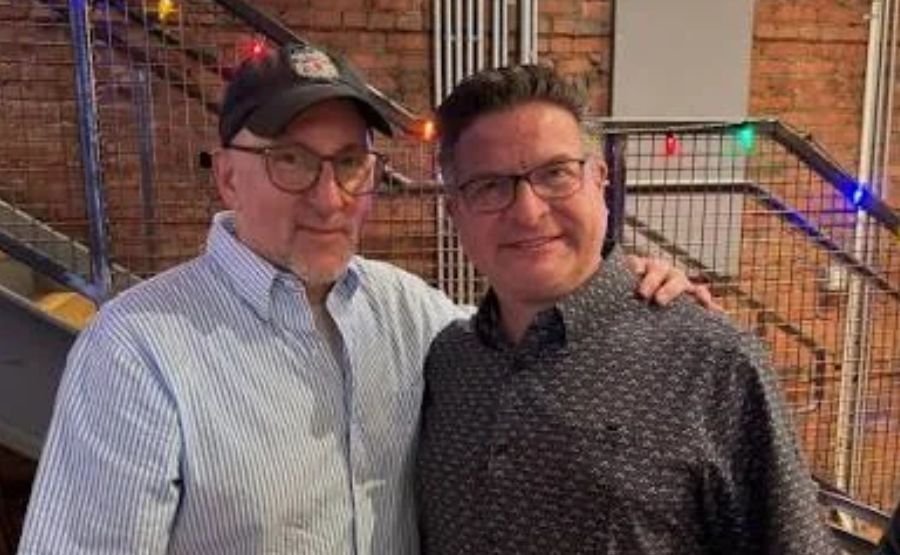
His most recent on-screen credit is Theatre People, a 2026 half-hour comedy pilot shot in Phoenixville, Pennsylvania — not far at all from where Peter grew up and built his professional life. The show, created by Drew Boardman and produced through Drewniverse Productions and Red Flight Pictures, is a story about a director, a choreographer, and an actress who are essentially community-theater pariahs after a catastrophic staging of Reefer Madness, then get talked back into mounting a new show to save their historic venue from financial collapse. Peter appears in the ensemble cast alongside Jake McClellan, Michael Roman, Rachael Opdenaker, and Carolyn A. Nelson, among others. The show premiered in August 2026 and screened at the Colonial Theatre in Phoenixville. It is a local story, rooted in a community that Peter knows well — and his presence in it feels entirely natural.
A Life Built Around Family and Community
Peter Fey is, by every indication, someone who has kept his personal life private in a way that most people can only envy. He married into a family connection with Jeff Richmond, Tina’s husband and collaborator, making Jeff his brother-in-law. Beyond that, the details of his personal relationships and home life are not part of the public record.
What does emerge clearly from various sources and his own public writings is a man who is deeply attached to place — specifically to Philadelphia, to Upper Darby, and to the southwestern Pennsylvania suburbs he grew up in. His 2013 essay for the Philadelphia Inquirer about childhood in Upper Darby was written with genuine warmth and specificity, capturing what it felt like to be a kid in that particular corner of the world during the 1960s and 1970s, when the neighborhood’s character was defined by its immigrant families, its street-corner community life, and its particular mix of working-class comfort and urban edge.
Honoring Their Father: The Donald H. Fey Memorial Scholarship
In October 2015, Donald H. Fey died of heart failure at Bryn Mawr Hospital. He was 82. His death was a loss not only for his children but, in a sense, for a wider community that had benefited from his career in development writing and his decades of service to educational and civic institutions.
Peter and Tina responded by establishing the Donald H. Fey Memorial Scholarship at Temple University’s School of Media and Communication. The scholarship is specifically designed for veterans — a tribute to their father’s own experience as a Korean War veteran who used the GI Bill to attend Temple in the 1960s before building his career. The first recipient was Ashley Rodriguez, a U.S. Navy veteran and president of the Temple Veterans Association, who was studying communications at the time.
Peter’s voice in discussing the scholarship was clear and meaningful. He spoke about his father as a man who worked nights and went to school during the day, a man who turned his military service into a launching point for a creative and intellectual life, and whose example he found genuinely difficult to replicate but deeply admirable. He said the scholarship was exactly the right way to represent what his father had been.
The fact that Peter, as a Temple alumnus himself, helped design something for future Temple students in journalism and media carries a certain completeness. The school produced both father and son. Now it carries the father’s name.
Hardships and Setbacks
Peter Fey’s life has not been built around dramatic public setbacks or spectacular failures — not any that have been reported, anyway. The most significant loss in his public life is clearly the death of his father in 2015, which appears to have affected both Fey siblings deeply. Tina dedicated her film Whiskey Tango Foxtrot to him and announced the scholarship live on The Tonight Show with Jimmy Fallon, visibly moved.
For Peter, the quieter challenge of his life might simply be the one that is never spoken of directly but that anyone in his position might feel: being the sibling of one of the most celebrated entertainers in America, working in adjacent fields, and doing so without the same level of recognition or public platform. That is not a tragedy. But it is a particular experience, and one that requires a certain groundedness to navigate with grace. Everything Peter Fey has said publicly suggests he has that groundedness in abundance.
Net Worth and Financial Life
Peter Fey’s net worth is not a matter of public record, and no credible financial estimates exist for him. What can be reasonably inferred is that a long career as a writer and producer at a major cable shopping network like QVC — which has been one of the most profitable entities in American television for decades — would have provided him a stable, comfortable professional income. His work is not the kind that generates royalties or box office percentages. It is salaried creative work, the kind that rewards consistent contribution over time.
His acting credits, though genuine, are not the kind that generate meaningful independent income. Short films and guest appearances on television typically pay union-rate fees for the specific work done. The financial rewards of Peter’s creative life have almost certainly come through his long career at QVC, not through his film and television roles.
He appears to live modestly and privately in the greater Philadelphia area, in keeping with the region and the community he has always called home.
What He Is Doing Now
As of 2026, Peter Fey’s most recent visible creative project is Theatre People, the comedy pilot that premiered in August 2026 at the Colonial Theatre in Phoenixville, Pennsylvania. His involvement in that project — a locally produced, community-rooted comedy about theater people trying to save a historic venue — feels very true to who he has always been: someone who finds meaning in local stories, local institutions, and the kind of creative work that doesn’t necessarily aim for a global audience.
Whether he continues to pursue acting alongside his production work at QVC is unknown. But at 64, with a full career behind him and what appears to be an active creative life in front of him, Peter Fey seems to be doing exactly what he wants to do.
Final Words
Peter Fey’s story is, in one sense, easy to summarize: older brother of a famous comedian, lifelong Philadelphian, television writer and producer, occasional actor, devoted son. But that summary misses something important.
Peter is someone who was raised in the same house, by the same remarkable parents, in the same working-class Philadelphia suburb as one of the defining comic voices of the last thirty years — and who then built a completely different kind of life from those same ingredients. He went to the same type of school as his father. He works in the same general medium as his sister. He has shown up on screen in the same show his sister created. And yet his trajectory has been entirely his own: local, grounded, craft-focused, private.
What makes Peter Fey distinctive is not fame, not a list of awards, not a famous quote or a famous face. What makes him distinctive is the particular integrity of a life lived at the intersection of creativity and community, without apparent hunger for recognition beyond what the work itself provides. He has acted when he wanted to act. He has written when he had something to say. He has honored his father. He has helped his sister in small, genuine ways. He has stayed close to the place that shaped him.
That is a kind of success too. It just tends to be quieter.
FAQs
1. Who is Peter Fey?
Peter Fey is an American actor, writer, and television producer born in 1962. He is best known publicly as the older brother of comedian and actress Tina Fey, but he has his own career spanning acting roles in short films and television, as well as long-term work as a writer and producer at the QVC shopping network.
2. How is Peter Fey related to Tina Fey?
Peter is Tina Fey’s older brother. He was born in 1962, making him eight years her senior. They grew up together in Upper Darby, Pennsylvania, and both have worked in media and television throughout their adult lives.
3. What are Peter Fey’s most notable acting credits?
His most recognized acting credits are Repossessed (2010), a short film in which he played a character named Ray; 30 Rock (2012), where he appeared in the episode “Unwindulax” as a Crab Catcher; and Theatre People (2026), a comedy pilot shot in Phoenixville, Pennsylvania. He also has uncredited extra appearances in Blow Out (1981) and Trading Places (1983).
4. Where did Peter Fey grow up?
He grew up in Upper Darby Township, Pennsylvania, a suburb on the western edge of Philadelphia. He has written publicly and affectionately about his childhood in that community and appears to have remained closely connected to the greater Philadelphia area throughout his life.
5. Where did Peter Fey go to college?
He attended Temple University’s School of Media and Communication, graduating in 1984. His father Donald also graduated from the same school in 1966, giving the family a strong two-generation connection to that institution.
6. What is Peter Fey’s day job?
For much of his adult professional life, Peter has worked as a writer and producer at QVC, the television shopping network based in West Chester, Pennsylvania. This is his primary career, running alongside his intermittent acting work.
7. What is the story behind the Jay Leno/QVC incident?
During a QVC employee contest to increase the network’s brand visibility, Peter reportedly arranged for his sister Tina to display a QVC-branded shirt on The Tonight Show with Jay Leno. This generated significant national exposure for the company. Peter received special recognition for the stunt, reportedly including a financial award from QVC, even though the top prize went to a different employee for a different campaign.
8. What is the Donald H. Fey Memorial Scholarship?
After their father Donald died in October 2015 at age 82, Peter and Tina established a scholarship in his memory at Temple University’s School of Media and Communication. The scholarship is specifically for military veterans studying journalism, honoring Donald’s own experience as a Korean War veteran who attended Temple on the GI Bill. The first recipient was Ashley Rodriguez, a Navy veteran.
9. Did Peter Fey appear in his sister’s show 30 Rock?
Yes. In 2012, Peter appeared in the 30 Rock Season 6 episode “Unwindulax” as one of several Crab Catchers. It was a cameo role, and the show’s trivia notes explicitly identify him as Tina’s older brother.
10. What is Theatre People, and what was Peter’s role in it?
Theatre People is a 2026 half-hour comedy pilot written and directed by Drew Boardman and filmed in Phoenixville, Pennsylvania. It follows three theater people trying to save a historic community venue after a disastrous production. Peter appears in the ensemble cast. The show premiered at the Colonial Theatre in Phoenixville in August 2026.
11. What is Peter Fey’s estimated net worth?
No public financial data or credible estimates exist for Peter Fey’s net worth. His income has come primarily from his long career as a television writer and producer at QVC, which would represent stable professional earnings rather than the kind of entertainment royalties or public equity associated with more visible celebrities. He is widely regarded as living a private, modest life in the Philadelphia region.
12. What kind of person is Peter Fey based on what he’s said publicly?
Based on his essay in the Philadelphia Inquirer, his interview with Main Line Today, and his comments about his father through Temple University’s news channel, Peter comes across as self-deprecating, witty, deeply connected to his family and his hometown, and grounded in a way that suggests someone who has found real meaning in a creative life that doesn’t require public validation. He speaks about his father with love and intellectual respect, and he seems genuinely comfortable in a supporting role to his sister’s larger public narrative.