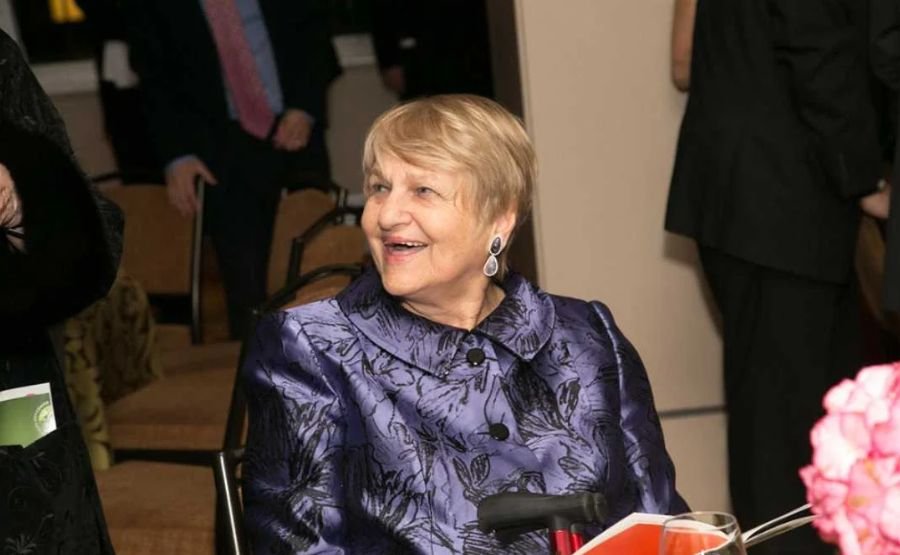
Annaliese Witschak: A Life Lived on Her Own Terms
Quick Bio
| Detail | Information |
| Full Name | Annaliese Witschak (later Annaliese Soros) |
| Born | January 3, 1934, Verden an der Aller, northern Germany |
| Died | September 5, 2025, age 91 |
| Nationality | German-American |
| Known For | First wife of billionaire investor George Soros |
| Children | Robert, Andrea, and Jonathan Soros |
| Grandchildren | Nine |
| Occupation | Secretary (early career); arts patron; philanthropist; author |
| Notable Work | Dinner Party Disasters (2007); 40+ years on the Young Concert Artists board |
| Major Philanthropy | Young Concert Artists; Southampton Performing Arts; Pianofest in the Hamptons |
| Marriage | George Soros (married 1960; separated 1977; divorced 1983) |
| Final Years | Divided time between New York City, Southampton, and Berlin |
A Note Before We Begin
A quick word on the state of information about Annaliese Witschak online: much of it is garbage. Dozens of content-farm articles claim she was an “artist,” a “model,” or a “renowned expert,” assigning her birthdates ranging from 1934 to 1995, birthplaces from rural Germany to Los Angeles, and careers ranging from rock climbing to social activism. None of these articles cite anything real.
The reality is more intriguing and easier to understand. Annaliese Witschak was a German orphan who crossed the Atlantic alone with almost nothing, built a full and generous life in New York City, raised three accomplished children, became a quietly beloved figure in the American classical music world, and died in 2025 at the age of 91 surrounded by people she adored. Her obituary, published in the East Hampton Press, is the only substantive primary source about her — and it paints a picture far richer than any invented biography could.
See also “Heidi Van Pelt: A Life in Motion From the Midwest to the Vegan Kitchen and Back Again“
A Child of War and Loss
Annaliese’s story begins in the kind of place that tends to produce tough people. Verden an der Aller is a small town in northern Germany, unremarkable on a map but deeply ordinary in the way that so many German towns were ordinary in 1934: communities of farmers, shopkeepers, and small-town professionals navigating a country that was lurching toward catastrophe.
She was born on January 3 of that year, the daughter of Walter Witschak and his wife Elisabeth. Her father died when Annaliese was only three years old — an early blow that immediately reshaped the family. Elisabeth moved with her young daughter to the nearby village of Neuenkirchen bei Soltau, and there she did what a widowed woman in rural Germany had to do: she found whatever work she could. Bookkeeping, odd jobs, the occasional article or poem submitted to a local newspaper. She kept the household going, but the effort took a toll. Elisabeth had a heart condition that required her to be hospitalized repeatedly, and during those stretches Annaliese went to live with relatives she later described as unkind.
That word — unkind — is doing a lot of quiet work. It’s the word a person chooses when they want to be honest without being bitter.
The worst of it came when Annaliese was 16. Her mother and her only brother, Hans, both died within six months of each other. She was now entirely alone in the world — an orphan without siblings, without parents, without anyone to soften things. The years that immediately followed, she later said, were the loneliest of her life.
What saved her — or at least what gave her something to hold onto — was music. At school, a teacher had recognized something in her and encouraged her to join the chorus and study piano, an instrument she often played alongside her mother. When she was 15, he organized a trip for the class to see the opera in Hanover. The experience hit her hard and deep. “It felt like a whole other world opened up for me,” she wrote years later. It did. Music would be the thread running through everything that came after.

From the Countryside to Hamburg, Then the Atlantic
Annaliese was hungry to study. She wanted university. Her aunt and uncle, who had grudgingly taken her in after her mother died, refused to pay for it. Instead, they steered her toward secretarial school — something practical, they said, something that would let her support herself without being a burden on anyone. She complied, trained as a secretary, and then moved to Hamburg.
She was done looking back.
Hamburg was a turning point. For the first time, she was responsible entirely for herself, and something in her rose to meet that responsibility with energy rather than dread. She found a room to share with a friend she’d met while briefly staying at a Salvation Army hostel. The two of them lived carefully — sometimes all they had for breakfast was a single bread roll split between them — but Annaliese was building something. She worked first at a publishing house, then moved to a position with Shell Oil. She loved dancing. She loved music. When she had a few spare marks, she bought standing-room tickets for concerts rather than spending the money on something more sensible.
It is hard not to like this person.
After several years in Hamburg, though, restlessness took hold. She had almost no family ties left in Germany. The country itself was still carrying the weight of the war in ways that felt suffocating to a young woman already acquainted with sorrow. So in 1955, at the age of 21, Annaliese packed up and booked passage to New York. She spent the entire five-day crossing seasick in her berth — but through the porthole, as the ship entered the harbor, she saw the Statue of Liberty. She kept that memory her whole life.
Finding Her Footing in New York
America was not immediately welcoming. Annaliese’s first job was as an au pair on Long Island. She was lonely, homesick, and miserable enough to quit and move to Manhattan, where she found secretary and keypunch-operator work at an insurance company and a roommate through a newspaper ad. Her new colleagues became friends who helped her navigate the city. New York, over time, became home in a way that Germany never quite had been.
This was 1950s Manhattan — a city teeming with European immigrants, intellectuals, artists, and people who had arrived from somewhere else with nothing but their wits. It suited Annaliese. She was curious, sociable, and genuinely engaged with ideas and culture in a way that made her interesting company. She sought out concerts and found her way into the city’s cultural life the way she always had: through sheer appetite for it.
Meeting George Soros
In 1957, two years after Annaliese had settled in New York, she met a man named George Soros. He was a Hungarian-born immigrant who had arrived in the city just a year earlier, working his way into the finance world. He was, by every account, an unusual person — brilliant, philosophically restless, intensely ambitious, and unlike anyone she had encountered before.
By her own account, she fell madly in love with him.
They married in September 1960 and moved into an apartment in Greenwich Village, then later to Central Park West. It was a good marriage for many years — not the marriage of two quiet, conventional people, but the marriage of two people who had each crossed an ocean alone and arrived with something to prove and something to give. Their apartment became a gathering place for philosophers, academics, writers, and later, as George’s philanthropic interests broadened, anti-apartheid activists. Annaliese was not simply a backdrop to these gatherings. She taught herself to cook seriously, became an exceptional chef, and was widely known among their social circle as a magnificent host.
Together, they had three children over seven years. Andrea was born in 1965, Jonathan Tivadar in 1970, and Robert Daniel in 1963. The children grew up in a household where ideas mattered and guests were always expected.

Separation, Divorce, and the Second Chapter
George and Annaliese separated in 1977, though the formal divorce did not come until 1983. The reasons for the split were never publicly detailed — Annaliese maintained her dignity and her privacy on this point, as she did on most personal matters. What is documented is that they remained on genuinely good terms to the end of their lives. This was not a bitter divorce. It was a marriage that had run its course, between two people who each had a great deal of life left to live independently.
In 1983, Soros wed Susan Weber, his second wife. Annaliese never remarried.
What she did instead was rediscover herself. The woman who had arrived in New York alone at 21 found that independence again after her children were grown. She traveled widely — often organizing trips around music festivals, hiking routes, and biking itineraries. She kept and deepened friendships with an unusual warmth and consistency. She hosted constantly, in her New York apartment and at her Southampton summer home, where she spent summers for six decades.
And she turned seriously toward music, in the way that people sometimes return to the things that saved them when they were young.
A Life in Music: The Real Achievements
Here is where Annaliese Witschak’s story becomes genuinely impressive, and where the content-farm versions of her life fail most completely by inventing things rather than reporting what was real.
Annaliese became a major patron of classical music — not in the passive sense of writing checks, but in the hands-on, board-level, relationships-across-decades sense of actually dedicating herself to the work.
Her longest commitment was to Young Concert Artists, an organization that supports emerging musicians at the start of their careers by providing representation and performance opportunities. She served on their board of directors for more than forty years. In 2004, in recognition of her decades of support, the organization established the Annaliese Soros Educational Residency Program in her name. She didn’t just donate money; she opened her apartment to young musicians who needed a place to practice before major New York performances, and she followed their careers with genuine personal interest.
In 1981, she helped found the Southampton Performing Arts festival, bringing classical concerts to the community where she had spent summers. This was her initiative — not a contribution to someone else’s project, but something she helped build from scratch.
In the early 1990s, she joined the board of Pianofest in the Hamptons, a summer master class program for young pianists, and she remained on that board until her death.
She also published a book. In 2007, Annaliese wrote Dinner Party Disasters: True Stories of Culinary Catastrophe, a collection of humorous stories about hosting mishaps — including her own. It was characteristic of her: she had a vivid enough inner life and enough comfort with her own imperfections to find the whole thing funny and worth sharing.
The Children She Raised
The three children Annaliese raised with George Soros all went on to significant careers.
Robert Daniel Soros became a businessman and philanthropist, deeply involved in philanthropy connected to education. Andrea Soros Colombel became a documentary filmmaker and founded the Trace Foundation, which supports Tibetan culture and communities. Jonathan Tivadar Soros became an investor and political donor, co-founding One Madison Group after earlier work at Soros Fund Management, and graduating from both Wesleyan University and Harvard Law School.
Their spouses — Jamie, Eric, and Jennifer — became part of Annaliese’s close family circle. Nine grandchildren, ranging in age from five months to 31 years at the time of her death, were the other deep joy of her later years.
Germany, Again, at the End
Late in life, Annaliese developed the habit of returning to Germany — the country she had left at 21 with almost nothing. This might seem surprising given her difficult childhood, but Annaliese herself acknowledged the complicated pull of it. She still felt a strong cultural connection to Germany, even though her actual childhood memories were largely ones of hardship and loneliness.
She rented an apartment in Berlin, a city she loved specifically for its density of musical culture — three opera houses, multiple concert halls, an active performing schedule. She went once or twice a year for extended stays during the performance season. In 2024, the year before her death, she traveled to Berlin one last time to celebrate her ninetieth birthday.
That trip is worth pausing on. A woman who had been born in rural northern Germany ninety years earlier, who had been orphaned at 16, who had crossed the Atlantic alone at 21, went back to that continent at 90 to celebrate her life in a city full of music. The arc of that journey is quietly extraordinary.
Net Worth and Financial Picture
Annaliese’s finances are not publicly known in any detailed way, and that is entirely appropriate. What we can say is that she lived comfortably — she had a New York City apartment and a Southampton summer home she kept for six decades — and that she was generous with what she had, directing meaningful support to arts organizations over many decades. She was not a billionaire; that is her ex-husband. She was a person of independent means who used those means to support music and young artists rather than to pursue celebrity or accumulation.
The Annaliese Soros Educational Residency Program endowed in her name suggests that at some point she made a substantial financial gift to Young Concert Artists. Beyond that, the financial specifics belong to her family.
See also “Heidi Van Pelt: A Life in Motion From the Midwest to the Vegan Kitchen and Back Again“
Final Words
Annaliese Witschak is worth knowing about. Not because of who she married, but because of what she did with the hand she was dealt, which was initially a very hard hand indeed.
She was orphaned at 16, left Europe alone at 21, built a life in a new language and a new country through secretarial work and sheer force of personality, married a man who would become one of the most influential and controversial financiers of the twentieth century, raised three accomplished children through that marriage, navigated its end with dignity, and spent the second half of her long life doing exactly what she wanted to do: traveling, hosting, making friends, supporting young musicians, and attending as much opera as she possibly could.
She died at 91, surrounded by her children and grandchildren and, by all accounts, a genuinely large network of people who loved her. She wrote a funny book about dinner party disasters. She went to Berlin at 90 to hear opera.
What makes Annaliese distinctive is that she took a life shaped by real tragedy — war, orphanhood, displacement — and refused to let it become her identity. She turned it into fuel instead. And the people who mattered most to her knew exactly who she was, even when the internet had no idea.
FAQs
1. Who was Annaliese Witschak?
Annaliese Witschak was a German-born American woman best known as the first wife of billionaire investor George Soros. Beyond her marriage, she was an arts patron, philanthropist, and board member of several classical music organizations, and a beloved figure among friends and family in New York and Southampton.
2. When and where was Annaliese Witschak born?
She was born on January 3, 1934, in Verden an der Aller, a small town in northern Germany.
3. When did Annaliese Witschak die?
She died on September 5, 2025, at the age of 91, of natural causes.
4. How did Annaliese Witschak’s childhood shape her?
Her childhood was defined by loss. Her father died when she was three, her mother had a chronic heart condition and was hospitalized repeatedly, and Annaliese was orphaned at 16 when her mother and only brother died within six months of each other. Those experiences instilled in her a resilience and independence that shaped everything that followed.
5. When did she immigrate to the United States?
Annaliese moved to New York in 1955, at age 21, spending five days seasick on a transatlantic crossing before seeing the Statue of Liberty through her porthole as the ship entered harbor.
6. When did she marry George Soros?
They married in September 1960, three years after meeting in New York in 1957. At the time, Soros had arrived in the city only one year before Annaliese met him.
7. How many children did they have?
Three: Robert Daniel Soros (born 1963), Andrea Soros Colombel (born 1965), and Jonathan Tivadar Soros (born 1970).
8. When did the marriage end?
George and Annaliese separated in 1977, though the formal divorce wasn’t finalized until 1983. The parting was amicable — they remained on good terms for the rest of their lives.
9. Did Annaliese remarry after the divorce?
No. She chose not to remarry and built an independent life centered on travel, friendships, her children, and her passion for music.
10. What was Annaliese’s most significant contribution to the arts?
Her longest and most impactful commitment was to Young Concert Artists, an organization supporting emerging classical musicians. She served on their board for over forty years, and in 2004 the Annaliese Soros Educational Residency Program was endowed in her name. She also helped found the Southampton Performing Arts festival in 1981 and served on the board of Pianofest in the Hamptons from the early 1990s until her death.
11. Did she write anything?
Yes. In 2007, she published Dinner Party Disasters: True Stories of Culinary Catastrophe, a humorous collection of hosting mishaps that reflected her decades of legendary dinner parties.
12. What was her connection to music as a child?
Music entered her life through a school teacher who encouraged her to join the chorus and study piano. At 15, that same teacher took the class to see opera in Hanover — an experience Annaliese described as opening “a whole other world” to her. She was forced to give up piano after her mother’s death, but music and opera remained with her for the rest of her life.






One Comment